
Perryville in Boyle County, Kentucky — The American South (East South Central)
Perryville and the Emancipation Proclamation
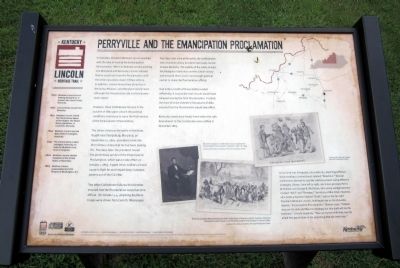
Photographed by Bernard Fisher, August 18, 2011
1. Perryvile And The Emancipation Proclamation Marker
However, three Confederate failures in the autumn of 1862 gave Lincoln the political conditions necessary to issue the final version of the Emancipation Proclamation.
The Union victory at the battle of Antietam, fought near Sharpsburg, Maryland, on September 17, 1862, provided Lincoln the first military victory that he had been looking for. Five days later, the president issued the preliminary version of the Emancipation Proclamation, which was to take effect on January 1, 1863. It gave Union soldiers a moral cause to fight for and helped keep European powers out of the Civil War.
Two other Confederate failures that October ensured that the Proclamation would become official. On October 3-4, attacking
this page online
Four days later, here at Perryville, the Confederates won a tactical victory but were eventually forced to leave Kentucky. The inability of the rebels to hold the Bluegrass State was another Union victory and ensured that Lincoln had enough political cachet to make the Proclamation official.
Had either or both of these battles ended differently, it is possible that Lincoln would have delayed issuing the final Proclamation. Instead, the chain of Union victories in the autumn of 1862 ensured that the Proclamation would take effect.
Kentucky slaves were finally freed when the 13th Amendment to the Constitution was ratified in December 1865.
(sidebar)
Kentucky Lincoln Heritage Trail
1809 Abraham Lincoln born at Sinking Spring farm, in present-day Larue County, Kentucky.
1816 Lincoln family moved from Kentucky.
1841 Abraham Lincoln visited his friend Joshua Speed at Farmington, the Speed family plantation, in Louisville, Kentucky.
1842 Abraham Lincoln married Mary Todd of Lexington, Kentucky.
1847 The Lincoln family visited Lexington, Kentucky, en route to

Photographed by Bradley Owen, October 17, 2025
2. Perryville and the Emancipation Proclamation Marker
Marker is on the left. Same marker, but new location since 2011.
1860 Abraham Lincoln elected President of the United States in November.
1865 Abraham Lincoln assassinated at Ford’s Theatre in Washington, D.C.
www.kylincolntrail.com www.heritage.ky.gov www.kylincolntrail.org www.history.ky.gov www.transportation.ky.gov
A project of the Kentucky Abraham Lincoln Bicentennial Commission produced by the Kentucky Heritage Council in partnership with the Kentucky Historical Society and the Kentucky Transportation Cabinet
Erected by Kentucky Abraham Lincoln Bicentennial.
Topics and series. This historical marker is listed in this topic list: War, US Civil. In addition, it is included in the Former U.S. Presidents: #16 Abraham Lincoln series list. A significant historical date for this entry is January 1, 1863.
Location. 37° 40.489′ N, 84° 58.256′ W. Marker is in Perryville, Kentucky, in Boyle County. It is on Park Road 0.3 miles west of Battlefield Road (Kentucky Route 1920), on the right when traveling west. Located in Perryville Battlefield State Historic Site. Touch for map. Marker is at or near this postal address: 1825 Battlefield Road, Perryville KY 40468, United

Photographed by Currier & Ives, circa 1876
3. Breaking that "backbone"
Library of Congress [LC-USZ62-42560]

Regionally, this marker is in Kentucky’s Bluegrass Region. It is also in the American South and specifically in the Upper South. Globally, it is in North America, the Western Hemisphere, the Western World, and the Anglosphere. Historically, it finds itself in what was once the territory of the Mississippian Culture and also the Antebellum South.
Other nearby markers. At least 8 other markers are within walking distance of this marker: Soldiers' Reaction to Lincoln's Emancipation (here, next to this marker); Perryville Battlefield (a few steps from this marker); Perryville Confederate Memorial (a few steps from this marker); Confederate Cemetery (within shouting distance of this marker); Squire Henry P. Bottom (within shouting distance of this marker); "The Stars and Bars" (within shouting distance of this marker); Union Monument (within shouting distance of this marker); Army of the Ohio (within shouting distance of this marker). Touch for a list and map of all markers in Perryville.
Another marker is no longer nearby. The Battle of Perryville (was here, next to this

1863
4. The effects of the proclamation - freed Negroes coming into our lines at Newbern, North Carolina
Illus. in: Harper's weekly, 1863 Feb. 21, p. 116. Library of Congress [LC-USZ62-112158]
More about this marker. On the lower right are three images with the captions:
An artist’s depiction of Abraham Lincoln signing the Emancipation Proclamation, created on April 18, 1864." Courtesy of the Library of Congress, Prints and Photographs Division
Formerly enslaved African Americans enter Union lines in New Bern, North Carolina, following Abraham Lincoln’s issuance of the Emancipation Proclamation in January 1863. Courtesy of the Library of Congress, Prints and Photographs Division
A Currier & Ives lithograph, circa 1862/63, depicting Jefferson Davis holding a chained beast labeled “Rebellion.” Several northerners attempt to slay the rebellious beast using different strategies. Shown, from left to right, are Union generals Henry W. Halleck and George B. McClellan, who swing sledgehammers marked “Skill” and “Strategy;” Secretary of War Edwin Stanton, who holds a hammer labeled “Draft;” and on the far right President Abraham Lincoln, holding an axe on his shoulder labeled, “Emancipation Proclamation.” Stanton says, “Halleck may use his skill and Mac his strategy, but this draft

circa Apr 18, 18
5. Abraham Lincoln. President of the United States. Signing the Emancipation Proclamation
Library of Congress [LC-USZ62-17840]
Credits. This page was last revised on November 18, 2025. It was originally submitted on August 22, 2011, by Bernard Fisher of Richmond, Virginia. This page has been viewed 1,205 times since then and 30 times this year. Photos: 1. submitted on August 22, 2011, by Bernard Fisher of Richmond, Virginia. 2. submitted on November 18, 2025, by Bradley Owen of Morgantown, West Virginia. 3, 4, 5. submitted on August 22, 2011, by Bernard Fisher of Richmond, Virginia.
