Historic District in St. Augustine in St. Johns County, Florida — The American South (South Atlantic)
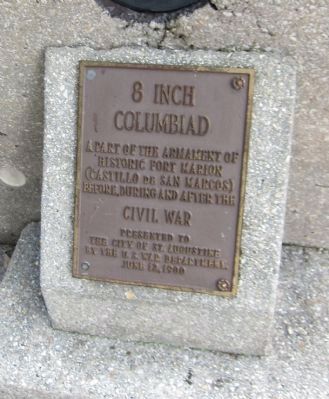
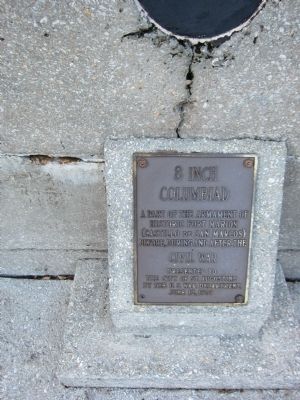
8 inch Columbiad
Photographed by Craig Swain, August 1, 2011
1. 8 inch Columbiad Marker
A part of the armament of historic Fort Marion (Castillo de San Marcos) before, during and after the Civil War
Presented to the City of St. Augustine by the U.S. War Department
June 12, 1900
Topics. This historical marker is listed in this topic list: War, US Civil. A significant historical month for this entry is June 1857.
Location. 29° 53.555′ N, 81° 18.761′ W. Marker is in St. Augustine, Florida, in St. Johns County. It is in the Historic District. It is at the intersection of Cathedral Plaza and St. George Street, on the left when traveling west on Cathedral Plaza. Located in the Plaza de la Constitución. Touch for map. Marker is at or near this postal address: 42 King St, Saint Augustine FL 32084, United States of America. Touch for directions.

Regionally, this marker is in First Coast and in Greater Jacksonville. It is also in the American South and on the Eastern Seaboard. Globally, it is in the North Atlantic Region, North America, a Gulf of Mexico state, the Western Hemisphere, the Western World, and the Anglosphere. Historically, it finds itself in what was once New Spain, the territory of the Mississippian
this page online
Other nearby markers. At least 8 other markers are within walking distance of this marker: Plaza de la Constitución (here, next to this marker); Government House: Legacy of Authority (here, next to this marker); Balcón de los Reyes (a few steps from this marker); Constitution Monument (a few steps from this marker); Andrew Young Crossing (a few steps from this marker); Coquina in These Walls (a few steps from this marker); Cathedral Basilica of St. Augustine (within shouting distance of this marker); Government House and the Plaza (within shouting distance of this marker). Touch for a list and map of all markers in St. Augustine.
Another marker is no longer nearby. Spanish Public Well (was within shouting distance of this marker but has been confirmed missing).
More about this marker. The plaque is likely in error. These guns were not part of Fort Marion's armament before the Civil War (the date of manufacture rules that out). The columbiads were part of a batch produced for the Confederacy early in the Civil War.
According to reports, the
Photographed by Craig Swain, August 1, 2011
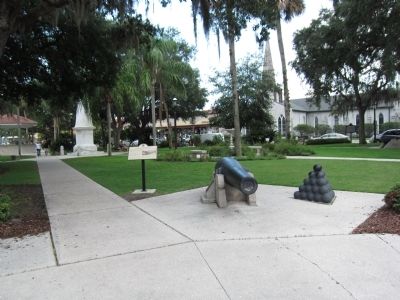
2. Plaza Marker, Cannon Plaque, and 8-inch Columbiad
Clearly the cannons were at Fort Marion after the war. However, their use by the Army after the war would be limited. The elevation system would require pre-Civil War carriages. Further, the guns were not constructed in the manner used by the regulation Federal 8-inch guns, and would be suspect when firing full charges.
Photographed by Craig Swain, August 1, 2011
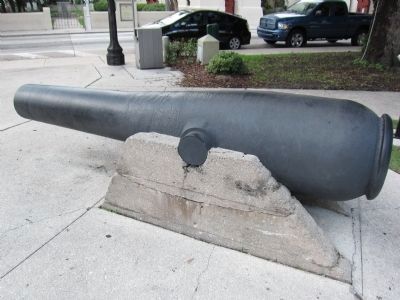
3. 8-inch Columbiad
This gun bears the marks of Bellona Foundry (owned by Junius L. Archer who's initials appear on the trunnions). It was produced in 1861, weighed 8750 pounds, and assigned registry number 29.
Photographed by Craig Swain, August 1, 2011
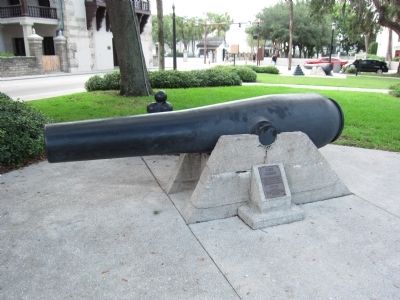
4. Second 8-inch Columbiad
Like its mate, this columbiad came from Bellona Foundry in 1861. Marks indicate its registry number as 27 with a weight of 8750 pounds. Also like the other columbiad, this cannon likely was not in St. Augustine before or during the Civil War.
Photographed by Craig Swain, August 1, 2011
5. Plaque on Second Columbiad
The second columbiad is at the corner of St. George and King Streets.
Photographed by Craig Swain, August 1, 2011
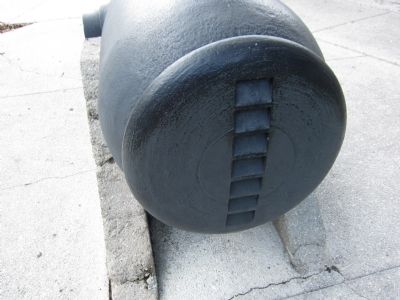
6. Ratchet Elevation System
The Confederate columbiads used the older ratchet system for elevation. During the Civil War the Federals replaced this system with a more easily handled method using sockets on the breech face.
Credits. This page was last revised on April 18, 2023. It was originally submitted on September 3, 2011, by Craig Swain of Leesburg, Virginia. This page has been viewed 1,752 times since then and 62 times this year. Photos: 1, 2, 3, 4, 5, 6. submitted on September 3, 2011, by Craig Swain of Leesburg, Virginia.
