
Merriam in Johnson County, Kansas — The American Midwest (Upper Plains)
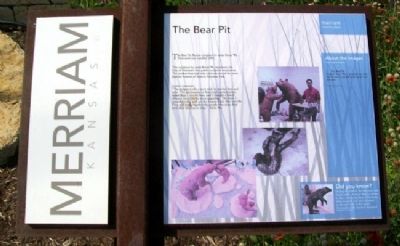
The Bear Pit
Merriam Historic Plaza
Photographed by William Fischer, Jr., July 2, 2011
1. The Bear Pit Marker
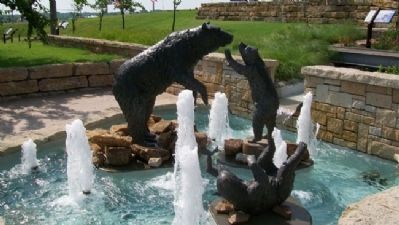
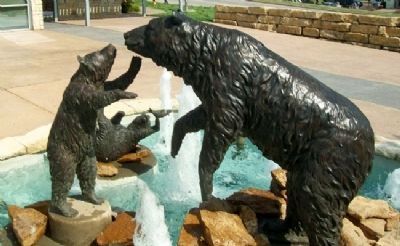
The Bear Pit Bronze sculpture by artist Kwan Wu. Dedicated and installed 2006.
This sculpture by artist Kwan Wu represents the City of Merriam's first public sculpture installation. The mother bear and cubs celebrate one of the most popular features of historic Merriam Park.
Artists' statement:
"The sculpture tells a story with its mother bear and cubs. The city needed an historical representation, rather than a specific bear, and I thought a family of bears would be most appealing. The bears I created for this park are the human kind: they love life. They will bring together the people who come here with their families to relax." Kwan Wu
About the Images
The Bear Pit -
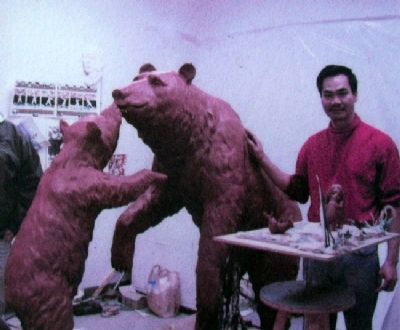
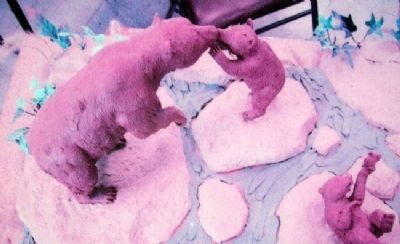
Sculptor Kwan Wu is pictured with scale and life-size clay models of the mother bear and cubs.
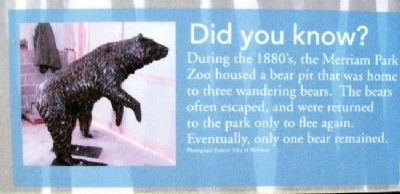
Did you know?
During the 1880's, the Merriam Park Zoo housed a bear pit that was home to three wandering bears. The bears often escaped and were returned to the park only to flee again. Eventually, only one bear remained.
Erected 2006 by City of Merriam.
Topics. This historical marker is listed in these topic lists: Animals • Arts, Letters, Music
this page online
Location. 39° 0.875′ N, 94° 41.423′ W. Marker is in Merriam, Kansas, in Johnson County. It is on East Frontage Road. Marker is at the Merriam Visitors Bureau, near Exit #228B of Interstate 35, and immediately southwest of the intersection of Shawnee Mission Parkway (US 56) and Eby Avenue. Touch for map. Marker is at or near this postal address: 6304 East Frontage Road, Mission KS 66202, United States of America. Touch for directions.

Regionally, this marker is in Eastern Kansas and specifically in Greater Kansas City. It is also in the American Midwest, in the Corn Belt, on the prairies, on the Southern Plains, and on the Santa Fe Trail Corridor. Globally, it is in North America, the Western Hemisphere, the Western World, and the Anglosphere. Historically, it finds itself in what was once the Louisiana Purchase.
Other nearby markers. At least 8 other markers are within walking distance of this marker: The Trolley Line & Hocker Grove Amusement Park (a few steps from this marker); Education in Merriam (a few steps from
Photographed by William Fischer, Jr., July 2, 2011
2. The Bear Pit at Merriam Historic Plaza
Marker at upper right distance
Also see . . .
1. Explore Merriam, Kansas. (Submitted on January 6, 2022, by Larry Gertner of New York, New York.)
2. About page for Kwan Wu.
Mr. Wu began his sculpture education at the leading school of sculpture in China in 1973. He was one of only eight students admitted at that time. After graduation, Mr. Wu was one of only two students chosen for the master’s program by Chinese National Sculptor, Pan Ho. He later became a professor at the Art Institute of Canton and a leading sculptor in southern China. During the 1980s Mr. Wu produced many public sculptures throughout China. As the protégé of Pan Ho, Mr. Wu was being groomed to eventually assume his role. As(Submitted on January 4, 2025, by Devry Becker Jones of Washington, District of Columbia.)part of this training, he was sent to the United States in 1988 as a delegate to the International Sculpture Association Conference in Washington D.C. The intent of the visit was to broaden his experience and expose him to Western art and culture. In mid 1989, the political situation in China made it impossible for him to return to his home country. The next several years required that he rebuild his life and career in the U.S. These years were difficult ones for the artist, but eventually, his extraordinary talent was recognized and he began receiving commissions for public art. The Bill of Rights, a 14-foot bronze monument at the Federal Courthouse in Kansas City was one of his first. Since then, many commissions have followed including the twelve life-sized bronze baseball players for the National Negro League Baseball Museum; the nine-foot statue of Phog Allen at the University of Kansas; a life-sized sculpture of George Brett at Kauffman Stadium in Kansas City; and the Children of the Trails memorial in the Johnson County Courthouse Square in Olathe, Kansas. A bronze model of his work, Lewis the Naturalist, in honor of the botanicalPhotographed by William Fischer, Jr., July 2, 20113. The Bear Pit at Merriam Historic Plazawork of the Lewis and Clark expedition, has been on display in the White House and is permanently on display in the Smithsonian in Washington D.C. The beauty and exquisite quality of his work is highly recognized and sought after throughout the U.S. Mr. Wu brings equal power to figure, wildlife and animal. This range and quality sets him apart from some of the finest sculptors of our day. Although most widely recognized as a sculptor, Mr. Wu also is an accomplished painter whose unique style and color palette has caught the attention of collectors worldwide. Mr. Wu is represented by SouthWind Gallery, Topeka KS Kwan Wu, Overland Park, KS Mr. Wu began his sculpture education at the leading school of sculpture in China in 1973. He was one of only eight students admitted at that time. After graduation, Mr. Wu was one of only two students chosen for the master’s program by Chinese National Sculptor, Pan Ho. He later became a professor at the Art Institute of Canton and a leading sculptor in southern China. During the 1980s Mr. Wu produced many public sculptures throughout China. As the protégé of Pan Ho, Mr. Wu was being groomed to eventuallyPhotographed by Unknown, undated4. Photo on The Bear Pit Markerassume his role. As part of this training, he was sent to the United States in 1988 as a delegate to the International Sculpture Association Conference in Washington D.C. The intent of the visit was to broaden his experience and expose him to Western art and culture. In mid 1989, the political situation in China made it impossible for him to return to his home country. The next several years required that he rebuild his life and career in the U.S. These years were difficult ones for the artist, but eventually, his extraordinary talent was recognized and he began receiving commissions for public art. The Bill of Rights, a 14-foot bronze monument at the Federal Courthouse in Kansas City was one of his first. Since then, many commissions have followed including the twelve life-sized bronze baseball players for the National Negro League Baseball Museum; the nine-foot statue of Phog Allen at the University of Kansas; a life-sized sculpture of George Brett at Kauffman Stadium in Kansas City; and the Children of the Trails memorial in the Johnson County Courthouse Square in Olathe, Kansas. A bronze model of his work, Lewis the Naturalist,Photographed by Unknown, undated5. Photo of The Bear Pit Models on Markerin honor of the botanical work of the Lewis and Clark expedition, has been on display in the White House and is permanently on display in the Smithsonian in Washington D.C. The beauty and exquisite quality of his work is highly recognized and sought after throughout the U.S. Mr. Wu brings equal power to figure, wildlife and animal. This range and quality sets him apart from some of the finest sculptors of our day. Although most widely recognized as a sculptor, Mr. Wu also is an accomplished painter whose unique style and color palette has caught the attention of collectors worldwide.Photographed by City of Merriam, 20066. On The Bear Pit Marker
Photographed by William Fischer, Jr.
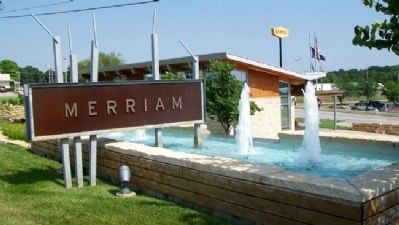
7. Merriam Visitors Bureau Sign on Shawnee Mission Parkway
Credits. This page was last revised on January 4, 2025. It was originally submitted on September 6, 2011, by William Fischer, Jr. of Reynoldsburg, Ohio. This page has been viewed 1,395 times since then and 102 times this year. Photos: 1, 2, 3, 4, 5, 6, 7. submitted on September 6, 2011, by William Fischer, Jr. of Reynoldsburg, Ohio.
