Capitol District in Richmond, Virginia — The American South (Mid-Atlantic)
George Washington Monument
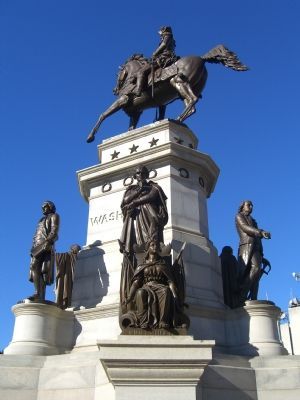
Photographed by Kevin W., January 3, 2008
1. George Washington Monument Marker
Prominent Virginian Thomas Jefferson, with seated female figure representing Independence.
Erected 1858.
Topics and series. This monument and memorial is listed in these topic lists: Patriots & Patriotism • War, US Revolutionary. In addition, it is included in the Former U.S. Presidents: #01 George Washington series list.
Location. 37° 32.373′ N, 77° 26.043′ W. Monument is in Richmond, Virginia. It is in the Capitol District. It is on North 9th Street near East Grace Street. Marker is located in Capitol Square. Touch for map. Monument is at or near this postal address: 201 N 9th St, Richmond VA 23219, United States of America. Touch for directions.

Regionally, this memorial monument is in Central Virginia. It is also in the American South and specifically in the Upper South. Globally, it is in North America, the Western Hemisphere, the Western World, and the Anglosphere. Historically, it finds itself in what was once the territory of the Mississippian Culture, one of the original Thirteen Colonies, one of the Confederate States of America, and the Antebellum South.
Other nearby markers. At least 8 other markers are within
this page online
Other markers no longer nearby. Harry Flood Byrd (was within shouting distance of this marker but has been replaced with another marker now near it); William Smith (was within shouting distance of this marker but has been permanently removed); Thomas J. Jackson, General CSA (was within shouting distance of this marker but has been permanently removed).
More about this monument. The monument consists of a bronze equestrian portrait of George Washington atop an elaborate granite base adorned on the
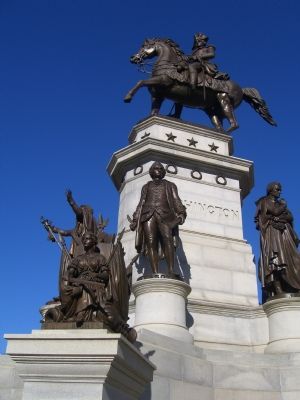
Photographed by Kevin W., January 3, 2008
2. George Washington Monument Marker
Prominent Virginian George Mason, with seated female figure representing the Bill of Rights.
The cornerstone was laid Feb. 22, 1850 and the monument dedicated Feb. 22, 1858. The last figure was installed in 1869.
In 1856, Thomas Crawford completed the equestrian statue of George Washington in Rome and had it cast in Munich; however, he died on Oct. 10, 1857 just before the sculpture arrived in America on Nov. 2, 1857. Before he died, Crawford had also completed models for all of the other bronze figures on the monument, but only the figures of Thomas Jefferson and Patrick Henry were ready in time for the dedication, which took place on Feb. 22, 1858. Randolph Rogers completed the statues of George Mason, installed in 1860; John Marshall, installed in March of 1867; Andrew Lewis, installed Sept. of 1867; and Thomas Nelson,
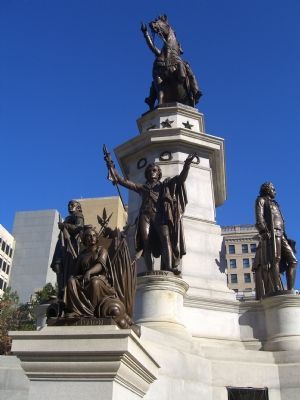
Photographed by Kevin W., January 3, 2008
3. George Washington Monument Marker
Prominent Virginian Patrick Henry, with seated female figure representing Revolution.
Information Source: Smithsonian Institution Research Information System (SIRIS)
Regarding George Washington Monument. (Marker conveys the impact of Virginians on our Country's history through its prominent and allegorical figures. See the "More about this marker" section and the links for more information).
Also see . . .
1. Biography of Thomas Jefferson, author of the Declaration of Independence. Monticello website entry:
Thomas Jefferson is the prominent Virginian paired with the allegorical figure of Independence (Submitted on January 15, 2008, by Kevin W. of Stafford, Virginia.)
2. Patrick Henry. Portraits in Revolution website entry:
Patrick Henry, the most celebrated orator of the American Revolution is paired with the allegorical figure of Revolution. (Submitted on January 15, 2008, by Kevin W. of Stafford, Virginia.)
3. Andrew Lewis, Augusta Colonial Founder. Christian History Society of America website entry:
Andrew Lewis, the prominent Virginian paired with the allegorical figure of Colonial Times,
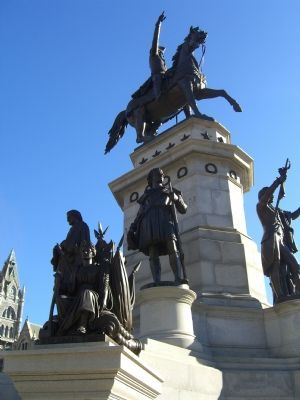
Photographed by Kevin W., January 3, 2008
4. George Washington Monument Marker
Prominent Virginian Andrew Lewis, with seated female figure representing Colonial Times.
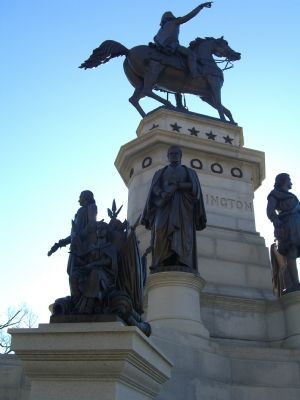
Photographed by Kevin W., January 3, 2008
5. George Washington Monument Marker
Prominent Virginian John Marshall, with seated female figure representing Justice.
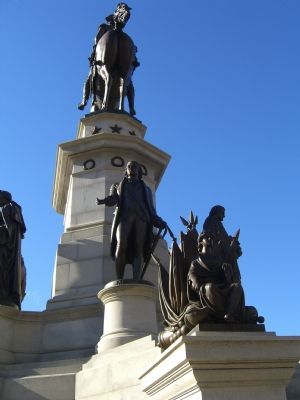
Photographed by Kevin W., January 3, 2008
6. George Washington Monument Marker
Prominent Virginian Thomas Nelson, Jr., with seated female figure representing Finance.
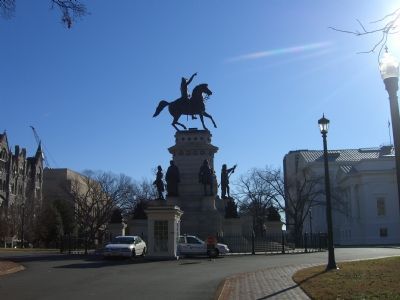
Photographed by Kevin W., January 3, 2008
7. George Washington Monument Marker
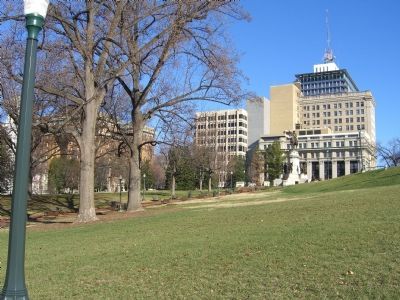
Photographed by Kevin W., January 3, 2008
8. George Washington Monument Marker
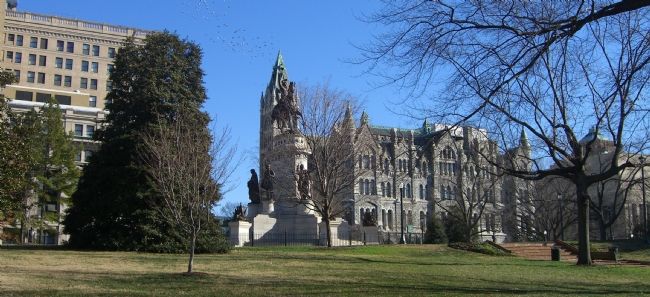
Photographed by Kevin W., January 3, 2008
9. George Washington Monument Marker
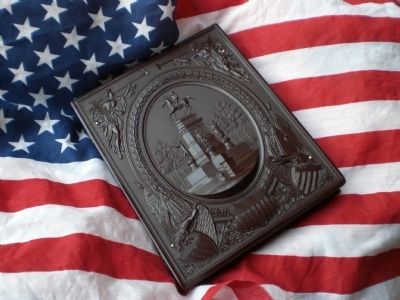
Photographed by Nelson Anderson, March 22, 2008
10. George Washington Monument Marker (Half Plate Daguerreotype Case 1858)
Daguerreotype case (Berg 1-35) "Washington Monument with Seraphs and Eagles" Made by A.P.Critchlow and Co. 1858. The engraver's name F.Goll (Frederick P. Goll) appears on the left side of the base of the statue.
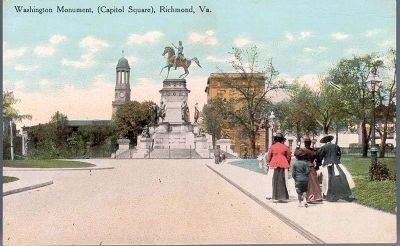
Photographed by Southern Bargain House, Richmond, Va.
11. Washington Monument, (Capitol Square), Richmond, Va.
This imposing work of art by Thomas Crawford (father of F. Marion Crawford, the novelist) has been declared by competent critics to be the finest equestrian statue in the world. It was unveiled Feb. 22, 1838; it is said that 'when the wall was withdrawn a sunbeam fell on the horse and rider, through the falling snow, making a most striking scene.' The design of the base is a six-ray star, the statue of an eminent Virginian resting upon each ray, as follows: Patrick Henry, Geo. Mason, Thos. Jefferson, John Marshall, Thos. Nelson, Jr., and Andrew Lewis. VCU Libraries Digital Collections - Rarely Seen Richmond
Credits. This page was last revised on August 16, 2024. It was originally submitted on January 14, 2008, by Kevin W. of Stafford, Virginia. This page has been viewed 4,187 times since then and 89 times this year. Photos: 1, 2, 3, 4, 5, 6, 7, 8. submitted on January 14, 2008, by Kevin W. of Stafford, Virginia. 9. submitted on January 31, 2008, by Kevin W. of Stafford, Virginia. 10. submitted on July 9, 2010, by Nelson Anderson of Modesto, California. 11. submitted on May 10, 2012, by Bernard Fisher of Richmond, Virginia.
