Ansonborough in Charleston in Charleston County, South Carolina — The American South (South Atlantic)
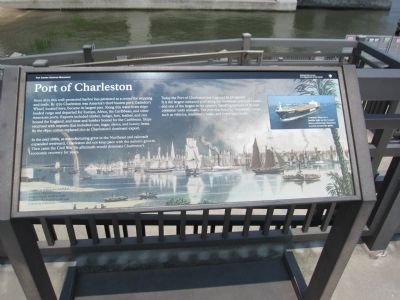
Port of Charleston
Photographed by Craig Swain, August 4, 2011
1. Port of Charleston Marker
In the mid-1800s, as manufacturing grew in the Northeast and railroads expanded westward, Charleston did not keep pace with the nation's growth. Then came the Civil War. Its aftermath would dominate Charleston's economic recovery for years.
Today the Port of Charleston has regained its prosperity. It is the largest container port along the Southeast and Gulf Coasts and is one of the largest in the country, handling millions of 20-foot container units annually. The port also handles "breakbulk" cargo, such as vehicles, machinery, boats, and heavy equipment.
Container ships are a familiar sight on the Cooper River, connecting
this page online
(Caption for background):
Charleston Harbor around 1838 as seen from Hog Island (now Patriot's Point). At left is Castle Pinckney; the steamer on the right is the ferry to Hobcaw.
Erected by Fort Sumter National Monument - National Park Service - US Department of the Interior.
Topics. This historical marker is listed in these topic lists: Industry & Commerce • Waterways & Vessels. A significant historical year for this entry is 1670.
Location. 32° 47.436′ N, 79° 55.497′ W. Marker is in Charleston, South Carolina, in Charleston County. It is in Ansonborough. It can be reached from the intersection of Calhoun Street and Concord Street, on the right when traveling east. Located at the Fort Sumter tour boat wharf, adjacent to the South Carolina Aquarium. Touch for map. Marker is in this post office area: Charleston SC 29401, United States of America. Touch for directions.

Regionally, this marker is in Historic Charleston and in the Lowcountry. It is also in the American South, specifically in the Deep South, and on the Eastern Seaboard. Globally, it is in the North Atlantic Region, North
Photographed by Craig Swain
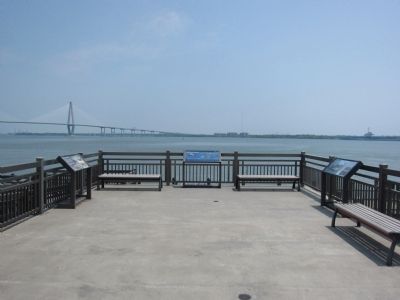
2. Markers at the Wharf Overlook
Other nearby markers. At least 8 other markers are within walking distance of this marker: Fort Sumter Today (here, next to this marker); Fort Sumter Bricks (within shouting distance of this marker); Septima Poinsette Clark 1898-1987 (about 300 feet away, measured in a direct line); Septima Poinsette Clark (about 300 feet away); Gadsden's Wharf (about 500 feet away); Philip Simmons (about 500 feet away); The UNESCO Routes of Enslaved Peoples (about 700 feet away); The Borough Houses (approx. ¼ mile away). Touch for a list and map of all markers in Charleston.
Photographed by Craig Swain, August 4, 2011
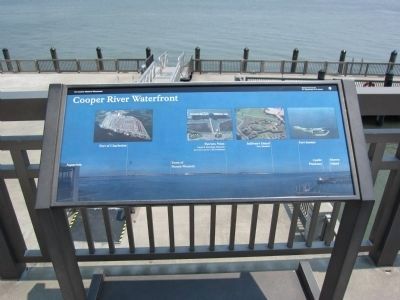
3. Cooper River Waterfront
Marker at the front of the overlook.
Photographed by Craig Swain, August 4, 2011
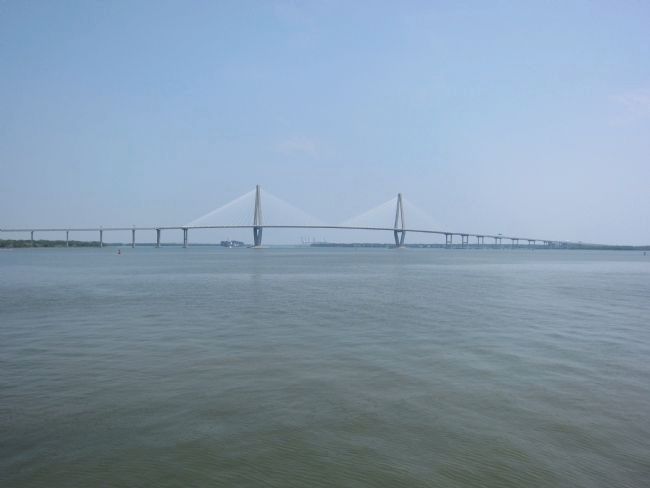
4. New Cooper River Bridge (Arthur Ravenel, Jr. Bridge)
The bridge stands at the entrance to north Charleston harbor.
Photographed by Craig Swain, August 4, 2011
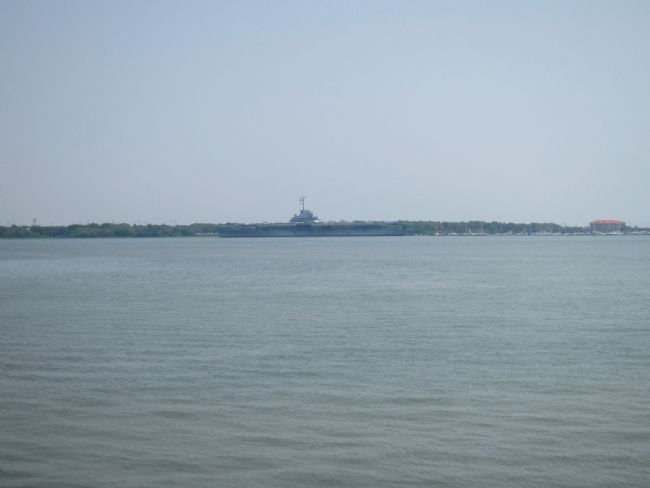
5. Patriot's Point
The USS Yorktown and Medal of Honor Museum stand on Patriot's Point, across the harbor.
Photographed by Craig Swain, August 4, 2011
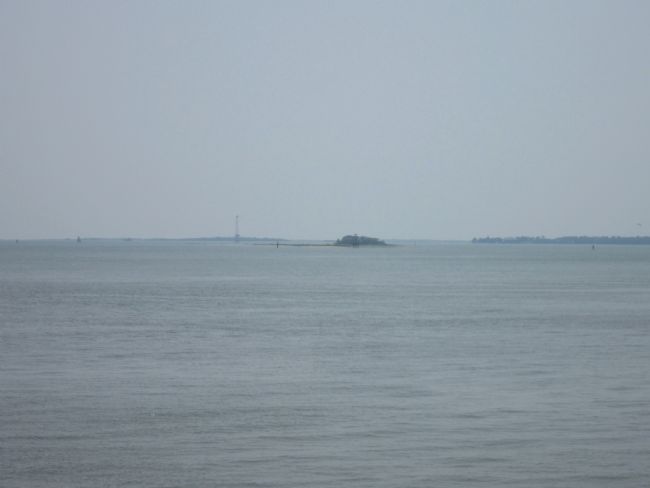
6. Castle Pinckney
Located on a small island in the harbor, for many decades Castle Pinckney was the premier defense of Charleston.
Credits. This page was last revised on February 16, 2023. It was originally submitted on September 25, 2011, by Craig Swain of Leesburg, Virginia. This page has been viewed 1,584 times since then and 76 times this year. Photos: 1, 2, 3, 4, 5, 6. submitted on September 25, 2011, by Craig Swain of Leesburg, Virginia.
