Dredging Amana's Millrace
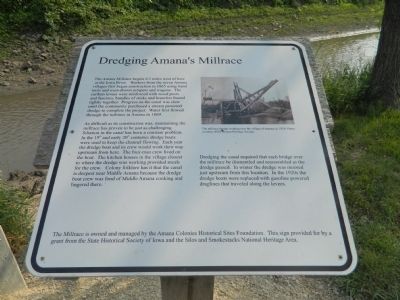
as difficult as its construction was, maintaining the millrace has proven to be just as challenging. Siltation in the canal has been a constant problem. In the 19th and early 20th centuries dredge boats were used to keep the channel flowing. Each year the dredge boat and its crew would work their way upstream from here. The four-man crew lived on the boat. The kitchen houses in the village closest to where the dredge was working provided meals for the crew. Colony folklore has it that the canal is deepest near Middle Amana because the dredge boat crew was fond of Middle Amana cooking and lingered there.
Dredging the canal required that each bridge
this page online
Photo
The millrace dredge working near the village of Amana ca 1920. Photo courtesy of the Amana Heritage Society.
Topics. This historical marker is listed in these topic lists: Industry & Commerce • Waterways & Vessels. A significant historical year for this entry is 1865.
Location. 41° 47.783′ N, 91° 51.916′ W. Marker is in Amana, Iowa, in Iowa County. It is on 48th Avenue. Touch for map. Marker is in this post office area: Amana IA 52203, United States of America. Touch for directions.
Regionally, this marker is in Eastern Iowa. It is also in the American Midwest and in the Corn Belt. Globally, it is in North America, the Western Hemisphere, the Western World, and the Anglosphere. Historically, it finds itself in what was once the territory of the Mississippian Culture and also the Louisiana Purchase.
Other nearby markers. At least 8 other markers are within walking distance of
Credits. This page was last revised on June 16, 2016. It was originally submitted on October 14, 2011, by Bill Pfingsten of Bel Air, Maryland. This page has been viewed 1,270 times since then and 46 times this year. Photos: 1, 2. submitted on October 14, 2011, by Bill Pfingsten of Bel Air, Maryland.
