Cascade in El Paso County, Colorado — The American Mountains (Southwest)
The Continental Divide
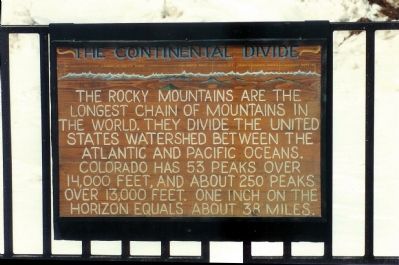
Photographed by Michael Stroud, May 1994
1. The Continental Divide Marker, at the summit of Pikes Peak
Topics. This historical marker is listed in these topic lists: Exploration • Natural Features • Natural Resources.
Location. 38° 50.431′ N, 105° 2.504′ W. Marker is near Cascade, Colorado, in El Paso County. It is on Pikes Peak Hwy. Located at the summit of Pikes Peak. Touch for map. Marker is in this post office area: Cascade CO 80809, United States of America. Touch for directions.

Regionally, this marker is in the Front Range and in Pikes Peak Region. It is also in the American Mountain West. Globally, it is in North America, the Rocky Mountains, the Western Hemisphere, the Western World, and the Anglosphere. Historically, it finds itself in what was once the Comanchería.
Other nearby markers. At least 8 other markers are within 3 miles of this marker, measured as the crow flies: Zebulon Montgomery Pike (here, next to this marker); Pike's Peak (a few steps from this marker); Commemorating the 100th Anniversary of the Inspiration of America the Beautiful (within shouting distance of this marker); The First Summit House
this page online
Also see . . . Wikipedia entry for Continental Divide. A continental divide is a line of elevated terrain which forms a border between two watersheds such that water falling on one side of the line eventually travels to one ocean or body of water, and water on the other side travels to another, generally on the opposite side of the continent. (Submitted on January 20, 2008, by Mike Stroud of Bluffton, South Carolina.)
Additional commentary.
1. Continential Divide
The divide runs along the crest of the Rockies, from British Columbia, through the United States, and continues southward into Mexico and Central America. It divides the continent's principal drainage into that flowing eastward (to the Hudson Bay in Canada or to the Mississippi River) and that flowing westward (to the Pacific Ocean).
— Submitted January 20, 2008, by Mike Stroud of Bluffton, South Carolina.
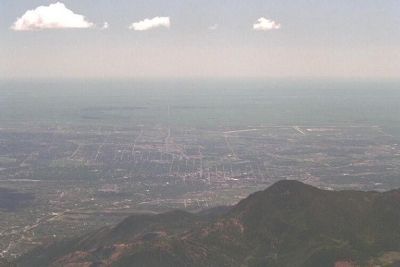
Photographed by Michael Stroud, May 1994
2. Looking Eastward, Colorado Springs seen below
Atlantic Ocean Watershed; rainfall on this side eventually reaches the Atlantic Ocean.
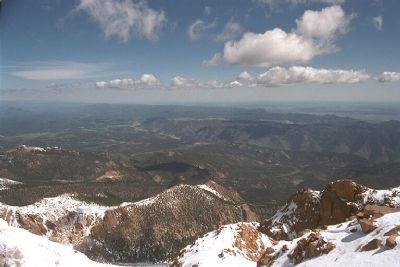
Photographed by Michael Stroud, May 1994
3. Looking Westward, from summit of Pikes Peak
Pacific Ocean Watershed; rainfall on this side eventually reaches the Pacific Ocean.
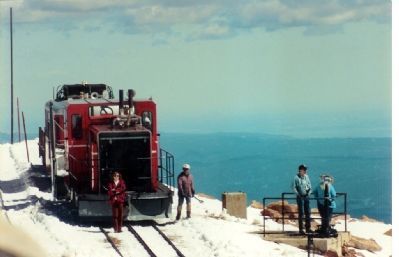
Photographed by Michael Stroud, circa 1994
4. The Cog Railway, 1994 style
June 30, 2007
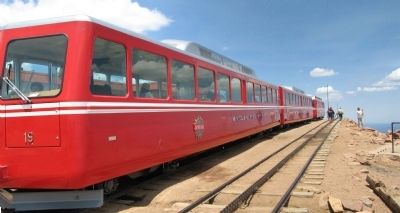
5. Manitou and Pikes Peak Railroad cars.
Click for more information.
July 18, 2007
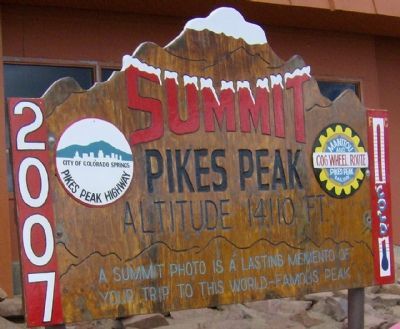
6. Pikes Peak Summit
Credits. This page was last revised on October 18, 2025. It was originally submitted on January 20, 2008, by Mike Stroud of Bluffton, South Carolina. This page has been viewed 10,949 times since then and 247 times this year. Photos: 1, 2, 3, 4. submitted on January 20, 2008, by Mike Stroud of Bluffton, South Carolina. 5, 6. submitted on January 21, 2008, by Kevin W. of Stafford, Virginia. • Kevin W. was the editor who published this page.
