Simpsonville in Greenville County, South Carolina — The American South (South Atlantic)
Oakland Plantation
Photographed by Brian Scott, October 17, 2011
1. Oakland Plantation Marker
Front
Front
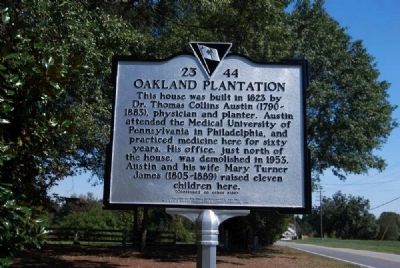
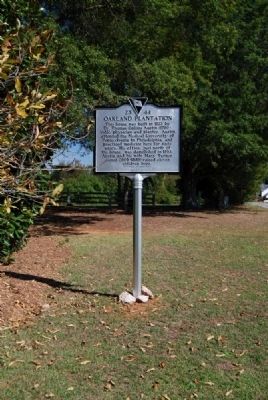
This house was built in 1823 by Dr. Thomas Collins Austin (1790-1883), physician and planter. Austin attended the Medical University of Pennsylvania in Philadelphia, and practiced medicine here for sixty years. His office, just north of the house, was demolished in 1953. Austin and his wife Mary Turner James (1805-1889) raised eleven children here.
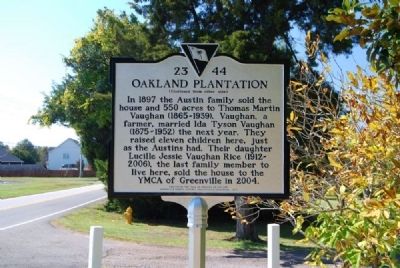
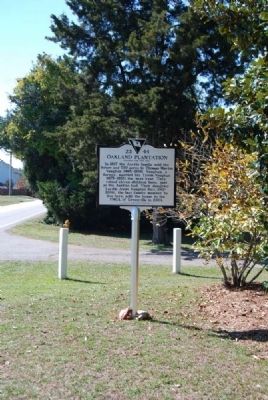
In 1897 the Austin family sold the house and 550 acres to Thomas Martin Vaughan (1865-1939). Vaughan, a farmer, married Ida Tyson Vaughan (1875-1952) the next year. They raised eleven children here, just as the Austins had. Their daughter Lucille Jessie Vaughan Rice (1912-2006), the last family member to live here, sold the house to the YMCA of Greenville in 2004.
Erected 2011 by YMCA of Greenville and the Greenville County Historic Preservation Commission. (Marker Number 23-44.)
Topics. This historical marker is listed in this topic list: Science & Medicine. A significant historical year for this entry is 1823.
Location. 34° 46.933′ N, 82° 14.75′ W. Marker is in Simpsonville, South Carolina, in Greenville County. It is on Adams Mill Road, on the left when traveling
this page online

Regionally, this marker is in Upstate and in the Greater Greenville-Spartanburg Area. It is also in the American South, specifically in the Deep South, in Appalachia, and specifically in Southern Appalachia. Globally, it is in North America, the Western Hemisphere, the Western World, and the Anglosphere. Historically, it finds itself in what was once the original Cherokee Nation, the territory of the Mississippian Culture, one of the original Thirteen Colonies, one of the Confederate States of America, and the Antebellum South.
Other nearby markers. At least 10 other markers are within 3 miles of this marker, measured as the crow flies: Gilder (approx. one mile away); Bethel Church (approx. 1½ miles away); Bethel Church Cemetery (approx. 1½ miles away); The Old Arbor (approx. 1½ miles away); The Old Oak Tree (approx. 1½ miles away); Bethel Community Training Ground (approx. 1.6 miles away); Graceland East Memorial Park Veterans Monument (approx. 2.4 miles away); Holy Cross Episcopal Church Labyrinth
Photographed by Brian Scott, October 17, 2011
2. Oakland Plantation Marker
Reverse
Reverse
Additional commentary.
1. Historic marker to be unveiled in Simpsonville
Katie Jones
The Greenville News
September 21, 2011
Dr. Thomas Austin and his wife, Mary, built a home in 1823 that would later become the Oakland Plantation. It stayed in the family until 1898, when Thomas Martin Vaughn and his wife, Ida Vaughn, bought it. Each family had 11 children.
When Ida Vaughn died in 1952, her daughter, Lucille Rice, bought the house. Rice lived their until her death about five years ago, even after she sold it to the YMCA in 2004, said Ida Vaughn, Rice’s niece.
And on Sunday , descendants and relatives will unveil a State Historical Marker at the site, commemorating the two families. The homestead is now the Hollingsworth Outdoor Center, down the road from the GHS Family YMCA’S Adams Mill Program Center.
“It’s one of the most remarkable historical places in the area,” said Greg McKee, Hollingsworth program director.
Between
Photographed by Brian Scott, October 17, 2011
3. Oakland Plantation Marker
Front
Front
“It’s just wonderful for our family because it recognizes and remembers the families that lived there,” she said. “So many times when something becomes something else, everybody forgets what went before.”
The recognition didn’t happen overnight, said Al Futrell, a volunteer with the Greenville County Historic Preservation Commission. It was a year-long process that cost more than $2,000.
The center, 259 Adams Mill Road, will offer tours and refreshments from 2-4 p.m. Sunday. The marker will be unveiled at 3 p.m.
— Submitted October 18, 2011, by Brian Scott of Anderson, South Carolina.
Photographed by Brian Scott, October 17, 2011
4. Oakland Plantation Marker
Reverse
Reverse
Credits. This page was last revised on January 3, 2024. It was originally submitted on October 18, 2011, by Brian Scott of Anderson, South Carolina. This page has been viewed 7,174 times since then and 341 times this year. Photos: 1, 2, 3, 4. submitted on October 18, 2011, by Brian Scott of Anderson, South Carolina.
