New Scotland in Albany County, New York — The American Northeast (Mid-Atlantic)
Bender Melons
Photographed by Howard C. Ohlhous, October 6, 2011
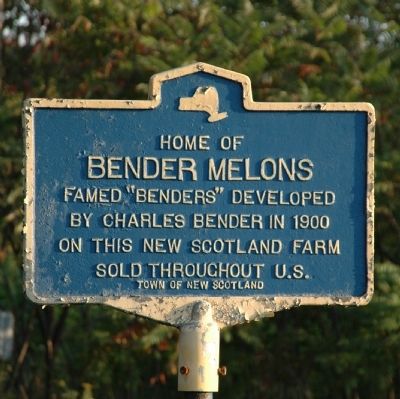
1. Bender Melons Marker
Home of Bender Melons. Famed "Benders" developed by Charles Bender in 1900 on this New Scotland Farm sold throughout U.S.
Erected by Town of New Scotland.
Topics. This historical marker is listed in these topic lists: Agriculture • Food & Drink • Industry & Commerce. A significant historical year for this entry is 1900.
Location. 42° 38.234′ N, 73° 54.131′ W. Marker is in New Scotland, New York, in Albany County. It is on Maple Road (New York State Route 85A), on the right when traveling west. Touch for map. Marker is in this post office area: Slingerlands NY 12159, United States of America. Touch for directions.

Regionally, this marker is in Upstate New York, in the Capital District, and in the Albany Metropolitan Area. It is also in the American Northeast and in the Mid-Atlantic. Globally, it is in North America, the Western Hemisphere, the Western World, and the Anglosphere. Historically, it finds itself in what was once New Netherland and also one of the original Thirteen Colonies.
Other nearby markers. At least 8 other markers are within 2 miles of this marker, measured as the crow flies:
this page online
Another marker is no longer nearby. Coughtry Homestead (was approx. 1.1 miles away but has been confirmed missing).
Also see . . . Charles Bender and the Bender Melon Farm. Graciously made available by the author, Dennis Sullivan, and the New Scotland Historical Association. (Submitted on September 3, 2026, by Trudi Jacobson of Slingerlands, New York.)
Additional commentary.
1. Bender Melon History and Land Today
“Bender Melons” were more than a locally popular crop. Beginning about 1884, Charles Bender spent approximately seventeen years breeding and refining muskmelons on this New Scotland farm, seeking to combine exceptionally sweet flavor with a rind sturdy enough to withstand shipping. By about
Photographed by Howard C. Ohlhous, October 6, 2011
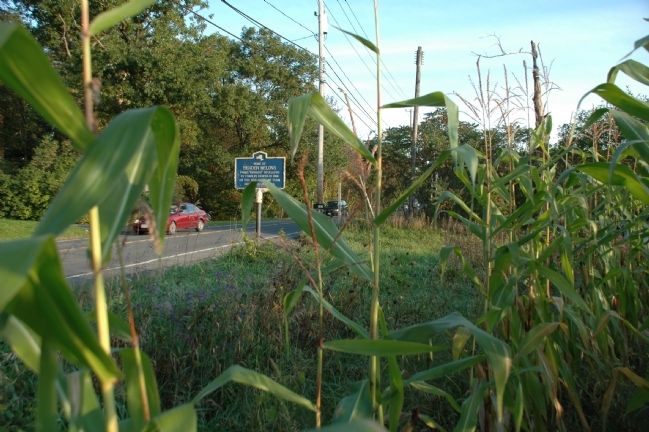
2. Bender Melons Marker
Bender used unusually labor-intensive cultivation methods. Seedlings were started in greenhouses and individual plants were protected in the fields by glass-topped cold frames, allowing an early start to the growing season. The plants were weeded by hand and individually watered during dry periods, and ripening melons were placed on wooden supports to protect them from damp soil. Bender carefully guarded his seed supply, reportedly removing the seeds from melons before selling them so that other growers could not easily reproduce his variety.
Bender also proved an effective marketer. He personally took ripe melons to New York City and offered samples to prominent hotels and restaurants. Benders became luxury fare at such establishments as the Waldorf-Astoria and Savoy and were popular in Saratoga during racing season. At the height of the farm's success, melons were shipped to 33 states and even overseas. Seed companies eventually
Photographed by Howard C. Ohlhous, October 6, 2011
3. Bender Melons Marker
Charles Bender farmed here for roughly four decades. With no children to inherit the farm, he eventually sold it to dairy farmer William Taylor, who continued growing Bender melons for several years with Bender's assistance. Changing markets and depleted soil ultimately brought commercial melon production here to an end. Much of the former farm survives today as the approximately 175-acre Bender Melon Farm Preserve, acquired by the Mohawk Hudson Land Conservancy to protect the historic landscape and its fields, wetlands, and wildlife habitat.
Sources
Francis C. Stokes & Co. 112 Superb Varieties for Market Gardeners, Season of 1926. Philadelphia: Francis C. Stokes & Company, 1926. U.S. Department of Agriculture, National Agricultural Library; digitized by the Biodiversity Heritage Library.
Maule, William Henry. The Maule Seed Book. Philadelphia: William Henry
Photographed by Trudi Jacobson, September 3, 2026
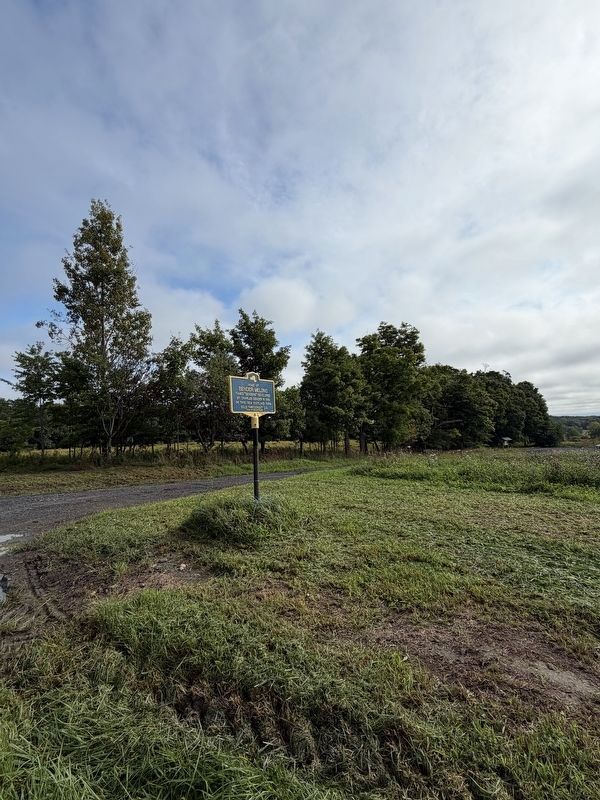
4. Bender Melons Marker and Surrounding Area
Mohawk Hudson Land Conservancy. “Bender Melon Farm Preserve.” History and description of the former Bender Melon Farm and its preservation.
Mohawk Hudson Land Conservancy. “Bender Melon Farm Success!” December 1, 2020. Account of the Conservancy’s acquisition of the property and the community campaign to preserve it.
New Scotland Historical Association. “The Bender Melon Farm.” The Sentinel, Fall 2022.
Sullivan, Dennis. Charles Bender and the Bender Melon Farm: A Local History. New Scotland Historical Association, 1990. Originally published in two installments in The Altamont Enterprise, August 28 and September 4, 1986.
Victory Seed Company. “Bender’s Surprise Muskmelon.” Historical notes citing the 1917 Joseph Harris Seed Company catalog and Sullivan’s history.
— Submitted September 3, 2026, by Trudi Jacobson of Slingerlands, New York.
Credits. This page was last revised on September 15, 2026. It was originally submitted on October 21, 2011, by Howard C. Ohlhous of Duanesburg, New York. This page has been viewed 1,650 times since then and 133 times this year. Last updated on September 14, 2026, by Trudi Jacobson of Slingerlands, New York. Photos: 1, 2, 3. submitted on October 21, 2011, by Howard C. Ohlhous of Duanesburg, New York. 4. submitted on September 3, 2026, by Trudi Jacobson of Slingerlands, New York. • Devry Becker Jones was the editor who published this page.
