
Fonthill in Niagara-on-the-Lake in Niagara Region, Ontario — Central Canada (North America)
Later Years
⎯⎯⎯
Après la guerre de 1812
Inoculation at Old Navy Hall, Niagara Camp
Photographed by Dale K. Benington, July 27, 2011
1. Later Years Marker

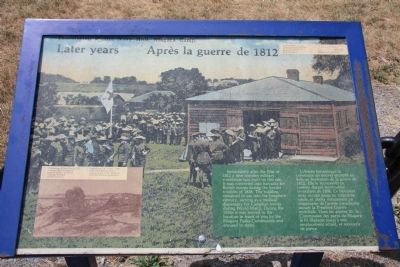
Immediately after the War of 1812 a new wooden storehouse was built on this site. It was converted into barracks for British troops during the border troubles of 1838. The building remained in use into the twentieth century, serving as a medical dispensary for Canadian troops during World War I. During the 1930s it was moved to the location in front of you by the Niagara Parks Commission and encased in stone.
[Captions:]
Canadian soldiers at Camp Niagara preparing for overseas service during World War I. (Burtniak Collection, Brock University)
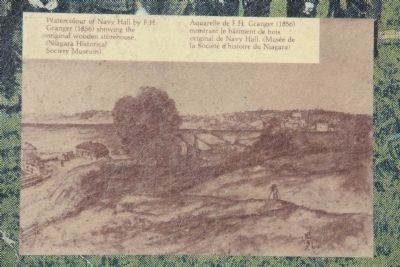
Watercolour of Navy Hall by F.H. Granger (1856) showing the original wooden storehouse. (Niagara Historical Society Museum)
this page online
[Légende de les images:]
Des soldats canadiens s'entraînent au camp Niagara durant la Première Guerre mondiale avant de servir en Europe. (Collction Burtniak, Université Brock)
Aquarelle de F.H. Granger (1856) montrant le bâtiment de bois original de Navy Hall. (Musée de la Société d'histoire du Niagara)
Erected by Canadian Parks Service.
Topics. This historical marker is listed in this topic list: Notable Buildings. A significant historical year for this entry is 1814.
Location. 43° 15.137′ N, 79° 3.54′ W. Marker is in Niagara-on-the-Lake, Ontario, in Niagara Region. It is in Fonthill. It is on Ricardo Street 0.4 kilometers south of Melville Street, on the left when traveling south. This historical marker is located on the grounds of the Navy Hall, between the site of Fort George and the Niagara River, nearest to the Niagara River. Touch for map. Marker is at or near this postal address: 305 Ricardo St, Niagara-on-the-Lake ON L0S 1J0, Canada. Touch for directions.

Regionally, this marker is on Ontario’s Golden Horseshoe and in Niagara Canada. It is also in Central Canada. Globally, it is in North America, the Western Hemisphere, the Western World, and the Anglosphere. Historically, it finds itself in what was once a British colony, the Viceroyalty of New France, the Haudenosaunee (Iroquois) Confederacy, and Rupert’s Land.
Other nearby markers. At least 8 other markers are within walking distance of this marker: The Early Years / Les premières décennies (here, next to this marker); Navy Hall (here, next to this marker); John Graves Simcoe (within shouting distance of this marker);
Photographed by Dale K. Benington, July 27, 2011
2. Later Years Marker
Close-up view of the picture insert on the historical marker showing a painting of the original structure.
Other markers no longer nearby. Fort Niagara (was approx. 0.3 kilometers away but has been replaced with another marker now near it); A Strategic Site (was approx. 0.3 kilometers away but has been replaced with another marker now near it).
More about this marker. The Navy Hall is located on the Canadian side of the Niagara River, just a short distance upstream from Fort Niagara which is located on the United States side of the River. Because the Navy Hall was located within the range of the cannon situated at Fort Niagara, its structures ended up being destroyed by American artillery fire during the War of 1812.
Also see . . .
Photographed by Dale K. Benington, July 27, 2011
3. Later Years Marker
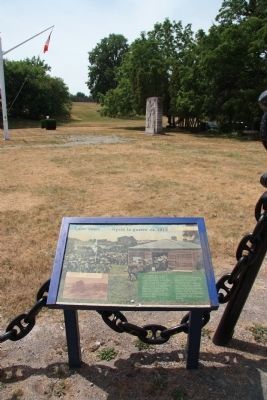
View of the historical marker and the grounds at the Navy Hall.
1. Navy Hall. This is a link to information provided by a web site that is Administered by Parks Canada. (Submitted on November 15, 2011, by Dale K. Benington of Toledo, Ohio.)
2. Navy Hall. This is a link to information provided by Wikipedia, the free encyclopedia. (Submitted on November 15, 2011, by Dale K. Benington of Toledo, Ohio.)
Photographed by Dale K. Benington, July 27, 2011
4. Later Years Marker
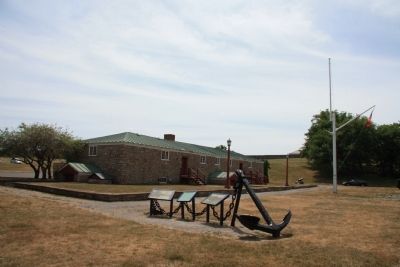
View of featured historical marker with a group of markers, on the grounds of Navy Hall, with a view of Navy Hall in the background.
Photographed by Dale K. Benington, July 27, 2011
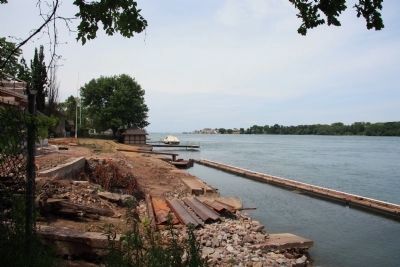
5. View of Fort Niagara
View from the grounds of the Navy Hall, looking north along the Niagara River towards Fort Niagara and Lake Ontario beyond the fort.
Photographed by Dale K. Benington, July 27, 2011
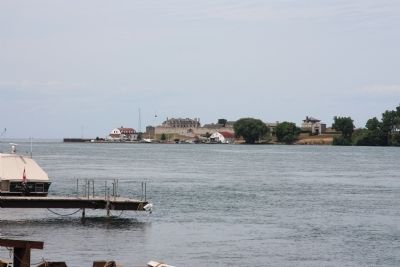
6. View of Fort Niagara
Another view from the grounds of the Navy Hall, looking north along the Niagara River towards Fort Niagara.
Credits. This page was last revised on November 10, 2025. It was originally submitted on November 13, 2011, by Dale K. Benington of Toledo, Ohio. This page has been viewed 612 times since then and 14 times this year. Last updated on September 2, 2025, by Kevin Westell of St. Catharines, Ontario. Photos: 1, 2, 3, 4, 5, 6. submitted on November 20, 2011, by Dale K. Benington of Toledo, Ohio. • Devry Becker Jones was the editor who published this page.
