
Near Dalton Post in Unorganized Yukon, Yukon — The Northern Territories (North America)
The Tatshenshini River
The Canadian Heritage River System
⎯⎯⎯
La rivière Tatshenshini
Le Réseau de rivières du patrimonine canadien
Photographed by Barry Swackhamer, June 19, 2010
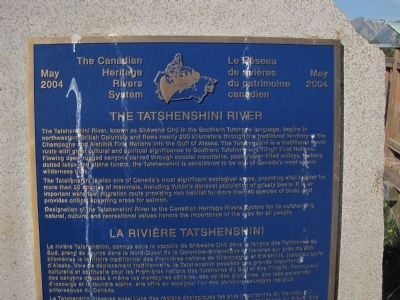
1. The Tatshenshini River Marker

[English:]
The Tatshenshini River
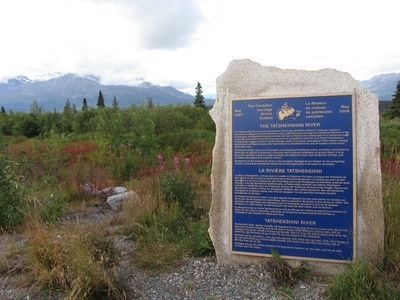
The Tatshenshini River, known as Shawshe Chu in the Southern Tutchone language, begins in northwestern British Columbia and flows nearly 200 kilometers through the traditional territory of the Champagne and Aishihik First Nations into the Gulf of Alaska. The Tatshenshini is a traditional travel route with great cultural and spiritual significance to Southern Tetchome and Tlingit First Nations. Flowing down rugged canyons carved through coastal mountains, post glacier-filled valleys, iceberg dotted lakes and alpine tundra, the Tatshenshine is considered to be one of Canada’s most scenic wilderness trips.
The Tatshenshini is also one of Canada’s most significant ecological areas, providing vital habitat for more than 50 species of mammals, including Yukon’s densest population of grizzly bears. It is an important waterfowl migration route providing rich habitat for more than 40 species of birds, and provides critical spawning areas for salmon.
Designation of the Tatsheshini River to the Canadian Heritage Rivers System for its outstanding natural, cultural and recreational value
this page online
La rivière Tatshenshini
La rivière Tatshenshini, connue sous le vocable de Shàwshe Chú dans le langue des Tuchcones du Sud, prend sa source dans le Nord-Ouest de la Colmbie-Britannique et traverse sur près du 200 kilomètres le territorie traditionnel des Premières nations de Campgagne et d’Aishihik, jusqu’au golfe d’Alaska. Voie de déplacement traditionnelle, la Tatshshini posséde une grande important culturelle et spirituelle pour les Premières nations de Tutchones de Sud et des Tlingits. Parcourant des canyons creusés à même les montagnes côtières, des vallées glaciaires, des lacs paraemès d’icebergs et la toundra alpine, elle offre au voyageur l‘un des parcours sauvages les plus pittoresques du Canada. La Tatshenshini traverse aussi l'une des régions écologiques les plus importantes du Canada, fournissant l'habitat vital de plus de 50 espèces de mammifères, y compris la plus dense du Yukon la population de grizzlis. C'est une importante voie migratoire pour la sauvagine fournissant riche habitat de plus de 40 espèces d'oiseaux, et fournit des zones de frai du saumon.
Désignation
Photographed by Web Image, circa n/a
2. The Tatshenshini River Marker
Erected 2004 by Government of Canada/Governement du Canada.
Topics and series. This historical marker is listed in these topic lists: Indigenous Peoples and Communities • Waterways & Vessels. In addition, it is included in the Canada, Historic Sites and Monuments Board series list. A significant historical year for this entry is 2004.
Location. 60° 2.328′ N, 136° 52.972′ W. Marker is near Dalton Post, Yukon, in Unorganized Yukon. It is on Haines Road (Yukon Route 3) 58.3 kilometers south of Alaska Highway ( Route 1), on the right when traveling north. This marker is on the Haines Highway approximately 50 miles from Haines Junction, YT and and Haines, AK. Touch for map. Marker is at or near this postal address: 6085 Haines Road, Dalton Post YT Y1A 7A2, Canada. Touch for directions.

Regionally, this marker is in the Canadian North. Globally, it is in North America, on the Ring of Fire, in the Arctic, in the Western
Photographed by Barry Swackhamer, June 19, 2010
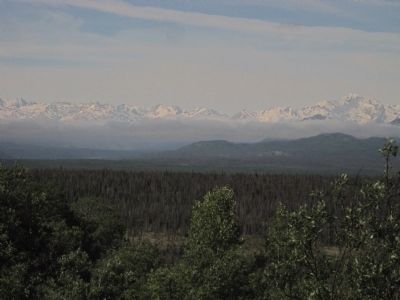
3. The Kluane Mountain Range
Also see . . . The Tatshenshine River - Wikipedia. (Submitted on November 19, 2011, by Barry Swackhamer of Brentwood, California.)
Photographed by Barry Swackhamer, June 19, 2010
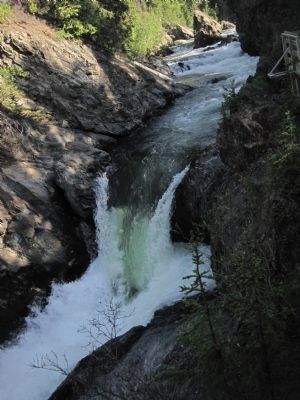
4. Million Dollar Falls
Credits. This page was last revised on July 26, 2026. It was originally submitted on November 18, 2011, by Barry Swackhamer of Brentwood, California. This page has been viewed 895 times since then and 19 times this year. Photos: 1, 2, 3, 4. submitted on November 18, 2011, by Barry Swackhamer of Brentwood, California. • Bill Pfingsten was the editor who published this page.
