The Port in Cambridge in Middlesex County, Massachusetts — The American Northeast (New England)
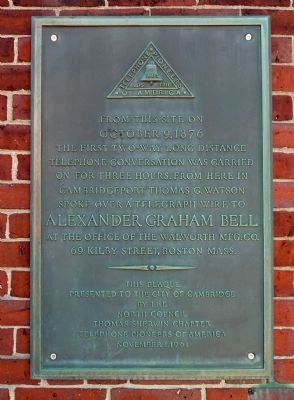
First Long-Distance Phone Call
Photographed by Roger W. Sinnott, November 19, 2011
1. First Long-Distance Phone Call Marker
Erected 1961 by North Council Thomas Sherwin Chapter Telephone Pioneers of America.
Topics. This historical marker is listed in these topic lists: Communications • Industry & Commerce. A significant historical date for this entry is October 9, 1876.
Location. 42° 21.782′ N, 71° 5.716′ W. Marker is in Cambridge, Massachusetts, in Middlesex County. It is in The Port. It is at the intersection of Main Street and Osborne Street, on the right when traveling east on Main Street. Touch for map. Marker is at or near this postal address: 710 Main Street, Cambridge MA 02139, United States of America. Touch for directions.

Regionally, this marker is in Historic Boston and specifically in Greater Boston. It is also in the American Northeast, in New England, and on the Eastern Seaboard. Globally, it is in the North Atlantic Region, North America,
this page online
Other nearby markers. At least 8 other markers are within walking distance of this marker: Davenport Car Manufactory (here, next to this marker); 'The Area 4 Story' (approx. ¼ mile away); William Wells Brown (approx. 0.3 miles away); Francis P. Soucie Square (approx. 0.3 miles away); Lunsford Lane (approx. 0.4 miles away); J. Milton Clarke 1820 - 1902 / Lewis Clarke 1818 - 1897 (approx. 0.4 miles away); Danny Lewin (approx. 0.4 miles away); "Past, Present, Future" (approx. 0.4 miles away). Touch for a list and map of all markers in Cambridge.
More about this marker. “Thomas G. Watson” in the inscription seems to be a typo for Thomas A. Watson.
Regarding First Long-Distance Phone Call. Coming just seven months after their first transmission of speech over a wire, this “long distance” experiment attracted wide notice. For example, on Nov. 18, 1876, the Arizona Citizen (Tucson, Arizona Territory) reprinted the report of a Boston paper: “Telephones were placed at either end
Photographed by Roger W. Sinnott, November 19, 2011
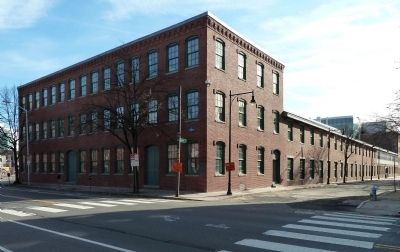
2. View of Building
The marker is mounted on the corner of the old Davenport Car Manufactory building, next to the first-floor window.
Also see . . .
1. Alexander Graham Bell - Wikipedia entry. (Submitted on November 22, 2011, by Roger W. Sinnott of Norwell, Massachusetts.)
2. Wikipedia entry for Long-Distance Calling. “On October 9, 1876, Alexander Graham Bell and Thomas A. Watson talked by telephone to each other over a two-mile (3 km) wire stretched between
Photographed by Allen C. Browne, August 9, 2015
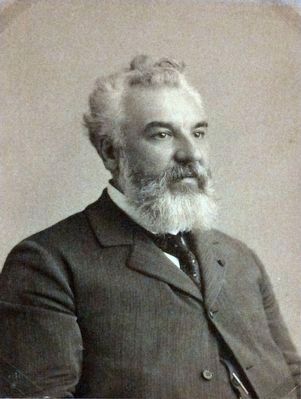
3. Alexander Graham Bell
This c. 1895 photo of Alexander Graham Bell by an unknown photographer hangs in the National Portrait Gallery in Washington, DC.
“Inventor Alexander Graham Bell sparked a communications revolution when he patented the telephone in 1876. But Bell considered his work with the deaf to be his true calling. Born to a deaf mother and a father renowned for his work in enunciation, Bell adapted his father's work — a visual, symbolic alphabet for use in producing spoken sounds — for use in teaching speech to the deaf. He opened a teacher training school and became a leader in the education of the deaf. Bell's teaching speech to the deaf was not viewed favorably by all; many advocates thought signing was the appropriate language for the hearing-impaired.” — National Portrait Gallery
“Inventor Alexander Graham Bell sparked a communications revolution when he patented the telephone in 1876. But Bell considered his work with the deaf to be his true calling. Born to a deaf mother and a father renowned for his work in enunciation, Bell adapted his father's work — a visual, symbolic alphabet for use in producing spoken sounds — for use in teaching speech to the deaf. He opened a teacher training school and became a leader in the education of the deaf. Bell's teaching speech to the deaf was not viewed favorably by all; many advocates thought signing was the appropriate language for the hearing-impaired.” — National Portrait Gallery
Credits. This page was last revised on February 12, 2026. It was originally submitted on November 22, 2011, by Roger W. Sinnott of Norwell, Massachusetts. This page has been viewed 5,209 times since then and 278 times this year. It was the Marker of the Week October 4, 2015. Photos: 1, 2. submitted on November 22, 2011, by Roger W. Sinnott of Norwell, Massachusetts. 3. submitted on October 28, 2015, by Allen C. Browne of Silver Spring, Maryland. • Bill Pfingsten was the editor who published this page.
