Big Chimney in Kanawha County, West Virginia — The American South (Appalachia)
Simon Kenton
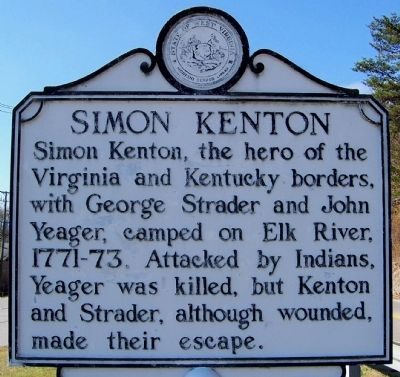
Photographed by Forest McDermott, November 10, 2008
1. Simon Kenton Marker
Topics and series. This historical marker is listed in these topic lists: Exploration • Indigenous Peoples and Communities. In addition, it is included in the West Virginia Archives and History series list.
Location. 38° 24.317′ N, 81° 31.962′ W. Marker is in Big Chimney, West Virginia, in Kanawha County. It is on Pennsylvania Avenue (U.S. 119) half a mile east of West Virginia Route 114, on the right when traveling north. Touch for map. Marker is at or near this postal address: 4500-4554 Pennsylvania Avenue, Charleston WV 25302, United States of America. Touch for directions.

Regionally, this marker is in Greater Charleston Area. It is also in the American South, specifically in the Upper South, in Appalachia, and specifically in Southern Appalachia. Globally, it is in North America, the Western Hemisphere, the Western World, and
this page online
Other nearby markers. At least 8 other markers are within 7 miles of this marker, measured as the crow flies: Pinch Reunion (approx. 2.6 miles away); W. Va. Air National Guard Memorial (approx. 2.7 miles away); Charleston's Civil War Sites (approx. 5.8 miles away); Craik-Patton House (approx. 5.8 miles away); H. Bernard Wehrle, Sr. (approx. 5.8 miles away); a different marker also named Daniel Boone (approx. 5.8 miles away); Donnally Monuments (approx. 5.8 miles away); Lewis’ March (approx. 6.3 miles away).
Another marker is no longer nearby. Daniel Boone (was approx. 5.8 miles away but has been confirmed missing).
Also see . . . Simon Kenton. 1904 article by Professor R. W. M’Farland in the Ohio History Journal, Vol. 13, No. 1. In the following excerpt, it is Strader who is killed, with Kenton and Yeager making their escape. No indication is given of exactly where on the Elk River the attack occurred.
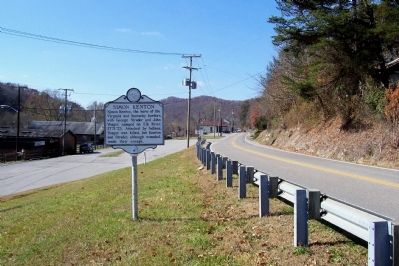
… and finally went up the Great Kanawha as far as the Elk river, not far from the present site of Charleston.(Submitted on March 17, 2021, by J. J. Prats of Powell, Ohio.)Here they hunted through the remainder of the year, and in the early part of 1772, took their peltries to the Ohio, and exchanged with the traders of Pittsburg for necessary supplies of provisions and ammunition.Photographed by Forest McDermott, November 10, 20082. Simon Kenton MarkerPhoto taken looking south on Route 119.
Returning to their hunting grounds they passed the remainder of the year in their usual way. In March, 1773, while in camp, the three hunters were fired on by Indians, Strader being killed. Kenton and Yeager barely escaped with their lives, being compelled to abandon guns, blankets, and provisions, and committing themselves to the wilderness, “without means of sheltering themselves from the cold, procuring a morsel of food, or even kindling a fire.”
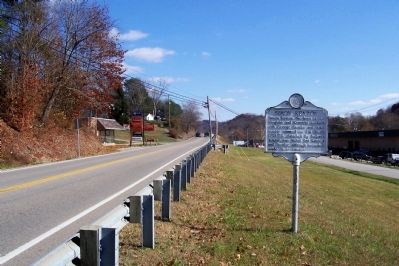
They started for the Ohio, allaying their hunger during the first two days by chewing such roots as they could find on the way. “On the third day their strength began to fail, and the keen appetite which had at first constantly tortured them, was succeeded by nausea, accompanied with dizziness and a sinking of the heart bordering on despair. On the fourth day they threw themselves on the ground, determined to await the approach of death, and were as oftenstimulated by the instinctive love of life to arise and resume their journey. On the fifth day they were completely exhausted, and were able only to crawl at intervals.Photographed by Forest McDermott, November 10, 20083. Simon Kenton MarkerPhoto taken looking north on Route 119
“In this manner they traveled about a mile during the day, and succeeded by sunset in reaching the banks of the Ohio. Here, to their inexpressible joy, they encountered a party of traders, from whom they obtained a comfortable supply of provisions.”
Additional commentary.
1.
Can not find any record where Kenton was wounded.
— Submitted March 16, 2021, by Jack mathers of Parkersburg, wv, Wood county, WV.
Credits. This page was last revised on October 16, 2023. It was originally submitted on November 27, 2011, by Forest McDermott of Masontown, Pennsylvania. This page has been viewed 2,034 times since then and 122 times this year. Photos: 1, 2, 3. submitted on November 27, 2011, by Forest McDermott of Masontown, Pennsylvania. • Bill Pfingsten was the editor who published this page.
