Tybee Island in Chatham County, Georgia — The American South (South Atlantic)
Fort Pulaski
Photographed by Mike Stroud, January 2008
1. Fort Pulaski Marker
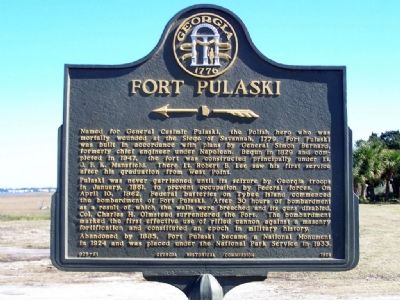
Named for General Casimir Pulaski, the Polish hero who was mortally wounded at the siege of Savannah, 1779, Fort Pulaski was built in accordance with plans by General Simon Bernard, formerly chief engineer under Napoleon. Begun in 1829 and completed in 1847, the Fort was constructed principally under Lt. J.F.K. Mansfield. There Lt. Robert E. Lee saw his first service after graduation from West Point.
Fort Pulaski was never garrisoned until its seizure by Georgia troops in January, 1861, to prevent occupation by Federal forces. On April 10, 1862, Federal batteries on Tybee Island commenced the bombardment of Fort Pulaski. After 30 hours of bombardment as a result of which the walls were breached and its guns disabled, Col. Charles H. Olmstead surrendered the Fort. The bombardment marked the first effective use of rifled cannon against a masonry fortification and constituted an epoch in military history.
Abandoned by 1885, Fort Pulaski became a National Monument in 1924 and was placed under the National Park Service in 1933.
Erected 1958 by Georgia Historical Commission. (Marker Number 25-61.)
Topics and series.
this page online
Location. 32° 1.126′ N, 80° 53.987′ W. Marker is on Tybee Island, Georgia, in Chatham County. It is on Islands Expressway (U.S. 80), on the left when traveling east. Located at the entrance to the park, East of Savannah, Georgia. Touch for map. Marker is in this post office area: Tybee Island GA 31328, United States of America. Touch for directions.

Regionally, this marker is on the Coastal Plain, on the Georgia Coast and the Golden Isles, in Greater Savannah, and on the Sea Islands. It is also in the American South, specifically in the Deep South, and on the Eastern Seaboard. Globally, it is in the North Atlantic Region, North America, the Western Hemisphere, the Western World, and the Anglosphere. Historically, it finds itself in what was once New Spain, the territory of the Mississippian Culture, one of the original Thirteen Colonies, one of the Confederate States of America, and the Antebellum South.
Photographed by Mike Stroud, January 1, 2008
2. Fort Pulaski Marker
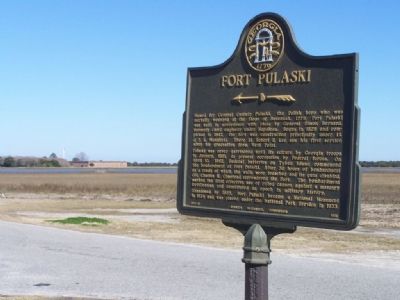
The fort can be seen on the left, from the highway.
Other nearby markers. At least 8 other markers are within walking distance of this marker: Soldier of Liberty (approx. 0.7 miles away); Guarding the Door (approx. 0.7 miles away); Freedom Ahead! (approx. 0.7 miles away); Sheltering Crown (approx. 0.7 miles away); Cisterns of the Construction Village (approx. ¾ mile away); The Waving Girl (approx. ¾ mile away); Engineering Dry Land (approx. ¾ mile away); A Bustling Village (approx. ¾ mile away). Touch for a list and map of all markers in Tybee Island.
Other markers no longer nearby. Quest for Freedom (was approx. 0.7 miles away but has been confirmed missing); Moat Feeder Canal (was approx. 0.7 miles away but has been confirmed missing).
Related marker. Click here for another marker that is related to this marker. Inside the fort.
Also see . . .
1. National Park Service. After thirty-hours of bombardment, the fort surrendered. (Submitted on January 28, 2008, by Mike Stroud of Bluffton, South Carolina.)
2. Wikipeda speaks about. Wooden pilings sunk up to 70 feet into mud support an estimated 25,000,000 bricks. (Submitted on January 28, 2008, by Mike Stroud of Bluffton, South Carolina.)
Photographed by Mike Stroud, January 1, 2008
3. Fort Pulaski
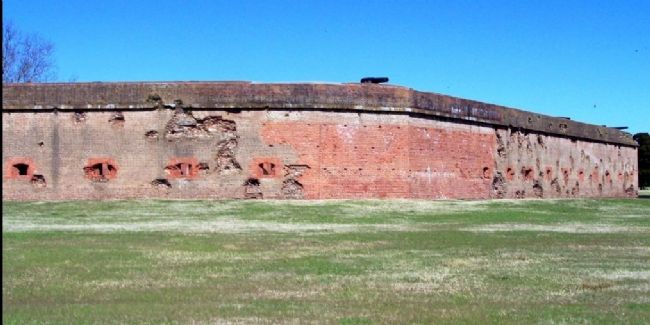
Fort Pulaski National Monument was established by Presidential Proclamation on October 15, 1924. It contains 5,365 acres, including some of the most pristine and scenic marshland on the Georgia coast.
Photographed by Mike Stroud, January 2008
4. Fort Pulaski Damage
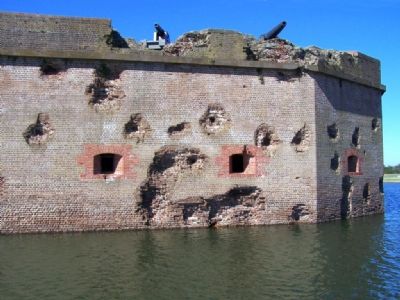
This Fort Pulaski position was fired upon for 30 hours from nearby Tybee Island, 1½ miles away
Photographed by Mike Stroud, January 2008
5. Fort Pulaski
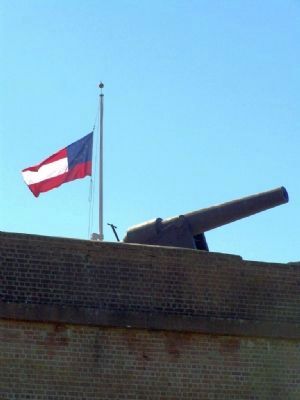
Fort Pulaski was never garrisoned until its seizure by Georgia troops in January, 1861, to prevent occupation by Federal forces. Prior to the war, a civilian caretaker had maintained the fortification.
Photographed by Mike Stroud, January 2008
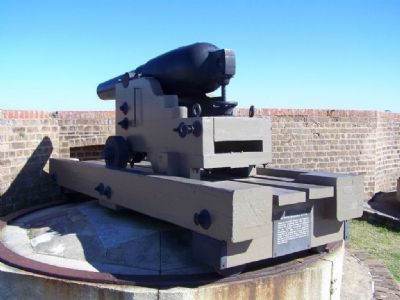
6. 4.5 inch Blakely Rifle
Fired a 24 pound projectile up to 3 miles
Photographed by Mike Stroud, January 2008
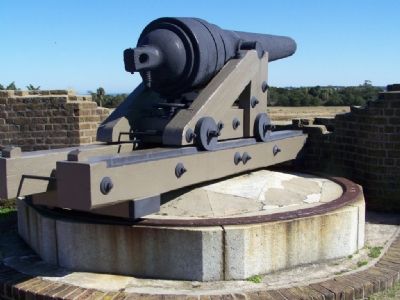
7. Brooke Rifle
This gun not truely used at fort, but was used in Defense of Savannah,Thunderbolt Battery (per NPS), could fire 64 pound projectiles 5 miles
Photographed by David Tibbs, November 22, 2008
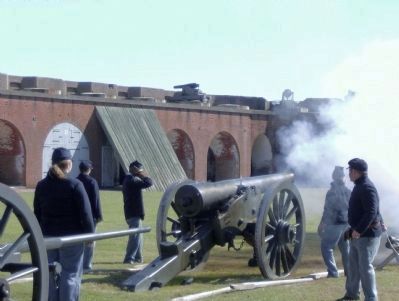
8. 30 pounder Parrott Demonstration
This is a demonstration of the type of cannons used against the fort. The demonstrations are only held on Saturdays. This is the largest and the only cannon of its type the National Park Service fires.

Photographed by Jeff Leichsenring, July 6, 2025
9. Fort Pulaski Marker
Credits. This page was last revised on June 16, 2026. It was originally submitted on January 28, 2008, by Mike Stroud of Bluffton, South Carolina. This page has been viewed 11,917 times since then and 1,161 times this year. Photos: 1, 2, 3, 4, 5, 6, 7. submitted on January 28, 2008, by Mike Stroud of Bluffton, South Carolina. 8. submitted on November 23, 2008, by David Tibbs of Resaca, Georgia. 9. submitted on August 2, 2025, by Jeff Leichsenring of Garland, Texas. • Craig Swain was the editor who published this page.
