Near Pursglove in Monongalia County, West Virginia — The American South (Appalachia)
Scotts Run
⎯⎯⎯
The First Shack
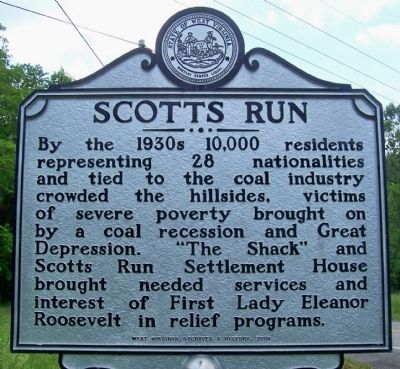
Photographed by Forest McDermott, June 1, 2010
1. Scotts Run Marker
The opposite side is The First Shack marker
Erected 2008 by West Virginia Archives & History.
Topics and series. This historical marker is listed in these topic lists: Charity & Public Work • Industry & Commerce • Settlements & Settlers • Women. In addition, it is included in the Eleanor Roosevelt, and the West Virginia Archives and History series lists. A significant historical year for this entry is 1932.
Location. 39° 40.013′ N, 80° 1.063′ W. Marker is near Pursglove,
this page online

Regionally, this marker is in North Central West Virginia. It is also in the American South, specifically in the Upper South, in Appalachia, and specifically in Northern Appalachia. Globally, it is in North America, the Western Hemisphere, the Western World, and the Anglosphere. Historically, it finds itself in what was once the territory of the Mississippian Culture.
Other nearby markers. At least 8 other markers are within walking distance of this marker: Scott’s Run Veterans Memorial (within shouting distance of this marker); Osage Spot (approx. ¾ mile away); Eleanor Roosevelt (approx. ¾ mile away); They Counted (approx. ¾ mile away); Music (approx. ¾ mile away); Christopher No. 3 Mine Tragedy (approx. ¾ mile away); Scott's Run Railway Co. (approx. ¾ mile away); Bunny Hop (approx. 0.8 miles away).
Also see . . . Scott's Run: An Introduction. 1994 publication by Ronald
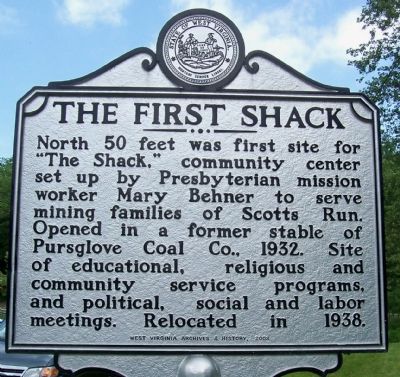
Photographed by Forest McDermott, June 1, 2010
2. The First Shack Marker
The opposite side is the Scotts Run marker
As in other West Virginia coalfields, the importation of workers produced a racially and ethnically diverse population. The 1920 manuscript census identified the following foreign-born nationalities among the adult (voting age) residents of Scotts Run: Austrian, Bohemian, Canadian, Croatian, English, Finnish, Greek, Hungarian, Italian, Irish, Lithuanian, Polish, Rumanian, Russian, Scottish, Serbian, Slovak, Ukrainian, and Welsh. Ninety-three percent of these immigrants were from southern or eastern Europe, and approximately 60 percent of Scotts Run's population was foreign born, with native whites and blacks divided about equally for the remaining 40 percent.(Submitted on March 1, 2025.)
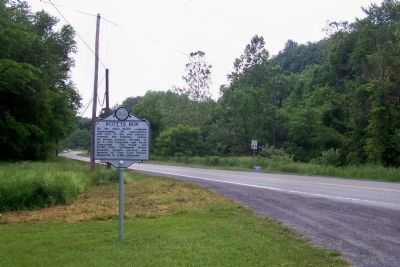
The coal boom beginning during World War I and continuing into the early 1920s was the first and last high mark for the industry on Scotts Run. By the late 1920s, coal entered the downward spiral which ultimately led to the depopulation of the hollow. During the economic collapse of the 1930s, Scotts Run became America's symbol of the Depression in the coalfields, setting the standard measurement for human suffering among miners. A writer for the Atlantic Monthlydeclared that Scotts Run was "the damndest cesspool of human misery I have ever seen in America." To what degree life was worse here than in other coal hollows is difficult to determine, but there was plenty of misery to go around. Scotts Run received so much attention because it was far more accessible to the outside photographers, reporters, social workers, and government officials who aimed the media spotlight into this particular corner of the coalfields.Photographed by Forest McDermott, June 1, 20103. Scotts Run/The First Shack MarkerPhoto taken looking east on WV Route 7
Additional keywords. Coal Industry, Great Depression, First Ladies of the United States of America, FLOTUS
Photographed by Forest McDermott, June 1, 2010
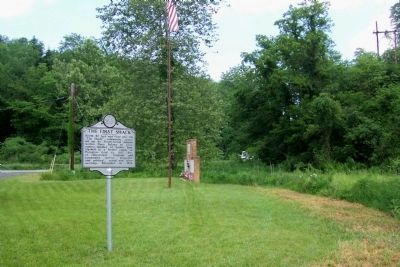
4. Scotts Run/The First Shack Marker
#8 Hollow Road is visible behind the marker.
Credits. This page was last revised on March 1, 2025. It was originally submitted on December 13, 2011, by Forest McDermott of Masontown, Pennsylvania. This page has been viewed 1,675 times since then and 108 times this year. Photos: 1, 2, 3, 4. submitted on December 13, 2011, by Forest McDermott of Masontown, Pennsylvania. • Bill Pfingsten was the editor who published this page.
