Woodmont in Arlington in Arlington County, Virginia — The American South (Mid-Atlantic)
Fort C.F. Smith
Defending the Capital
February 2, 2008
1. Fort C.F. Smith Civil War Trails Marker
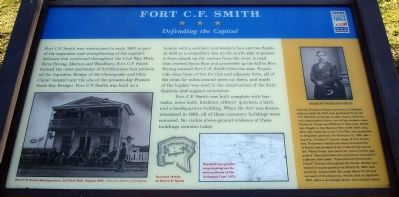
Fort C.F. Smith was constructed in early 1863 as part of the expansion and strengthening of the capital’s defenses that continued throughout the Civil War. With Forts Strong, Morton and Woodbury, Fort C.F. Smith formed the outer perimeter of the fortifications that protected the Aqueduct Bridge of the Chesapeake and Ohio Canal (located near the site of the present-day Francis Scott Key Bridge). Fort C.F. Smith was built as a lunette with a southern and western face and two flanks, as well as a cremaillere line on the north side to protect it from attack up the ravines from the river. A road that crossed Spout Run and proceeded up the hill to Fort Strong entered Fort C.F. Smith from the east. To provide clear lines of fire for this and adjacent forts, all of the trees for miles around were cut down, and much of the lumber was used in the construction of the fortifications and support structures.
Fort C.F. Smith was built complete with barracks, mess halls, kitchens, officers’ quarters, a barn and a headquarters building. When the fort was decommissioned in 1865, all of these accessory buildings were removed. No visible above-ground
this page online
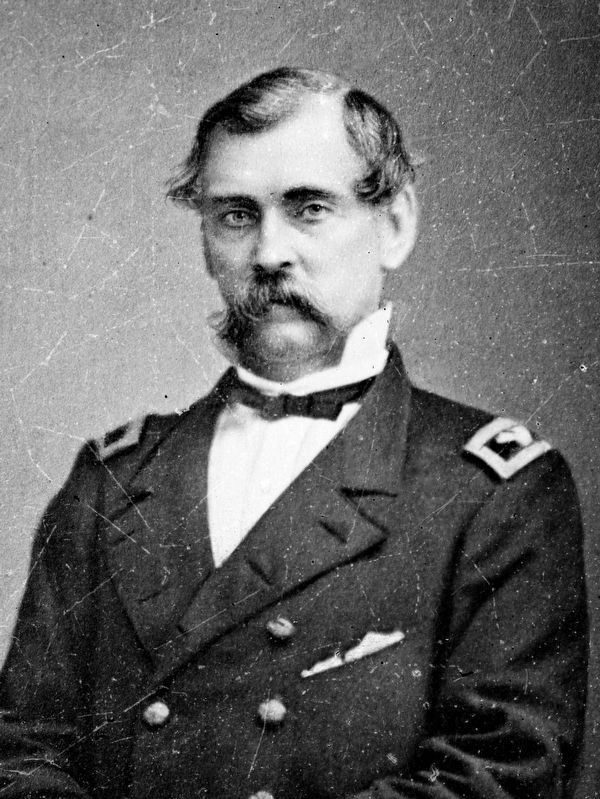
(Sidebar): Charles Ferguson Smith was born in Philadelphia on April 24, 1807, and graduated from the U.S. Military Academy in 1825. Later, while he was commandant there, two of his students were Ulysses S. Grant and William T. Sherman. Smith also fought in the Mexican War (1846-1848) and, after the outbreak of the Civil War, was promoted to brigadier general. On February 15, 1862, during Gen. Ulysses S. Grant’s siege of Fort Donelson, Tennessee, Smith’s division breached the defenses and prompted the Confederate surrender. When Grant was asked for terms, Smith suggested “unconditional and immediate surrender,” a phrase that made “Unconditional Surrender Grant” famous throughout the North. Smith, promoted to major general on March 21, 1862, temporarily commanded the army when Grant was accused of drunkenness. Smith died on April 25, 1862, after a seemingly minor non-combatant injury.
Erected by Virginia Civil War Trails.
Topics and series. This historical marker is listed in these topic lists: Forts and Castles • War, US Civil. In addition, it is included in the Chesapeake and Ohio (C&O) Canal,
February 2, 2008
2. Fort C.F. Smith Marker
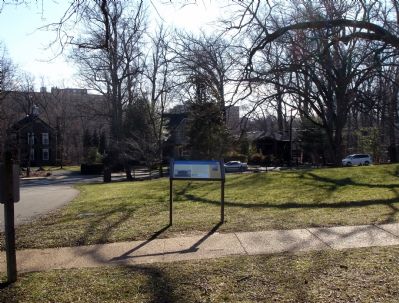
Location. This marker has been replaced by another marker nearby. It was located near 38° 54.08′ N, 77° 5.307′ W. Marker was in Arlington, Virginia, in Arlington County. It was in Woodmont. It could be reached from 24th Street North. Marker is in Fort C.F. Smith Park. Touch for map. Marker was at or near this postal address: 2411 24th Street North, Arlington VA 22207, United States of America. Touch for directions.

Regionally, this marker was in the Washington Metropolitan Area and in Northern Virginia. It was also in the American South, specifically in the Upper South, in the Mid-Atlantic, and on the Eastern Seaboard. Globally, it was in the North Atlantic Region, North America, the Western Hemisphere, the Western World, and the Anglosphere. Historically, it found itself in what was once the territory of the Mississippian Culture, one of the original Thirteen Colonies, one of the Confederate States of America, and the Antebellum South.
Other nearby markers. At
Library of Congress
3. Major General Charles F. Smith
Gen. Charles F. Smith, Died: April 25, 1862 of a foot infection he got in jumping from one boat to another in opening stages of Shiloh Campaign
Photo between 1860 and 1862
Photo between 1860 and 1862
Other markers no longer nearby. Fort C.F. Smith (was about 700 feet away, measured in a direct line but has been replaced with another marker now near it); a different marker also named Fort C.F. Smith (was about 800 feet away but has been replaced with another marker now near it).
More about this marker. On the lower left of marker is a photo captioned "Fort C.F. Smith Headquarters, 2nd New York, August, 1865 -Courtesy Library of Congress" and on the upper right is a photo of Charles Ferguson Smith. The marker also features a
Library of Congress
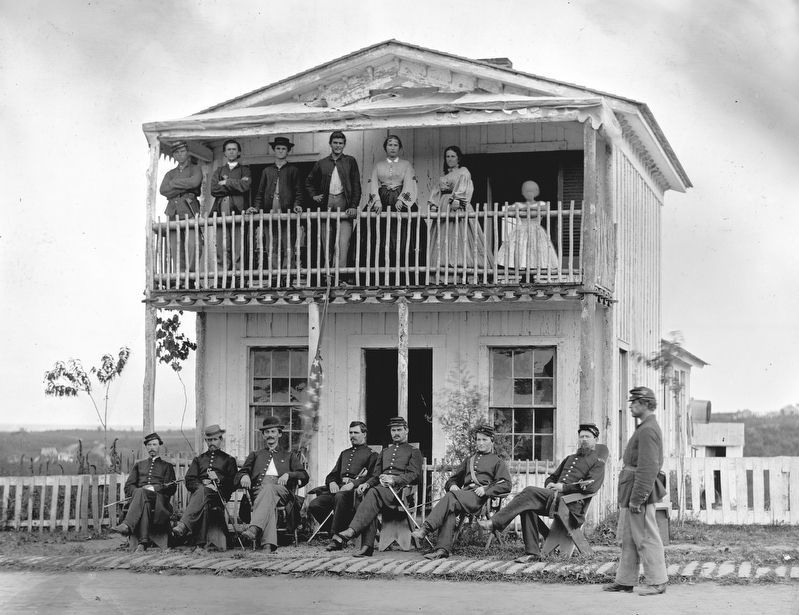
4. Fort C.F. Smith Headquarters 2nd New York, August 1865
Officers of Companies K & L, 2d New York Heavy Artillery at Fort C.F. Smith
Photo by William Morris Smith
Photo by William Morris Smith
Related marker. Click here for another marker that is related to this marker. This marker has replaced the linked marker which had slightly different content.
Also see . . . Fort C.F. Smith Park Walking Tour. Arlington VA PDF file (Submitted on February 2, 2008.)
February 2, 2008
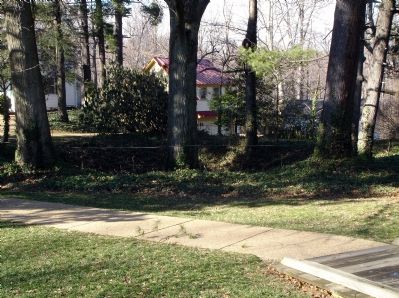
5. Fort Well
This shallow crater is the remains of a Civil War era well dug to provide water to the fort.
Credits. This page was last revised on August 17, 2024. It was originally submitted on February 2, 2008. This page has been viewed 3,113 times since then and 65 times this year. Photos: 1, 2. submitted on February 2, 2008. 3, 4. submitted on October 17, 2020, by Allen C. Browne of Silver Spring, Maryland. 5. submitted on February 2, 2008. • Craig Swain was the editor who published this page.
