East Dover Hundred in Kent County, Delaware — The American Northeast (Mid-Atlantic)
Bioretention
Photographed by Nate Davidson, December 29, 2011
1. Bioretention Marker
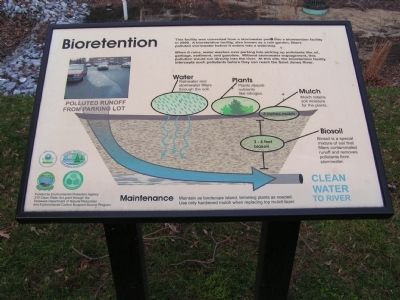
When it rains, water washes over parking lots picking up pollutants like oil, garbage, sediment, and gasoline. Without stormwater management, this pollution would run directly into the river. At this site, the bioretention facility intercepts such pollutants before they can reach the Saint Jones River.
Erected 2009 by Delaware Department of Natural Resources and Environmental Control.
Topics. This historical marker is listed in this topic list: Environment. A significant historical year for this entry is 2009.
Location. 39° 9.488′ N, 75° 31.133′ W. Marker is in Dover, Delaware, in Kent County. It is in East Dover Hundred. It can be reached from Duke of York Street. Touch for map. Marker is in this post office area: Dover DE 19901, United States of America. Touch for directions.

Regionally, this marker is in the American Mid-Atlantic, on the Delmarva Peninsula, and on the Eastern Seaboard. Globally, it is in the
this page online
Other nearby markers. At least 8 other markers are within walking distance of this marker: Dover Light Infantry (within shouting distance of this marker); Afghanistan-Iraq Memorial (within shouting distance of this marker); The Delaware Regiment (within shouting distance of this marker); The Bayonets of the Revolution (within shouting distance of this marker); Battles and Engagements of the Delaware Regiment (within shouting distance of this marker); The Delaware Continentals (within shouting distance of this marker); Delaware's Medal of Honor Recipients (about 300 feet away, measured in a direct line); a different marker also named Delaware's Medal of Honor Recipients (about 300 feet away). Touch for a list and map of all markers in Dover.
Photographed by Nate Davidson, December 29, 2011
2. Bioretention
Water: Rainwater and stormwater filters through the soil.
Plants: Plants absorb nutrients like nitrogen.
Mulch: Mulch retains soil moisture for the plants.
Biosoil: Biosoil is a special mixture of soil that filters contaminated runoff and removes pollutants from stormwater.
Plants: Plants absorb nutrients like nitrogen.
Mulch: Mulch retains soil moisture for the plants.
Biosoil: Biosoil is a special mixture of soil that filters contaminated runoff and removes pollutants from stormwater.
Credits. This page was last revised on May 15, 2026. It was originally submitted on December 29, 2011, by Nathan Davidson of Salisbury, Maryland. This page has been viewed 866 times since then and 25 times this year. Photos: 1, 2. submitted on December 29, 2011, by Nathan Davidson of Salisbury, Maryland. • Bill Pfingsten was the editor who published this page.
