Ansonborough in Charleston in Charleston County, South Carolina — The American South (South Atlantic)
Dr. Joseph Johnson House
56 Society Street
| — | circa 1840 | — |
Photographed by Mike Stroud, January 5, 2012
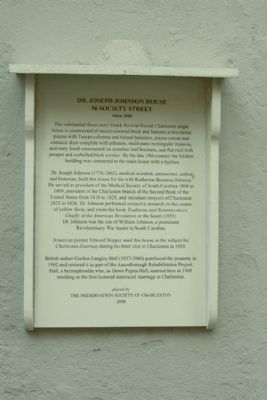
1. Dr. Joseph Johnson House 56 Society Street Marker
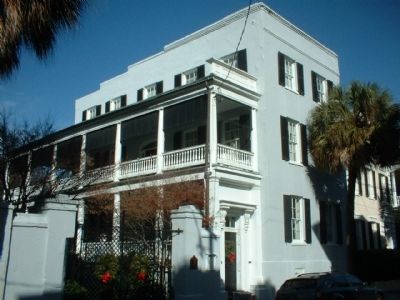
This substantial three-story Greek Revival Period Charleston single house is constructed of stucco-covered brick and features a two-tiered piazza with Tuscan columns and turned balusters, piazza screen and entrance door complete with pilasters, multi-pane rectangular transom, and entry hood surmounted on acanthus leaf brackets, and flat roof with parapet and corbelled brick cornice. By the late 19th century the kitchen building was connected to the main house with a hyphen.
Dr. Joseph Johnson (1776-1862), medical scientist, astronomer, author, and historian, built this house for his wife Katherine Bonneau Johnson. He served as president of the Medical Society of South Carolina 1808 to 1809, president of the Charleston branch of the Second Bank of the United States from 1818 to 1825, and intendant (mayor) of Charleston 1825 to 1826. Dr. Johnson performed extensive research on the causes of yellow fever, and wrote the book Traditions and Reminiscences, Chiefly of the American Revolution in the South (1851). Dr. Johnson was the son of William Johnson, a prominent Revolutionary War leader in South Carolina.
American painter Edward Hopper used this house as the subject for Charleston Doorway during his brief visit to Charleston in 1929.
British author Gordon Langley Hall (1937-2000) purchased the property in 1962 and restored it as part of the Ansonborough Rehabilitation Project. Hall, a hermaphrodite who, as Dawn Pepita Hall, married here in 1969 resulting in the first licensed interracial marriage in Charleston.
Erected 2008 by The Preservation Society of Charleston.
Topics and series. This historical marker is listed in these topic lists: Architecture • Arts, Letters, Music • Science & Medicine • Settlements & Settlers. In addition, it is included in the South Carolina, Preservation Society of Charleston
this page online
Location. 32° 47.062′ N, 79° 55.876′ W. Marker is in Charleston, South Carolina, in Charleston County. It is in Ansonborough. It is on Society Street, on the left when traveling east. Located between Meeting and Anson Streets. Touch for map. Marker is at or near this postal address: 56 Society Street, Charleston SC 29401, United States of America. Touch for directions.

Regionally, this marker is in Historic Charleston and in the Lowcountry. It is also in the American South, specifically in the Deep South, and on the Eastern Seaboard. Globally, it is in the North Atlantic Region, North America, the Western Hemisphere, the Western World, and the Anglosphere. Historically, it finds itself in what was once the territory of the Mississippian Culture, one of the original Thirteen Colonies, one of the Confederate States of America, and the Antebellum South.
Other nearby markers. At least 8 other markers are within walking distance of this marker: St. Stephen's Episcopal Church (within shouting distance of this marker); William C. McElheran House (within shouting distance
Photographed by Mike Stroud, January 5, 2012
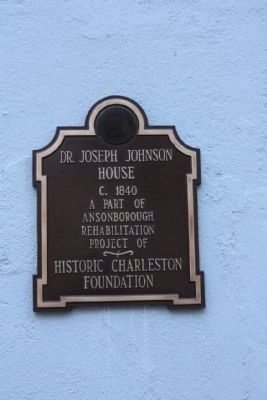
2. Dr. Joseph Johnson House Rehabilitation Project of Historic Charleston Foundation
Also see . . . Wikipedia article for Dawn Langley Simmons (noted here as Dawn Pepita Hall). (Submitted on January 31, 2026, by Devry Becker Jones of Washington, District of Columbia.)
Additional keywords. LGBT, LGBTQ, intersex persons
Photographed by Mike Stroud, December 29, 2011
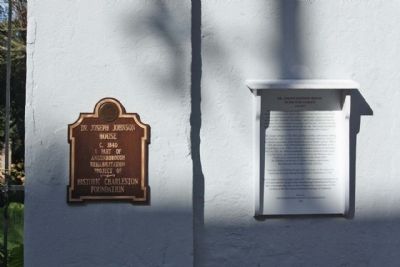
3. Dr. Joseph Johnson House 56 Society Street Markers
Photographed by Mike Stroud, December 29, 2011
4. 56 Society Street Marker, Dr. Joseph Johnson House
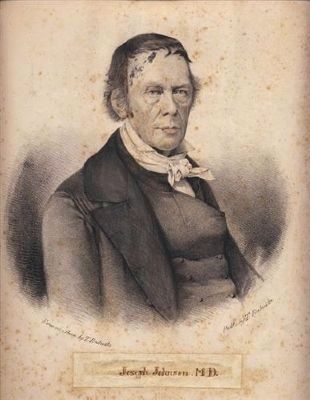
the Waring Historical Library, MUSC, Charleston, S.C.
5. Dr. Joseph Johnson
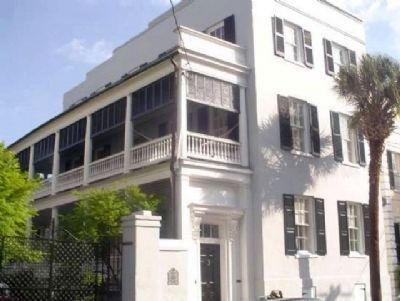
S.C. Dept. of Archives and History, April 6, 2007
6. Dr. Joseph Johnson House 56 Society Street
Credits. This page was last revised on January 31, 2026. It was originally submitted on January 10, 2012, by Mike Stroud of Bluffton, South Carolina. This page has been viewed 2,840 times since then and 118 times this year. Photos: 1, 2, 3, 4, 5, 6. submitted on January 13, 2012, by Mike Stroud of Bluffton, South Carolina.
