Danville in Vermilion County, Illinois — The American Midwest (Great Lakes)
Lincoln & Douglas in Danville
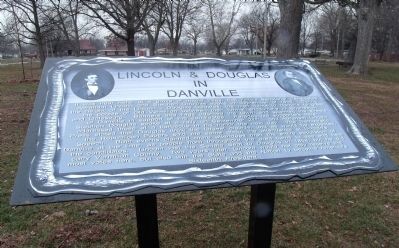
Photographed by Marilyn S. Wolf, January 11, 2012
1. Lincoln & Douglas in Danville Marker
Erected 2012
this page online
Topics and series. This historical marker is listed in this topic list: Notable Events. In addition, it is included in the Former U.S. Presidents: #16 Abraham Lincoln series list. A significant historical month for this entry is September 1858.
Location. 40° 7.073′ N, 87° 36.713′ W. Marker is in Danville, Illinois, in Vermilion County. It can be reached from the intersection of Wayne Street and South Bowman Avenue, on the right when traveling east. Marker is located in the northeast corner of Douglas Park. Touch for map. Marker is in this post office area: Danville IL 61832, United States of America. Touch for directions.

Regionally, this marker is in Central Illinois. It is also in the American Midwest and in the Corn Belt. Globally, it is in North America, the Western Hemisphere, the Western World, and the Anglosphere. Historically, it finds itself in what was once the territory of the Mississippian Culture and also the Northwest Territory.
Other nearby markers. At least 8 other markers are within 2 miles of this marker, measured as the crow flies: Abraham Lincoln (approx. 0.9 miles away);
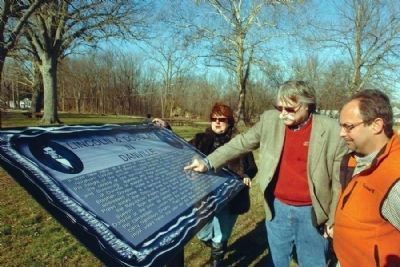
The Commercial-News, Danville, Il, January 8, 2012
2. Lincoln & Douglas in Danville Marker
From left to right: Rhea Ann Weatherford, Kevin Young and City of Danville Special Services Superintendent Steve Lane look at the plaque at Douglas Park commemorating the Lincoln-Douglas debates.
Also see . . . Plaque honors Lincoln, Douglas. (01/08/2012) The Commercial-News, Danville, IL (Submitted on January 12, 2012, by Al Wolf of Veedersburg, Indiana.)
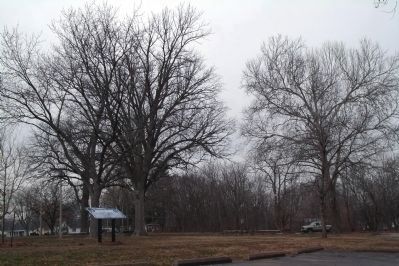
Photographed by Marilyn S. Wolf, January 11, 2012
3. Wide View - - Lincoln & Douglas in Danville Marker
Photographed by Allen C. Browne, August 9, 2015
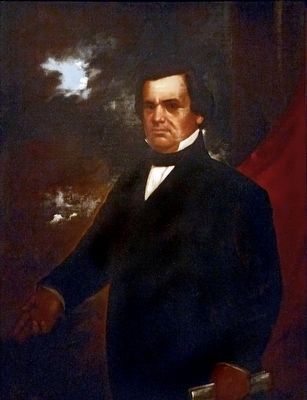
4. Stephen A. Douglas
This 1860 portrait of Stephen A. Douglas by Ducan Styles hangs in the National Portrait Gallery in Washington DC.
“The political prominence of Illinois senator Stephen A. Douglas rested largely on ‘popular sovereignty’ — a formula he had devised in the early 18505 to quell the controversy over slavery's westward extension by permitting the settlers of new territories to decide through balloting whether or not to allow slaveholding. In his quest for the presidency in 1860, he continued to urge this principle. By then, however, it satisfied neither North nor South. Although he was Lincoln's nearest rival in the four-way contest that year, his defeat in November was almost inevitable.
This portrait served as a visual backdrop at campaign rallies on Douglas's behalf. ” — National Portrait Gallery
“The political prominence of Illinois senator Stephen A. Douglas rested largely on ‘popular sovereignty’ — a formula he had devised in the early 18505 to quell the controversy over slavery's westward extension by permitting the settlers of new territories to decide through balloting whether or not to allow slaveholding. In his quest for the presidency in 1860, he continued to urge this principle. By then, however, it satisfied neither North nor South. Although he was Lincoln's nearest rival in the four-way contest that year, his defeat in November was almost inevitable.
This portrait served as a visual backdrop at campaign rallies on Douglas's behalf. ” — National Portrait Gallery
Photographed by Allen C. Browne, February 16, 2015
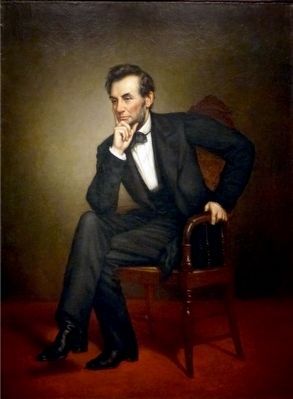
5. Abraham Lincoln
This 1887 portrait of Abraham Lincoln by George P. A. Healy hangs in the National Portrait Gallery in Washington DC.
“Today Abraham Lincoln is universally regarded as one of our greatest presidents. But from the start of his administration, Lincoln, guiding the nation in a time of civil war, was beset with criticism from all sides. Some charged him with moral cowardice for initially insisting that an end to slavery was not one of his wartime goals; others accused him of overstepping his constitutional powers; still others blamed him for military reverses in the field. But as Union forces moved toward victory, Lincoln's eloquent articulation of the nation's ideals and his eventual call for an end to slavery gradually invested him with grandeur. following his assassination in 1865, that grandeur beca.me virtually unassailable.
The original version of this portrait was a template for artist George P. A. Healy's large painting The Peacemakers, depicting Lincoln in consultation with three of his main military advisers at the end of the Civil War. But Healy recognized that this made a fine portrait in its own right and eventually made three replicas, including this one.” — National Portrait Gallery
“Today Abraham Lincoln is universally regarded as one of our greatest presidents. But from the start of his administration, Lincoln, guiding the nation in a time of civil war, was beset with criticism from all sides. Some charged him with moral cowardice for initially insisting that an end to slavery was not one of his wartime goals; others accused him of overstepping his constitutional powers; still others blamed him for military reverses in the field. But as Union forces moved toward victory, Lincoln's eloquent articulation of the nation's ideals and his eventual call for an end to slavery gradually invested him with grandeur. following his assassination in 1865, that grandeur beca.me virtually unassailable.
The original version of this portrait was a template for artist George P. A. Healy's large painting The Peacemakers, depicting Lincoln in consultation with three of his main military advisers at the end of the Civil War. But Healy recognized that this made a fine portrait in its own right and eventually made three replicas, including this one.” — National Portrait Gallery
Credits. This page was last revised on November 8, 2020. It was originally submitted on January 12, 2012, by Al Wolf of Veedersburg, Indiana. This page has been viewed 1,387 times since then and 82 times this year. Last updated on January 12, 2012, by Al Wolf of Veedersburg, Indiana. Photos: 1, 2, 3. submitted on January 12, 2012, by Al Wolf of Veedersburg, Indiana. 4, 5. submitted on October 29, 2015, by Allen C. Browne of Silver Spring, Maryland. • Bill Pfingsten was the editor who published this page.
