Fort Gibson in Muskogee County, Oklahoma — The American South (West South Central)
Manard
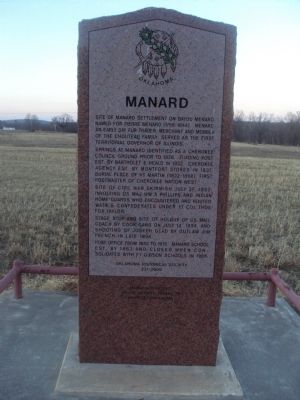
Photographed by Michael Manning, December 26, 2010
1. Manard Marker
Site of Manard Settlement on Bayou Menard. Named for Pierre Menard (1766-1844. Menard, an early day fur trader, merchant and member of the Chouteau family. Served as the first territorial governor of Illinois.
Springs at Manard identified as a Cherokee council ground prior to 1828. Trading post est. by Bartholet & Heald in 1832. Cherokee agency est. by Montfort Stokes in 1837. Burial place of HT Martin (1822-1868), first postmaster of Cherokee Nation West.
Site of Civil War skirmish on July 27, 1862, involving US Maj. WM A Phillips and Indian Home Guards who encountered and routed Watie's Confederates under Lt Col Thos Fox Taylor.
Stage stop and site of holdup of US Mail by Cook Gang on July 14, 1894, and shooting of Joseph Glad by outlaw Jim French in 1894.
Post office from 1883-1913. Manard school est. by 1863, and closed when consolidated with Ft Gibson Schools in 1966.
Erected 2000 by Oklahoma Historical Society. (Marker Number 237-2000.)
Topics and series. This historical marker is listed in these topic lists: Indigenous Peoples and Communities • Settlements & Settlers • War, US Civil.
this page online
Location. 35° 47.975′ N, 95° 6.27′ W. Marker is in Fort Gibson, Oklahoma, in Muskogee County. It is on U.S. 62 half a mile east of South Manard Road, on the right when traveling west. Marker is only accessible from the eastbound lanes of US 62, 1/2 mile east of South Manard Road, approximately 8 miles east of Fort Gibson. Touch for map. Marker is in this post office area: Fort Gibson OK 74434, United States of America. Touch for directions.

Regionally, this marker is in the Muscogee Nation, specifically in the Cherokee Nation, and in Northeast Oklahoma—Green Country. It is also in the American South, specifically on the prairies, and on the Southern Plains. Globally, it is in North America, the Western Hemisphere, the Western World, and the Anglosphere. Historically, it finds itself in what was once the territory of the Mississippian Culture and also the Louisiana Purchase.
Other nearby markers. At least 8 other markers are within 9 miles of this marker, measured as the crow flies: Ultimate Sacrifice (approx. 7 miles away); A National Cemetery System (approx. 7.1 miles away); Fort Gibson National Cemetery (approx. 7.1 miles away); Jack C. Montgomery (approx. 7.4 miles away); Cherokee Warrior Memorial (approx. 7.4 miles away); John Noah Reese, Jr. (approx. 7.4 miles away); Billy B. Walkabout (approx. 7.4 miles away); Revolutionary War Patriots (approx. 8.2 miles away). Touch for a list and map of all markers in Fort Gibson.
Credits. This page was last revised on February 14, 2026. It was originally submitted on February 13, 2012, by Michael Manning of Woodlawn, Tennessee. This page has been viewed 2,196 times since then and 181 times this year. Photo 1. submitted on February 13, 2012, by Michael Manning of Woodlawn, Tennessee. • Craig Swain was the editor who published this page.
Editor’s want-list for this marker. A photo of the marker and the surrounding area in context. • Can you help?
