Foxcroft Heights in Arlington in Arlington County, Virginia — The American South (Mid-Atlantic)
Freedman’s Village
A New Home for African Americans

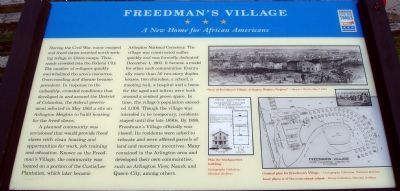
During the Civil War, many escaped and freed slaves traveled north seeking refuge in Union camps. Thousands crowded into the Federal City. The number of refugees quickly overwhelmed the area’s resources. Overcrowding and disease became prevalent. In response to the unhealthy, crowded conditions that developed in and around the District of Columbia, the federal government selected in May 1863 a site on Arlington Heights to build housing for the freed slaves.
A planned community was envisioned that would provide freed slaves with clean housing and opportunities for work, job training and education. Known as the Freedman’s Village, the community was located on a portion of the Custis/Lee Plantation, which later became Arlington National Cemetery. The village was constructed rather quickly and formally dedicated December 4, 1863. It became a model for other such communities. Eventually more than 50 two-story duplex houses, two churches, a school, a meeting hall, a hospital and a home for the aged and infirm were built around a central green space. In time, the village’s population exceeded 1,000. Though the village was intended
this page online
Erected by Virginia Civil War Trails.
Topics and series. This historical marker is listed in these topic lists: African Americans • Settlements & Settlers • War, US Civil. In addition, it is included in the Virginia Civil War Trails series list. A significant historical month for this entry is May 1863.
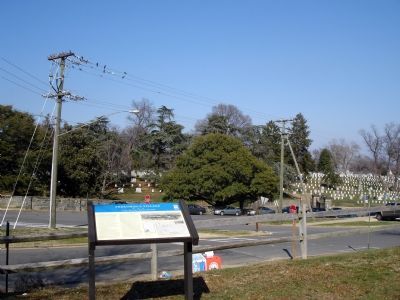
Location. 38° 52.125′ N, 77° 4.257′ W. Marker is in Arlington, Virginia, in Arlington County. It is in Foxcroft Heights. It is at the intersection of South Oak Street and Southgate Road, on the right when traveling north on South Oak Street. Marker is located in Foxcroft Heights Park. Touch for map. Marker is at or near this postal address: 801 S Oak St, Arlington VA 22204, United States of America. Touch for directions.

Regionally, this marker is in the Washington Metropolitan Area and in Northern
November 11, 2006
2. Freedman's Village Civil War Trails Marker
Other nearby markers. At least 8 other markers are within walking distance of this marker: A different marker also named Freedman's Village (here, next to this marker); Thornton Check (about 700 feet away, measured in a direct line); Daniel Check (about 700 feet away); Robert Edwin Peary (approx. 0.2 miles away); Matthew Alexander Henson (approx. 0.2 miles away); U.S. Coast Guard Memorial (approx. 0.2 miles away); You Are Remembered (approx. ¼ mile away); Our Air Force Memorial, Arlington Virginia (approx. ¼ mile away). Touch for a list and map of all markers in Arlington.
Another marker is no longer nearby. Site of Arlington Chapel (was approx. 0.2 miles away but has been
February 9, 2008
3. Freedman’s Village Marker
More about this marker. On the upper right of marker is a sketch captioned, "View of Freedman's Village, Arlington Heights, Virginia" - Harper's Weekly, May 7, 1864. On the lower right of marker are 2 diagrams captioned: Plan for headquarters building. Cartography Collection, National Archives and: General Plan for Freedman's Village. - Cartography Collection, National Archives. The marker also has a small photo captioned, Inset photo is of the contraband school - Brady Collection, National Archives.
Also see . . . Freedman’s Village: A community of former slaves. The Black Heritage Museum Arlington website entry (Submitted on December 21, 2024, by Larry Gertner of New York, New York.)
Credits. This page was last revised on July 9, 2026. It was originally submitted on February 10, 2008. This page has been viewed 4,459 times since then and 59 times this year. Photos: 1. submitted on July 9, 2026, by Devry Becker Jones of Washington, District of Columbia. 2, 3. submitted on February 10, 2008. • Craig Swain was the editor who published this page.
