Central Business District in New Orleans in Orleans Parish, Louisiana — The American South (West South Central)
Starting Point of the First Traditional New Orleans Mardi Gras Parade
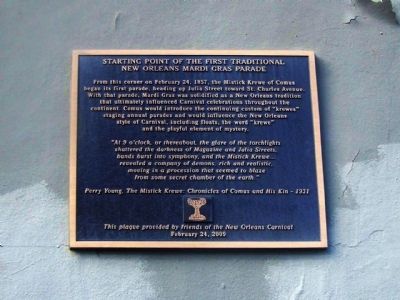
Photographed by Mike Stroud, April 1, 2012
1. Starting Point of the First Traditional New Orleans Mardi Gras Parade Marker
" At 9:00 o'clock, or thereabout, the glare of the torchlights shattered the darkness of Magazine and Julia Streets, bands burst into symphony, and the Mistick Krewe... revealed a company of demons, rich and realistic, moving in a procession that seemed to blaze from some secret chamber of the earth."
Perry Young, The Mistick Krewe: Chronicles of Comus and His Kin - 1931
Erected 2009 by Friends of the New Orleans Carnival.
Topics. This historical marker is listed in this topic list: Notable Events. A significant historical month for this entry is February 1926.
Location. 29° 56.728′ N, 90° 4.158′ W. Marker is in New Orleans, Louisiana, in Orleans
this page online

Regionally, this marker is in one of Louisiana’s River Parishes. It is also in the American South, specifically in the Deep South, on the Gulf Coast, and in the Great River Road Region. Globally, it is in North America, a Gulf of Mexico state, the Western Hemisphere, the Western World, and the Anglosphere. Historically, it finds itself in what was once New Spain, the Viceroyalty of New France, the territory of the Mississippian Culture, the Louisiana Purchase, one of the Confederate States of America, and the Antebellum South.
Other nearby markers. At least 8 other markers are within walking distance of this marker: The 747 (within shouting distance of this marker); St. Patrick's Church (about 500 feet away, measured in a direct line); St. Patrick's (about 500 feet away); Julia Row (about 500 feet away); Saint Patrick's Church (about
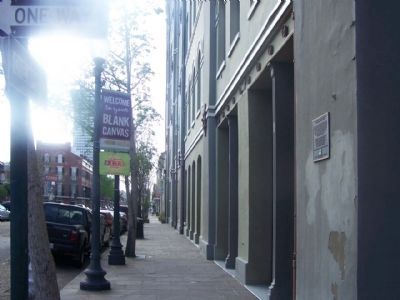
Photographed by Mike Stroud, April 1, 2012
2. Starting Point Marker along Julia Street
Also see . . .
1. Krewe, from Wikipedia. The word is thought to have been coined in the early 19th century by an organization calling themselves Ye Mistick Krewe of Comus, as an archaic affectation; with time it became the most common term for a New Orleans Carnival organization. (Submitted on April 29, 2012, by Mike Stroud of Bluffton, South Carolina.)
2. Mardi Gras. (Fat Tuesday in English) in New Orleans, Louisiana, United States, is a Carnival celebration well-known throughout the world. (Submitted on April 29, 2012, by Mike Stroud of Bluffton, South Carolina.)
3. Mistick Krewe of Comus, Storyvilledistrict. (Submitted on April 29, 2012, by Mike Stroud of Bluffton, South Carolina.)
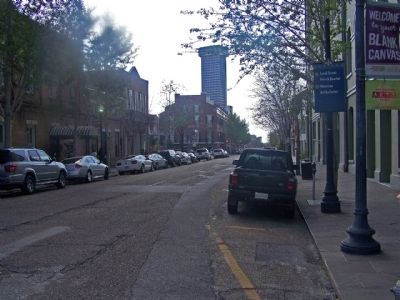
Photographed by Mike Stroud, April 1, 2012
3. Starting Point of the Parade looking up Julia Street
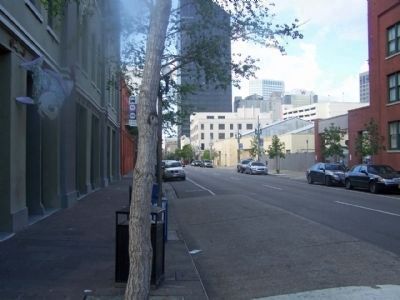
Photographed by Mike Stroud, April 1, 2012
4. Starting Point looking northward at Magazine Street from Julia Street
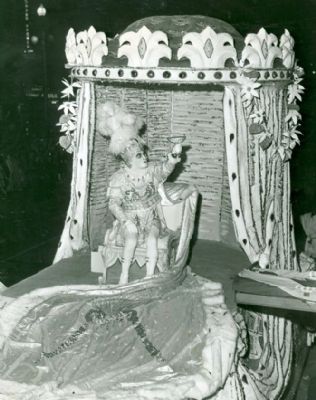
The Times-Picayune
5. New Orleans Mardi Gras Parade
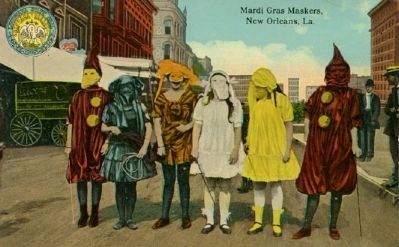
Photographed by Old Postcard, circa 1915
6. New Orleans Mardi Gras maskers,
"Note women carry whips to fend off any unwanted attentions"
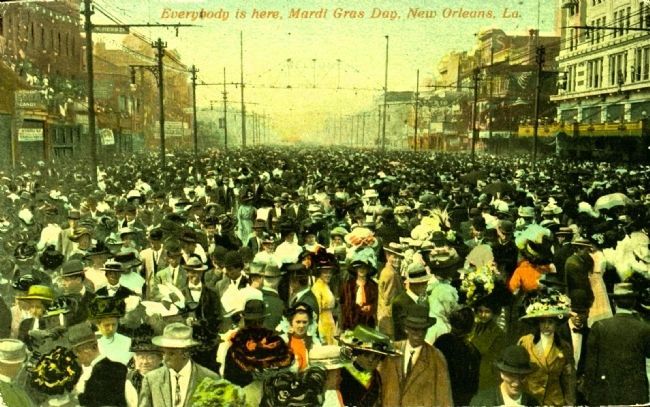
Postcard by J. Scordill, circa 1910
7. Everybody is Here, Mardi Gras Day, New Orleans, La.
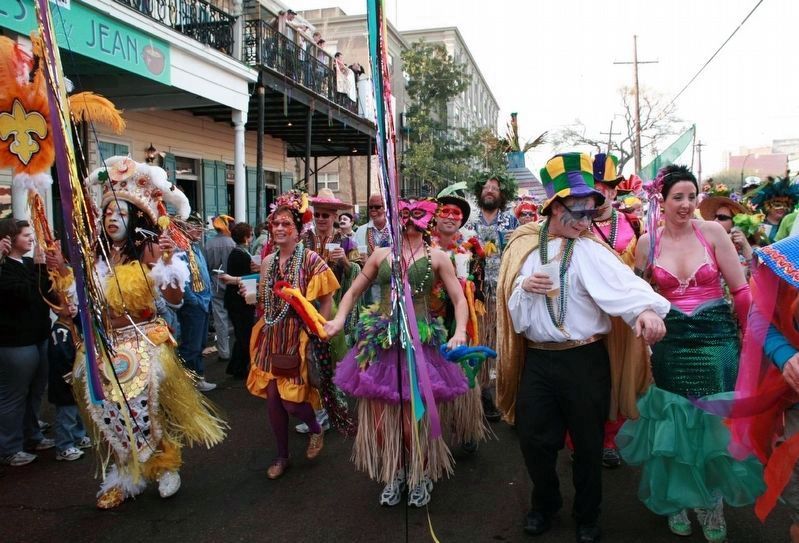
Flickr user radiate2357, via Wikipedia Commons, February 20, 2007
8. Mondo Kayo revelers parade on St. Charles Avenue in 2007
Credits. This page was last revised on February 12, 2023. It was originally submitted on April 29, 2012, by Mike Stroud of Bluffton, South Carolina. This page has been viewed 3,221 times since then and 127 times this year. It was the Marker of the Week February 24, 2019. Photos: 1, 2. submitted on April 30, 2012, by Mike Stroud of Bluffton, South Carolina. 3, 4, 5, 6. submitted on April 29, 2012, by Mike Stroud of Bluffton, South Carolina. 7. submitted on February 15, 2015. 8. submitted on February 23, 2019, by J. J. Prats of Powell, Ohio.
