Augusta in Richmond County, Georgia — The American South (South Atlantic)
The Colonial Church of Augusta

Photographed by Mike Stroud, March 27, 2012
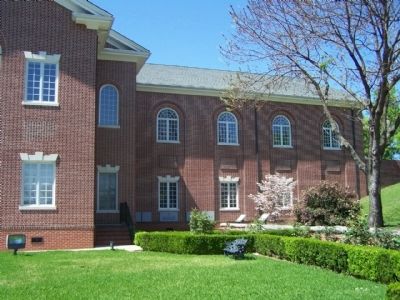
1. The Colonial Church of Augusta Marker
"But as Indian Friendship is sometimes precarious, we have built it opposite one of the Curtains of the Fort."
Augusta, April 12, 1750
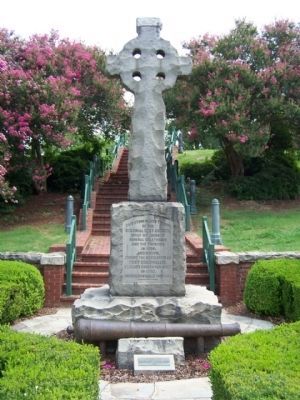
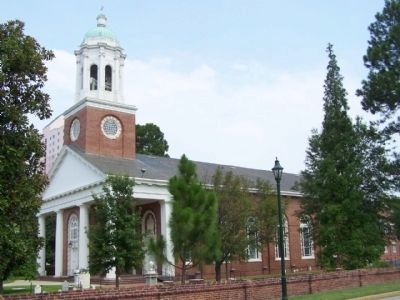
In June 1737, under orders from General James Oglethorpe, Captain Roger Lacy began a musketproof fort of wooden piles on the site where Saint Paul's stands today. Lay readers conducted religious services in Fort Augusta, and in 1749 the citizens of Augusta erected an adjoining church that would become Saint Paul's Church. Once the building was completed, a group of gentlemen applied to the Trustees of the colony for a minister. In 1751, the Reverend Jonathan Copp arrived in Augusta, the first of four missionaries sent by the Society for the Propagation of the Gospel in Foreign Parts during the pre-Revolutionary period.
(Church Plan, 1749 Included)
The original church plan depicted here in the Colonial Chapel paving reflects the rural Anglican church style of the period, with side entrances, a central freestanding pulpit, and a simple communion table. The rows of benches and the officer's pew accommodated the garrison of the fort.
Erected by Saint Paul's Church.
Topics. This
this page online
Location. 33° 28.591′ N, 81° 57.658′ W. Marker is in Augusta, Georgia, in Richmond County. It can be reached from Reynolds Street. Located in the northern yards of St. Paul's Church, reached from 6th Street. Touch for map. Marker is at or near this postal address: 605 Reynolds Street, Augusta GA 30901, United States of America. Touch for directions.

Regionally, this marker is in the American South and specifically in the Deep South. Globally, it is in North America, the Western Hemisphere, the Western World, and the Anglosphere. Historically, it finds itself in what was once the territory of the Mississippian Culture, one of the original Thirteen Colonies, one of the Confederate States of America, and the Antebellum South.
Other nearby markers. At least 8 other markers are within walking distance of this marker: Five Indian Nations (a few steps from this marker); Fort Augusta (a few steps from this marker); Washington's Southern Tour (within shouting distance of this marker);
Photographed by Mike Stroud, March 27, 2012
2. The Colonial Church of Augusta Marker
Another marker is no longer nearby. Railroads (was within shouting distance of this marker but has been confirmed missing).
Also see . . . The story of St. Paul's Church, Augusta, Georgia; A. D. 1750-1906. Digital Library of Georgia website entry (Submitted on December 14, 2024, by Larry Gertner of New York, New York.)
Photographed by Mike Stroud, July 26, 2008
3. Celtic Cross Marking The Location Of The Fort.
* See nearby markers
Photographed by Mike Stroud, 2011
4. St Paul's Church, seen today

The Colonial Church of Augusta Marker
5. The Colonial Church of Augusta Marker

The Colonial Church of Augusta Marker, `
6. The Colonial Church of Augusta Marker
Credits. This page was last revised on January 29, 2026. It was originally submitted on May 23, 2012, by Mike Stroud of Bluffton, South Carolina. This page has been viewed 1,215 times since then and 36 times this year. Photos: 1, 2, 3, 4, 5, 6. submitted on May 27, 2012, by Mike Stroud of Bluffton, South Carolina.
