Huntsville in Madison County, Alabama — The American South (East South Central)
Site of Green Academy
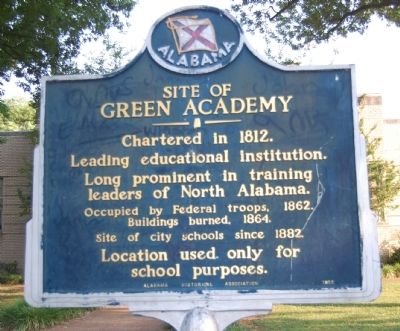
Photographed by Harry Gatzke, May 27, 2012
1. Site of Green Academy Marker
Erected 1955 by Alabama Historical Association.
Topics and series. This historical marker is listed in these topic lists: Education • War, US Civil. In addition, it is included in the Alabama Historical Association series list. A significant historical year for this entry is 1812.
Location. 34° 44.122′ N, 86° 34.742′ W. Marker is in Huntsville, Alabama, in Madison County. It is on Clinton Avenue East, on the right when traveling west. The marker is in front of East Clinton School, between Calhoun Street and White Street. Touch for map. Marker is in this post office area: Huntsville AL 35801, United States of America. Touch for directions.

Regionally, this marker is in North Alabama. It is also in the American South, specifically in the Deep South, in Appalachia, and specifically in Southern Appalachia. Globally, it is in North America, a Gulf
this page online
Other nearby markers. At least 8 other markers are within walking distance of this marker: Cabaniss Home / Dr. Francis Cabaniss Roberts (1916-2000) (about 400 feet away, measured in a direct line); Twickenham Historic District (about 500 feet away); Huntsville Female Seminary (about 600 feet away); Site of Huntsville Female College (approx. 0.2 miles away); Feeney-Barber-Stanfield House (approx. ¼ mile away); Maple Hill Cemetery (approx. ¼ mile away); Huntsville Meridian (approx. 0.3 miles away); Temple B’nai Sholom (approx. 0.3 miles away). Touch for a list and map of all markers in Huntsville.
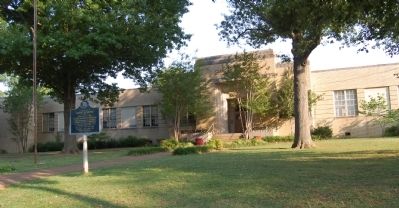
Photographed by Harry Gatzke, May 27, 2012
2. East Clinton Street School Located at Site of Green Academy
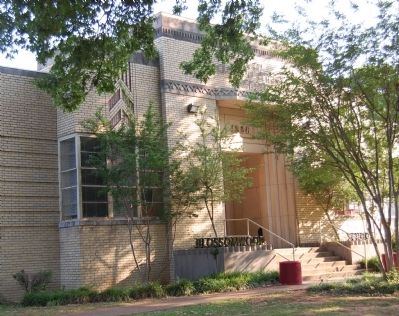
Photographed by Harry Gatzke, May 27, 2012
3. Entrance of East Clinton Street School, Constructed 1938
Credits. This page was last revised on June 16, 2016. It was originally submitted on May 27, 2012, by Harry Gatzke of Huntsville, Alabama. This page has been viewed 1,380 times since then and 42 times this year. Photos: 1, 2, 3. submitted on May 27, 2012, by Harry Gatzke of Huntsville, Alabama. • Craig Swain was the editor who published this page.
