Recovery in Decatur County, Georgia — The American South (South Atlantic)
Camp Recovery
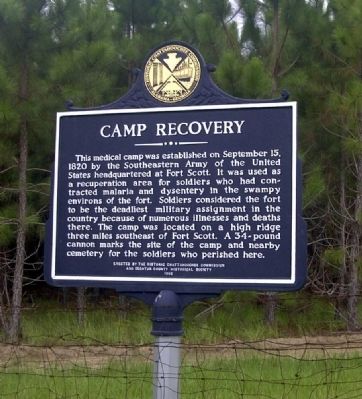
Photographed by David Seibert, February 28, 2005
1. Camp Recovery Marker
Erected 1995 by Historic Chattachooche Commission and the Decatur County Historical Society.
Topics. This historical marker is listed in these topic lists: Military • Wars, US Indian. A significant historical month for this entry is September 1777.
Location. 30° 45.237′ N, 84° 43.901′ W. Marker is in Recovery, Georgia, in Decatur County. It is on Booster Club Road 0.9 miles west of Hutchinson Ferry Road (Georgia Highway 97 Spur), on the left when traveling west. Hutchinson Ferry Road is also County Road 310 and GA Highway 97 Spur. Touch for map. Marker is in this post office
this page online

Regionally, this marker is on the Coastal Plain. It is also in the American South and specifically in the Deep South. Globally, it is in North America, the Western Hemisphere, the Western World, and the Anglosphere. Historically, it finds itself in what was once the territory of the Mississippian Culture, one of the original Thirteen Colonies, one of the Confederate States of America, and the Antebellum South.
Other nearby markers. At least 8 other markers are within 8 miles of this marker, measured as the crow flies: Camp Recovery Monument (about 500 feet away, measured in a direct line); Fort Scott (approx. 1.1 miles away); Joshua Davis House (approx. 4½ miles away in Florida); Ira Sanborn (approx. 5.4 miles away); Apalachicola Arsenal (approx. 6.8 miles away in Florida); a different marker also named Apalachicola Arsenal (approx. 7.2 miles away in Florida); United States Arsenal (1832-1861) (approx. 7.2 miles away in Florida); Charles James Munnerlyn / “Refuge” (approx. 7½ miles away).
Regarding Camp Recovery. The cannon was one of three
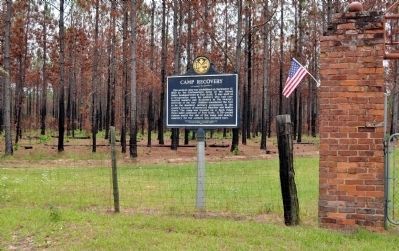
Photographed by David Seibert, May 16, 2012
2. Camp Recovery Marker
Also see . . . Camp Recovery Monument - Decatur County, Georgia. Explore Southern History website entry (Submitted on May 12, 2025, by Larry Gertner of New York, New York.)
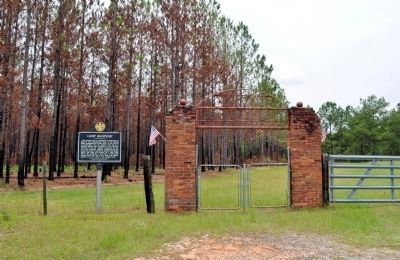
Photographed by David Seibert, May 16, 2012
3. Camp Recovery Marker
In 1971 the owners of the property constructed this gate to the site, with brick pillars and a steel arch spelling out "Camp Recovery."
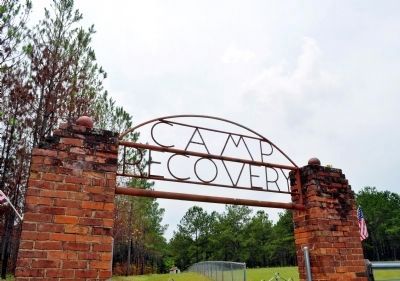
Photographed by David Seibert, May 16, 2012
4. Camp Recovery Gate
The arch over the gate to the Camp Recovery cemetery. The small visitors' center building, constructed in 1971, is visible in the distance.
Credits. This page was last revised on May 12, 2025. It was originally submitted on August 6, 2008, by David Seibert of Sandy Springs, Georgia. This page has been viewed 1,917 times since then and 56 times this year. Last updated on June 1, 2012, by David Seibert of Sandy Springs, Georgia. Photos: 1. submitted on August 6, 2008, by David Seibert of Sandy Springs, Georgia. 2, 3, 4. submitted on June 2, 2012, by David Seibert of Sandy Springs, Georgia. • Craig Swain was the editor who published this page.
