Hilton Head Island in Beaufort County, South Carolina — The American South (South Atlantic)
William Simmons House
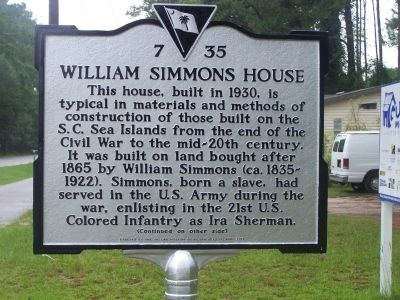
Photographed by Mike Stroud, June 26, 2012
1. William Simmons House Marker
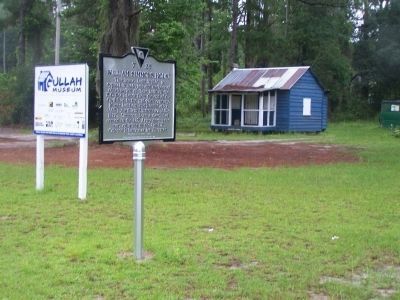
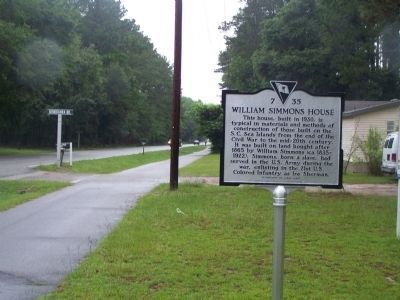
This house, built in 1930, is typical in materials and methods of construction of those built on the S.C. Sea Islands from the end of the Civil War to the mid-20th century. It was built on land bought after 1865 by William Simmons (ca. 1835-1922). Simmons, born a slave, had served in the U.S. Army during the war, enlisting in the 21st U.S. Colored Infantry as Ira Sherman.
William Simmons’s granddaughter Georgianna Jones Bryan (1900-1989) built this house in 1930 for her brother, William “Duey” Simmons (1901-1966). It illustrates everyday life and the persistence of Gullah culture in an African-American farm community until after a bridge was built from the mainland in 1956. It was renovated in 2010-11 as the Gullah Museum of Hilton Head Island.
Erected 2011 by South Carolina State Historic Preservation Office, sponsored by The Gullah Museum of Hilton Head Island. (Marker Number 7-35.)
Topics and series. This historical marker is listed in these topic lists: African Americans • Anthropology & Archaeology • Architecture. In addition, it is included in the South Carolina Historical Markers series
this page online
Location. 32° 13.607′ N, 80° 44.487′ W. Marker is on Hilton Head Island, South Carolina, in Beaufort County. It is on Gumtree Road, on the right when traveling north. Located between Fetterbush Drive and Georgianna Drive. Touch for map. Marker is at or near this postal address: 187 Gumtree Road, Hilton Head Island SC 29926, United States of America. Touch for directions.

Regionally, this marker is in the Lowcountry and on the Sea Islands. It is also in the American South, specifically in the Deep South, and on the Eastern Seaboard. Globally, it is in the North Atlantic Region, North America, the Western Hemisphere, the Western World, and the Anglosphere. Historically, it finds itself in what was once New Spain, the territory of the Mississippian Culture, one of the original Thirteen Colonies, one of the Confederate States of America, and the Antebellum South.
Other nearby markers. At least 8 other markers are within 3 miles of this marker, measured as the crow flies: Charlie Simmons, Sr. (approx. one mile away); First African Baptist Church (approx. 2 miles away);
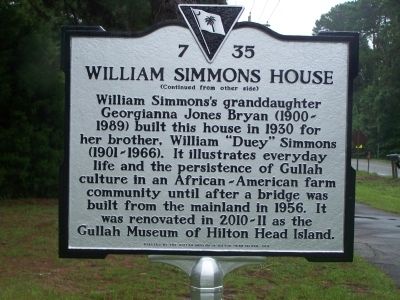
Photographed by Mike Stroud, June 26, 2012
2. William Simmons House Marker, reverse side
Additional commentary.
1. The Civil War Archive - United States Colored Troops Infantry
21st Regiment Infantry
Organized from 3rd and 4th Regiments, South Carolina Colored Infantry, March 14, 1864. Attached to 3rd Brigade, Vogdes' Division, District of Florida, Dept. of the South, to April, 1864. Morris Island, S.C., Northern District, Dept. of the South, to October, 1864. 1st Separate Brigade, Dept. of the South, to February, 1865. Garrison of Charleston, S.C., Dept. of the South, to August, 1865. Dept. of the South, to October, 1866.
SERVICE.--Duty at Jacksonville, Fla., until April, 1864. Moved to Hilton Head, S.C., thence to Folly Island, S. C., April 18. Duty on Folly Island, Morris Island and Coles Island operating
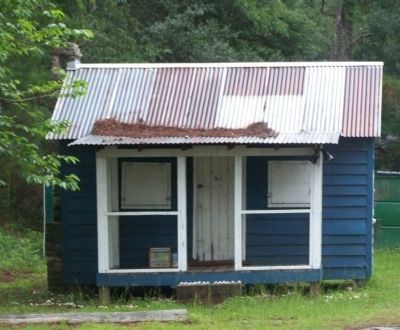
Photographed by Mike Stroud, June 26, 2012
3. William Simmons House
— Submitted June 29, 2012, by Mike Stroud of Bluffton, South Carolina.
2. Gullah
Historically, the Gullah region extended from the Cape Fear area on the coast of North Carolina south to the vicinity of Jacksonville on the coast of Florida; but today the Gullah area is confined to the South Carolina and Georgia Lowcountry.
The Gullah have preserved much of their African linguistic and cultural heritage. They speak an English-based creole language containing many African loanwords and significant influences from African languages in grammar and sentence structure. The Gullah language is related to Jamaican Creole, Barbadian Dialect, Bahamian Dialect, and the Krio language of Sierra Leone in West Africa. Gullah storytelling, cuisine, music, folk beliefs, crafts, farming and fishing
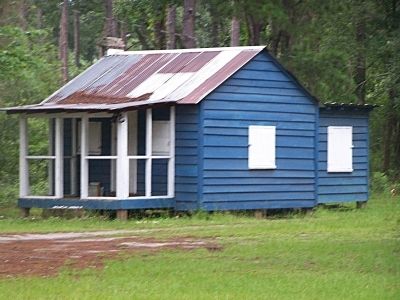
Photographed by Mike Stroud, June 26, 2012
4. William Simmons House
— Submitted June 29, 2012, by Mike Stroud of Bluffton, South Carolina.
Photographed by Mike Stroud, June 26, 2012
5. William Simmons House and Marker
Photographed by Mike Stroud, June 26, 2012
6. William Simmons House Marker, seen along Gumtree Road, looking north
Credits. This page was last revised on January 20, 2026. It was originally submitted on June 29, 2012, by Mike Stroud of Bluffton, South Carolina. This page has been viewed 2,818 times since then and 340 times this year. Photos: 1, 2, 3, 4, 5, 6. submitted on June 29, 2012, by Mike Stroud of Bluffton, South Carolina.
