Manns Harbor in Dare County, North Carolina — The American South (South Atlantic)
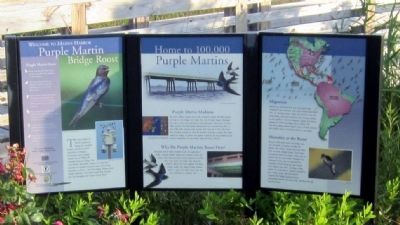
Purple Martin Bridge Roost
Photographed by Bernard Fisher, June 28, 2012
1. Purple Martin Bridge Roost Marker
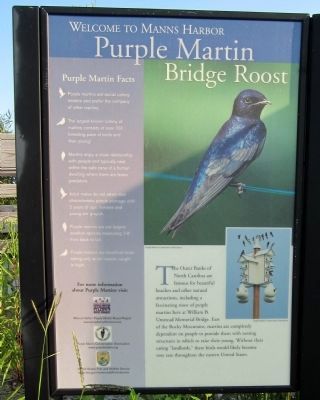
Welcome to Manns Harbor
Purple Martin Bridge Roost
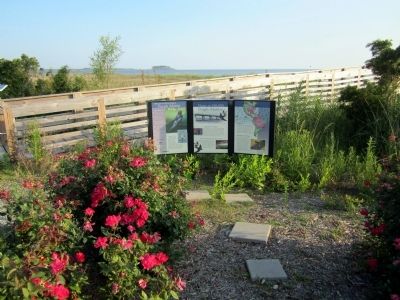
The Outer Banks of North Carolina are famous for beautiful beaches and other natural attractions, including a fascinating roost of purple martins here at William B. Umstead Memorial Bridge. East of the Rocky Mountains, martins are completely dependent on people to provide them with nesting structures in which to raise their young. Without their caring “landlords,” these birds would likely become very rare throughout the eastern United States.
(sidebar)
Purple Martin Facts
• Purple martins are social colony nesters and prefer the company of other martins.
• The largest known colony of martins consists of over 700 breeding pairs of birds and their young!
• Martins enjoy a close relationship with people and typically nest within the safe zone of a human dwelling where there are fewer predators.
• Adult males do not attain their characteristic purple plumage until 2 years of age; females and young are grayish.
• Purple martins are our largest swallow species measuring 7-8” from beak to tail.
• Purple martins are beneficial birds
this page online
(panel 2)
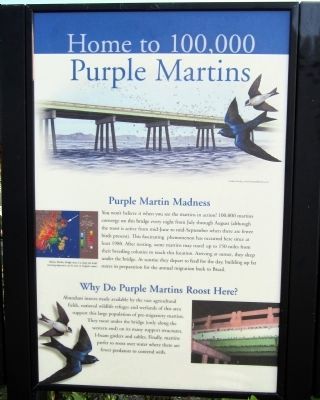
Home to 100,000 Purple Martins
Purple Martin Madness
You won’t believe it when you see the martins in action! 100,000 martins converge on this bridge every night from July through August (although the roost is active from mid-June to mid-September when there are fewer birds present). This fascinating phenomenon has occurred here since at least 1980. After nesting, some martins may travel up to 150 miles from their breeding colonies to reach this location. Arriving at sunset, they sleep under the bridge. At sunrise they depart to feed for the day, building up fat stores in preparation for the annual migration back to Brazil.
Why Do Purple Martins Roost Here?
Abundant insects made available by the vast agricultural fields, national wildlife refuges and wetlands of this area support this large population of pre-migratory martins. They roost under the bridge (only along the western end) on its many support structures, I-beam girders and cables. Finally, martins prefer to roost over water where there are fewer predators to contend with.
(panel 3)
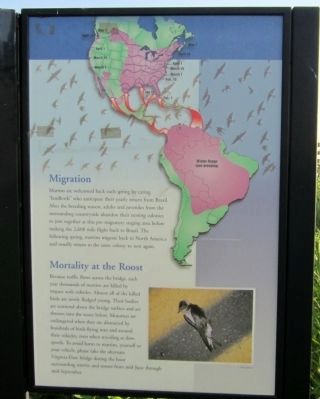
Migration
Martins
Photographed by Bernard Fisher, June 28, 2012
2. Panel 1
Mortality at the Roost
Because traffic flows across the bridge, each year thousands of martins are killed by impact with vehicles. Almost all of the killed birds are newly fledged young. Their bodies are scattered about the bridge surface and are thrown into the water below. Motorists are endangered when they are distracted by hundreds of birds flying into and around their vehicles, even when traveling at slow speeds. To avoid harm to martins, yourself or your vehicle, please take the alternate Virginia-Dare bridge during the hour surrounding sunrise and sunset from mid-June through mid-September.
Topics. This historical marker is listed in these topic lists: Animals • Bridges & Viaducts
Photographed by Bernard Fisher, June 28, 2012
3. Panel 2
Location. 35° 54.727′ N, 75° 46.122′ W. Marker is in Manns Harbor, North Carolina, in Dare County. It is on U.S. 64 half a mile east of Old Ferry Dock Road, on the left when traveling east. Touch for map. Marker is in this post office area: Manns Harbor NC 27953, United States of America. Touch for directions.

Regionally, this marker is in the Coastal Plain and on the Outer Banks. It is also in the American South, specifically in the Upper South, in the Tidewater, and on the Eastern Seaboard. Globally, it is in the North Atlantic Region, North America, the Western Hemisphere, the Western World, and the Anglosphere. Historically, it finds itself in what was once the territory of the Mississippian Culture, one of the original Thirteen Colonies, one of the Confederate States of America, and the Antebellum South.
Other nearby markers. At least 8 other markers are within 4 miles of this marker, measured as the crow flies: Fort Forrest (approx. 1.9 miles away); Fort Huger (approx. 2.7 miles away); Naval Battle of Roanoke Island (approx. 2.7 miles away); Fort Blanchard
Photographed by Bernard Fisher, June 28, 2012
4. Panel 3
Other markers no longer nearby. Deliverance (was approx. 2.7 miles away but has been permanently removed); Bondage (was approx. 2.7 miles away but has been permanently removed); The Promised Land (was approx. 2.7 miles away but has been permanently removed).
Also see . . . Purple Martin Conservation Association. Website homepage (Submitted on July 3, 2012, by Bernard Fisher of Richmond, Virginia.)
Photographed by Bernard Fisher, June 28, 2012
5. Purple Martins Marker
Photographed by Bernard Fisher, June 28, 2012
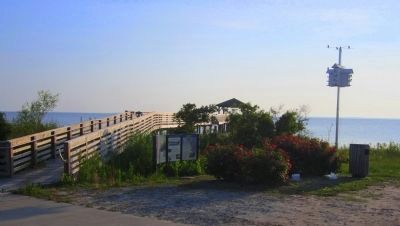
6. Observation Deck
Credits. This page was last revised on May 31, 2024. It was originally submitted on July 3, 2012, by Bernard Fisher of Richmond, Virginia. This page has been viewed 1,630 times since then and 121 times this year. Photos: 1, 2, 3, 4, 5, 6. submitted on July 3, 2012, by Bernard Fisher of Richmond, Virginia.
