West Village in Manhattan in New York County, New York — The American Northeast (Mid-Atlantic)
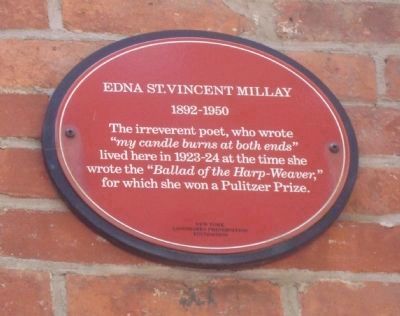
Edna St. Vincent Millay
1892 – 1950
Photographed by Barry Swackhamer, May 20, 2012
1. Edna St. Vincent Millay Marker
The irreverent poet, who wrote “my candle burns at both ends” lived here in 1923-24 at the time she wrote the “Ballad of the Harp-Weaver,” for which she won a Pulitzer Prize.
Erected by New York Landmarks Preservation Foundation.
Topics and series. This historical marker is listed in these topic lists: Arts, Letters, Music • Notable Buildings • Women. In addition, it is included in the New York, New York City Historic Landmarks Preservation Center Cultural Medallions series list.
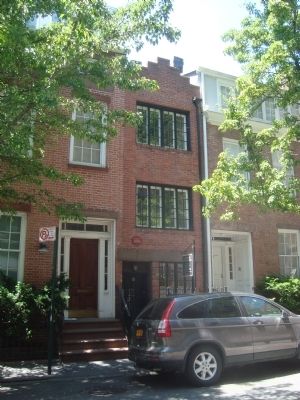
Location. 40° 43.883′ N, 74° 0.298′ W. Marker is in Manhattan, New York, in New York County. It is in West Village. It is at the intersection of Bedford Street and Commerce Street on Bedford Street. This marker is located in Greenwich Village. Touch for map. Marker is at or near this postal address: 75 1/2 Bedford Street, New York NY 10014, United States of America. Touch for directions.

Regionally, this marker is in New York City. It is also in the American Northeast, in the Mid-Atlantic, and on the Eastern Seaboard. Globally, it is in the North Atlantic Region, North America,
this page online
Other nearby markers. At least 8 other markers are within walking distance of this marker: 70 Bedford Street (a few steps from this marker); Commerce Street (a few steps from this marker); James Vandenburgh’s Home (a few steps from this marker); 36 Commerce Street (within shouting distance of this marker); 38 Commerce Street (within shouting distance of this marker); 24, 26 & 28 Commerce Street (within shouting distance of this marker); No. 48 Commerce Street (within shouting distance of this marker); Barrow Street (within shouting distance of this marker). Touch for a list and map of all markers in Manhattan.
Also see . . .
1. Edna St. Vincent Millay - Poem Hunter. Edna St. Vincent Millay was an American lyrical poet, playwright and feminist. She received the Pulitzer Prize for Poetry, and was known for her activism and her many love affairs. She used the pseudonym Nancy Boyd for her prose work. (Submitted on July 6, 2012, by Barry Swackhamer of Brentwood, California.)
2. The Skinniest House in New York -- No. 75-1/2 Bedford St.
Photographed by Barry Swackhamer, May 20, 2012
2. Edna St. Vincent Millay Marker
At just 10 feet wide, this is the narrowest house in Greenwich Village.
Additional keywords. narrow house
Photographed by Allen C. Browne, November 2, 2011
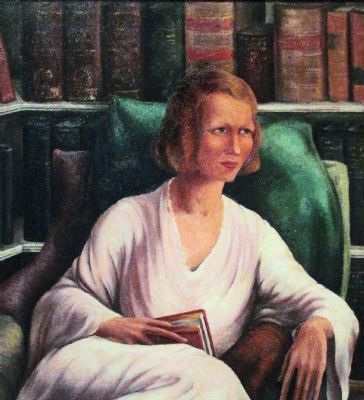
3. Edna St. Vincent Millay
This 1934 portrait of Edna St. Vincent Millay by Charles Ellis hangs in the National Portrait Gallery in Washington, DC.
“Literaily and temperamentally precocious, the poet Edna St. Vincent Millay exemplified the spirit of the ‘Roaring Twenties’ and the emancipation of American Women. She started writing as a child an became a rebellious student at Vassar College. In 1917 she move to Greenwich Village, the center of avant-garde and rebel culture. She won the Pulitzer Prize for The Harp-Weaver in 1923. Poetically, Millay was a romantic, inspired by the ecstatic visions of John Keats and William Wordsworth; he first notable poem ‘Renascence’ (1912) spoke of nature that ‘breathed my soul back into me.’ Her famous quatrain ‘First Fig’ (1920) celebrates abandonment:
My Candle burns at both ends;
It will not last the night;
But ah, my foes, and oh, my friends—
It gives a lovely light.
Millay's romanticism was at odds with literary modernism, and her reputation has declined. However, during the 1920s she exemplified the age that she did so much to define.” — National Portrait Gallery.
“Literaily and temperamentally precocious, the poet Edna St. Vincent Millay exemplified the spirit of the ‘Roaring Twenties’ and the emancipation of American Women. She started writing as a child an became a rebellious student at Vassar College. In 1917 she move to Greenwich Village, the center of avant-garde and rebel culture. She won the Pulitzer Prize for The Harp-Weaver in 1923. Poetically, Millay was a romantic, inspired by the ecstatic visions of John Keats and William Wordsworth; he first notable poem ‘Renascence’ (1912) spoke of nature that ‘breathed my soul back into me.’ Her famous quatrain ‘First Fig’ (1920) celebrates abandonment:
It will not last the night;
But ah, my foes, and oh, my friends—
It gives a lovely light.
Millay's romanticism was at odds with literary modernism, and her reputation has declined. However, during the 1920s she exemplified the age that she did so much to define.” — National Portrait Gallery.
Credits. This page was last revised on July 19, 2024. It was originally submitted on July 6, 2012, by Barry Swackhamer of Brentwood, California. This page has been viewed 990 times since then and 32 times this year. Photos: 1, 2. submitted on July 6, 2012, by Barry Swackhamer of Brentwood, California. 3. submitted on May 5, 2015, by Allen C. Browne of Silver Spring, Maryland. • Bill Pfingsten was the editor who published this page.
