New Paltz in Ulster County, New York — The American Northeast (Mid-Atlantic)
Bevier House
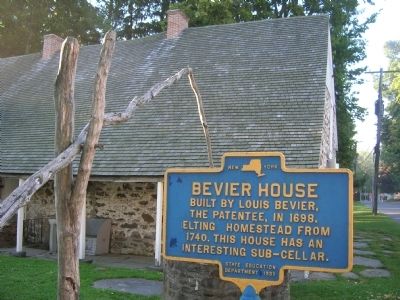
Photographed by Howard C. Ohlhous, September 17, 2007
1. The Bevier House in New Paltz, New York
Built by Louis Bevier, the patentee, in 1698. Elting homestead from 1740. This house has an interesting sub-cellar.
Erected 1935 by New York State Education Department.
Topics. This historical marker is listed in these topic lists: Colonial Era • Notable Buildings. A significant historical year for this entry is 1698.
Location. 41° 45.116′ N, 74° 5.294′ W. Marker is in New Paltz, New York, in Ulster County. It is at the intersection of Huguenot Street and Broadhead Street, on the right when traveling north on Huguenot Street. Touch for map. Marker is in this post office area: New Paltz NY 12561, United States of America. Touch for directions.

Regionally, this marker is in Upstate New York and in the Hudson Valley. It is also in the American Northeast, in the Mid-Atlantic, and on the Eastern Seaboard. Globally, it is in the North Atlantic Region, North America, the Western Hemisphere, the Western World, and the Anglosphere. Historically, it finds itself in what was once New Netherland and also one of the original Thirteen Colonies.
Other nearby markers. At least 8 other markers are within walking
this page online
Another marker is no longer nearby. The Reformed Church (was within shouting distance of this marker but has been replaced with another marker now near it).
More about this marker. The Huguenot Street Historic District is located along that street in New Paltz, New York. The seven stone houses and three accompanying structures in the district were built in the late 17th century by Huguenot settlers fleeing religious persecution in France and Belgium. They have been in use ever since, making this street the oldest continuously
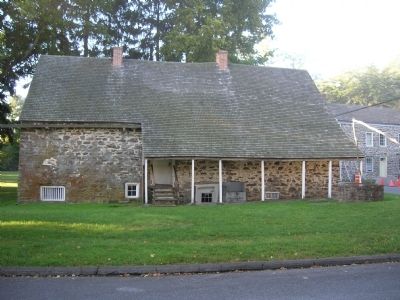
Photographed by Howard C. Ohlhous, September 17, 2006
2. Bevier House
Also see . . . Historic Huguenot Street. Website homepage (Submitted on February 24, 2008, by Howard C. Ohlhous of Duanesburg, New York.)
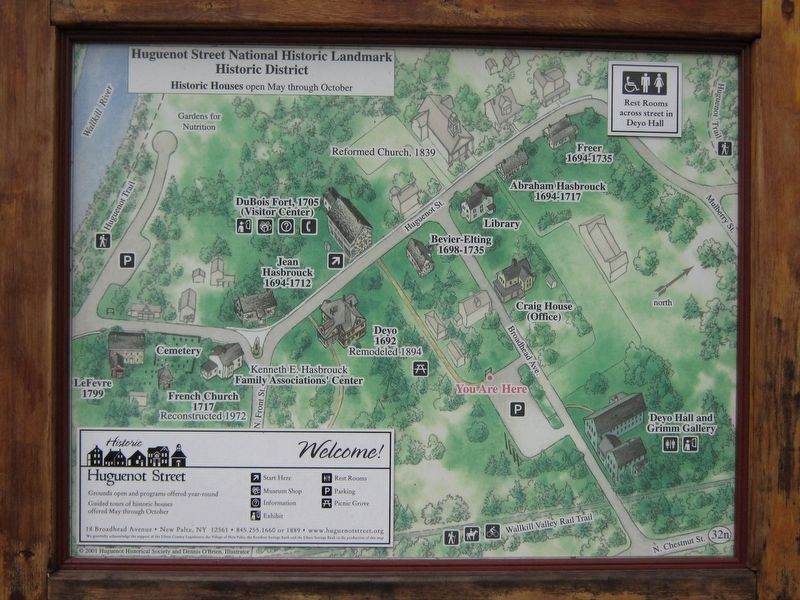
Photographed by Scott Sather, October 21, 2009
3. Huguenot Street National Historic Landmark Historic District Map
Credits. This page was last revised on June 22, 2026. It was originally submitted on February 24, 2008, by Howard C. Ohlhous of Duanesburg, New York. This page has been viewed 2,113 times since then and 79 times this year. Photos: 1, 2. submitted on February 24, 2008, by Howard C. Ohlhous of Duanesburg, New York. 3. submitted on July 26, 2016, by Scott Sather of Salem, Oregon. • Kevin W. was the editor who published this page.
Editor’s want-list for this marker. Pictures of the sub-cellar. • Can you help?
