Near Mohawk in Herkimer County, New York — The American Northeast (Mid-Atlantic)
Fort Herkimer
Photographed by Dale K. Benington, June 12, 2012
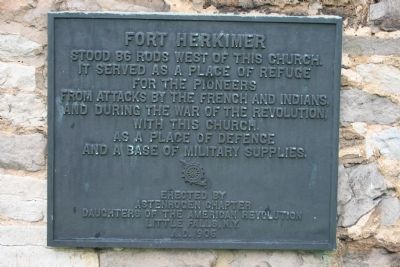
1. Fort Herkimer Marker
Stood 86 rods west of this church.
It served as a place of refuge
for the pioneers
from attacks by the French and Indians,
and during the War of the Revolution,
with this church,
as a place of defense
and a base of military supplies.
Erected 1906 by the Astenrogen Chapter, Daughters of the American Revolution, Little Falls, N.Y.
Topics and series. This historical marker is listed in these topic lists: Forts and Castles • Religion & Religious Structures • War, French and Indian • War, US Revolutionary. In addition, it is included in the Daughters of the American Revolution (DAR) series list.
Location. 43° 1.083′ N, 74° 57.246′ W. Marker is near Mohawk, New York, in Herkimer County. It is on New York State Route 5S west of Plantation Road (County Route 212A), on the left when traveling east. This historic marker is located on the grounds of the Fort Herkimer Church, being affixed to the south outside wall of the church, on the southwest corner. Touch for map. Marker is in this post office area: Mohawk NY 13407, United States of America.
this page online

Regionally, this marker is in Upstate New York and in the Mohawk Valley. It is also in the American Northeast and in the Mid-Atlantic. Globally, it is in North America, the Great North Woods, the Western Hemisphere, the Western World, and the Anglosphere. Historically, it finds itself in what was once the Haudenosaunee (Iroquois) Confederacy, New Netherland, and one of the original Thirteen Colonies.
Other nearby markers. At least 8 other markers are within 2 miles of this marker, measured as the crow flies: Site of Fort Herkimer (within shouting distance of this marker); Lieutenant Adam F. Helmer (within shouting distance of this marker); Here Was Born Nicholas Herkimer (within shouting distance of this marker); a different marker also named Fort Herkimer (approx. 0.3 miles away); General Nicolas Herrhheimer (approx. 1.9 miles away); Fred'ck Staring (approx. 1.9 miles away); Early Village Burying Ground (approx. 1.9 miles away); The Thirty-Fourth Regiment (approx. 1.9 miles away). Touch for a list and map of all markers in Mohawk.
Regarding Fort Herkimer. It was a special treat for me to find
Photographed by Dale K. Benington, June 12, 2012
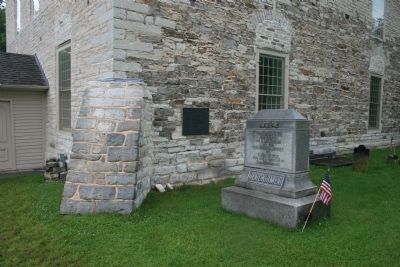
2. Fort Herkimer Marker
View of the historic maker affixed to the south wall of the church, near the southwest corner of the church.
In fact, it isn't all that hard to stare at the church building and envision the most dramatic seen of the movie, when the Native Americans had broken through the walls of the fort and the settlers were making their final desperate stand from inside of their fortress like church building.
Also see . . .
1. Fort Herkimer. This is a link to information provided by Wikipedia, the free encyclopedia. (Submitted on July 9, 2012, by Dale K. Benington of Toledo, Ohio.)
2. Old Fort Herkimer. This is a
Photographed by Dale K. Benington, June 12, 2012
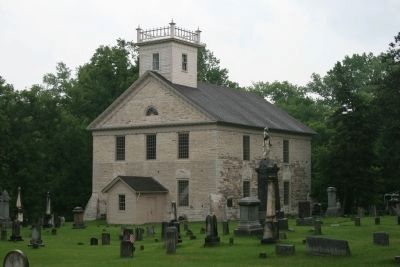
3. Fort Herkimer Marker
View of the historic marker affixed to the southeast corner of the church.
3. Fort Herkimer Church. Church website homepage (Submitted on July 30, 2023, by Larry Gertner of New York, New York.)
4. Attack on German Flatts (1778). This is a link to information provided by Wikipedia, the free encyclopedia. (Submitted on July 10, 2012, by Dale K. Benington of Toledo, Ohio.)
5. Drums Along the Mohawk (novel). This is a link to information provided by Wikipedia, the free encyclopedia. (Submitted on July 10, 2012, by Dale K. Benington of Toledo, Ohio.)
6. Drums Along the Mohawk. This is a link to information provided by Wikipedia, the free encyclopedia. (Submitted on July 10, 2012, by Dale K. Benington of Toledo, Ohio.)
Photographed by Dale K. Benington, June 12, 2012
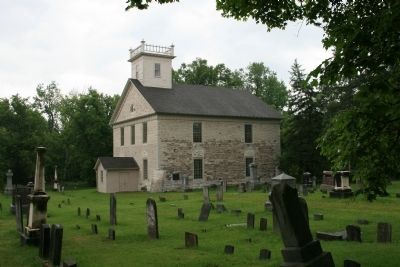
4. Fort Herkimer Marker
View of the historic marker and the south side of the church.
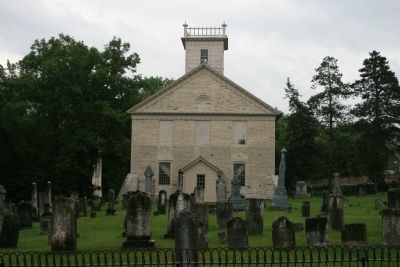
Photographed by Dale K. Benington, June 12, 2012
5. Fort Herkimer Church
View of the front (west) side of the historic Fort Herkimer Church.
Credits. This page was last revised on July 30, 2023. It was originally submitted on July 9, 2012, by Dale K. Benington of Toledo, Ohio. This page has been viewed 2,054 times since then and 156 times this year. Photos: 1, 2, 3, 4, 5. submitted on July 10, 2012, by Dale K. Benington of Toledo, Ohio.
