Kingston in Ulster County, New York — The American Northeast (Mid-Atlantic)
Academy Green Statues
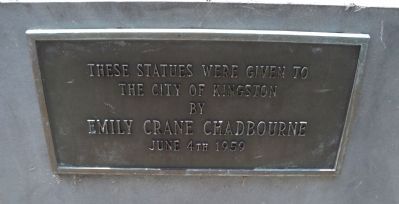
Photographed by Bill Coughlin, July 11, 2012
1. Academy Green Statues Marker
the City of Kingston
by
Emily Crane Chadbourne
June 4th, 1959
Erected 1959.
Topics. This historical marker is listed in these topic lists: Arts, Letters, Music • Colonial Era. A significant historical month for this entry is June 1895.
Location. 41° 55.937′ N, 74° 0.877′ W. Marker is in Kingston, New York, in Ulster County. It is on Clinton Avenue, on the left when traveling south. Marker is located in Academy Green Park on Clinton Ave. between Albany Ave. and Maiden Ln. Touch for map. Marker is at or near this postal address: 238 Clinton Ave, Kingston NY 12401, United States of America. Touch for directions.

Regionally, this marker is in Upstate New York and in the Hudson Valley. It is also in the American Northeast, in the Mid-Atlantic, and on the Eastern Seaboard. Globally, it is in the North Atlantic Region, North America, the Western Hemisphere, the Western World, and the Anglosphere. Historically, it finds itself in what was once New Netherland and also one of the original Thirteen Colonies.
Other nearby markers. At least 8 other markers are within walking distance of this marker:
this page online
Also see . . . An appreciation of Academy Green’s statues. Hudson Valley One website entry:
Three early statesmen are memorialized in the original capital of New York. (Submitted on February 10, 2020.)
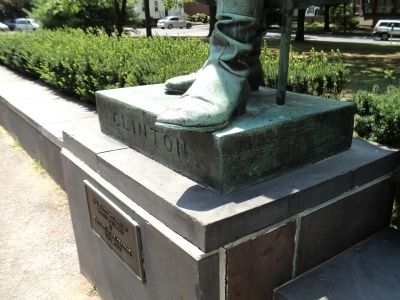
Photographed by Bill Coughlin, July 11, 2012
2. Academy Green Statues Marker
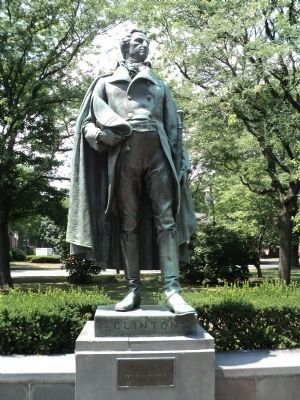
Photographed by Bill Coughlin, July 11, 2012
3. George Clinton Statue
Kingston resident George Clinton served as a Brigadier General during the Revolutionary War, was the first Governor of New York State and was elected Vice President of the United States under Jefferson and Madison.
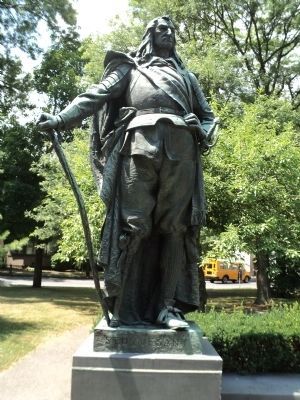
Photographed by Bill Coughlin, July 11, 2012
4. Peter Stuyvesant Statue
Peter Stuyvesant, the last Dutch governor of New Amsterdam, directed the settlers of Kingston to move to a central location in 1658 and build a stockade around the settlement. He then convinced the local Esopus Indians to sell him the land.
Photographed by Bill Coughlin, July 11, 2012
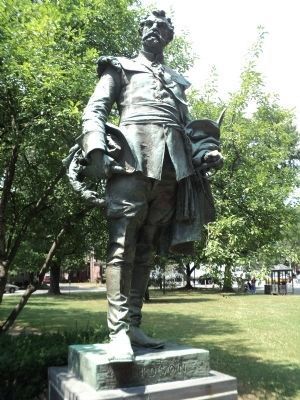
5. Henry Hudson Statue
In 1609, Henry Hudson became the first European to sail up the river that today bears his name. His exploration led to the settlement at Kingston.
Photographed by Bill Coughlin, July 11, 2012
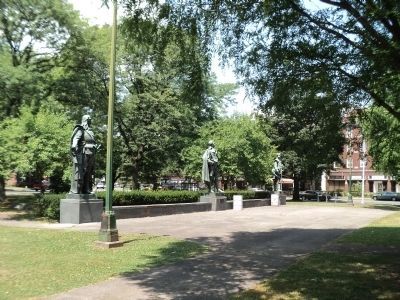
6. Statues in Academy Green Park
The statues in Academy Green Park depict three men who were notable in the history of Kingston.
Photographed by Bill Coughlin, July 11, 2012
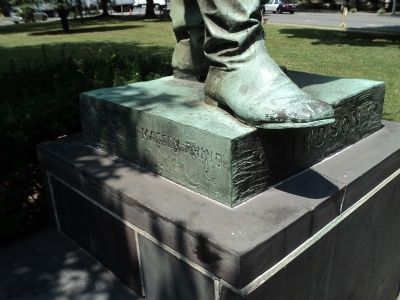
7. Artist's Mark
The Artist's mark is seen here on the Henry Hudson statue.
Photographed by Bill Coughlin, July 11, 2012
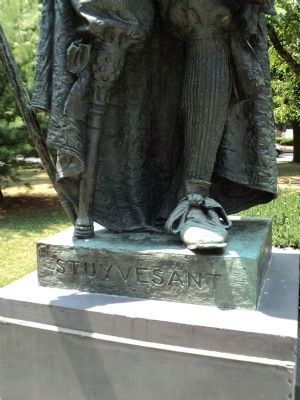
8. Detail of Peter Stuyvesant Statue
The statue depicts Peter Stuyvesant with his peg leg. He lost his leg in the service of the Dutch West India Company in the West Indies. According to legend, Stuyvesant would stamp his wooden leg and roar at the assembly of New Amsterdam when they would disagree with him.
Credits. This page was last revised on June 22, 2026. It was originally submitted on July 23, 2012, by Bill Coughlin of Woodland Park, New Jersey. This page has been viewed 1,500 times since then and 47 times this year. Photos: 1, 2, 3, 4, 5, 6, 7, 8. submitted on July 23, 2012, by Bill Coughlin of Woodland Park, New Jersey.
