Beaufort in Beaufort County, South Carolina — The American South (South Atlantic)
Maxcy-Rhett House
⎯⎯⎯
"Secession House"
Photographed by Mike Stroud, February 2008
1. Maxcy Rhett House side of the marker
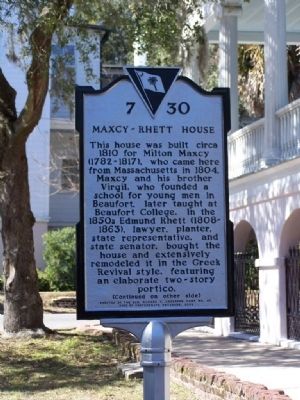
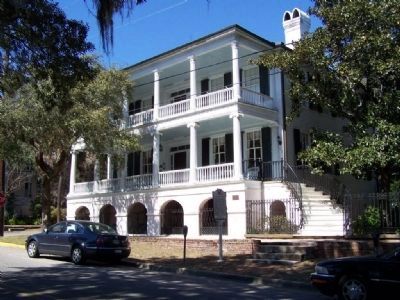
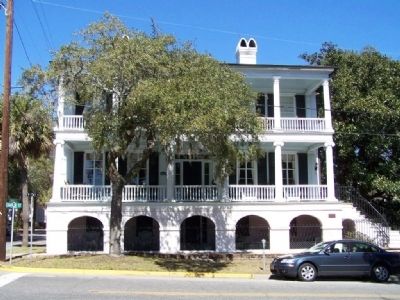
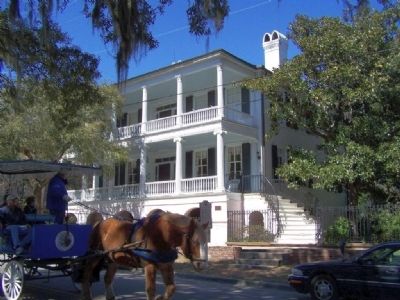
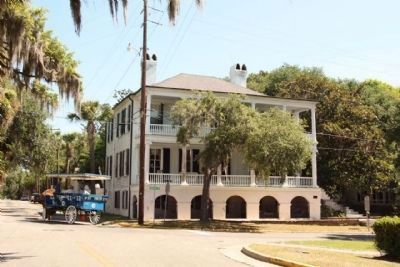
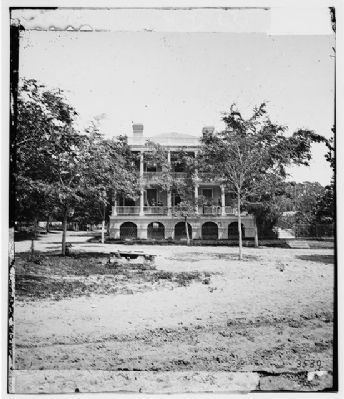
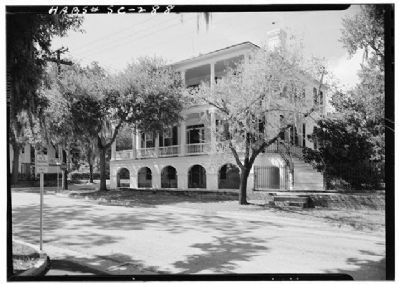
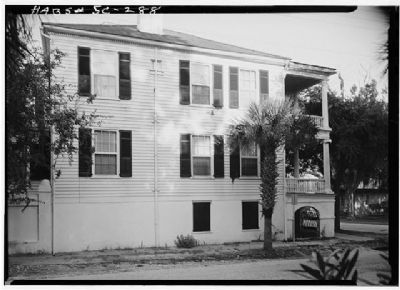
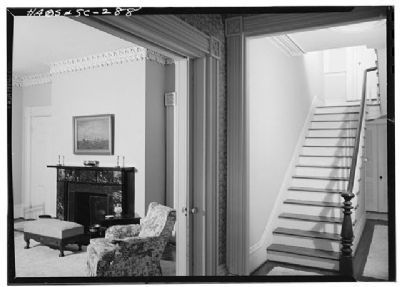
Maxcy - Rhett House. This house was built circa 1810 for Milton Maxcy (1782-1817), who came here from Massachusetts in 1804. Maxcy and his brother Virgil, who founded a school for young men in Beaufort, later taught at Beaufort College. In the 1850's Edmund Rhett (1808-1863), lawyer, planter, state representative, and state senator, bought the house and extensively remodeled it in the Greek Revival style, featuring an elaborate two-story portico.
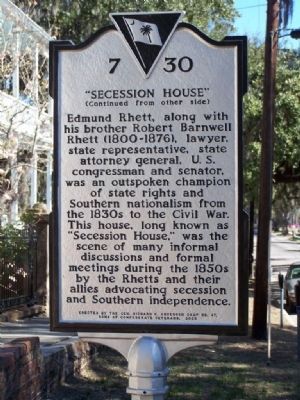
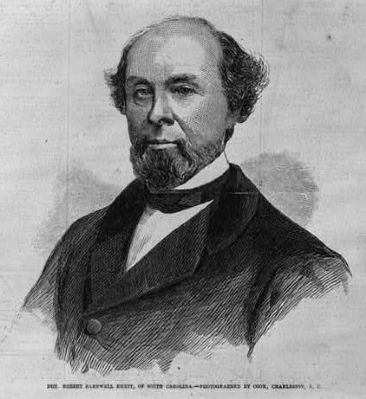
"Secession House". Edmund Rhett, along with his brother Robert Barnwell Rhett (1800-1876), lawyer, state representative, state attorney general, U.S. congressman and senator, was an outspoken champion of state rights and Southern nationalism from the 1830's to the Civil War. This house, long known as "Secession House," was the scene of many informal discussions and formal meetings during the 1850's by the Rhetts and their allies advocating secession and Southern independence.
Erected 2005 by The Gen. Richard H. Anderson Camp No. 47 Sons of Confederate Veterans. (Marker Number 7-30.)
Topics and series. This historical marker is listed in these topic lists: Architecture
this page online
Location. 32° 25.963′ N, 80° 40.496′ W. Marker is in Beaufort, South Carolina, in Beaufort County. It is at the intersection of Craven Street and Church Street, on the right when traveling west on Craven Street. Touch for map. Marker is at or near this postal address: 1113 Craven Street, Beaufort SC 29902, United States of America. Touch for directions.

Regionally, this marker is in the Lowcountry and on the Sea Islands. It is also in the American South, specifically in the Deep South, and on the Eastern Seaboard. Globally, it is in the North Atlantic Region, North America, the Western Hemisphere, the Western World, and the Anglosphere. Historically, it finds itself in what was once New Spain, the territory of the Mississippian Culture, one of the original Thirteen Colonies, one of the Confederate States of America, and the Antebellum South.
Other nearby markers. At least 8 other markers are within walking
Photographed by Mike Stroud, February 2008
2. "Secession House" side of the marker
Regarding Maxcy-Rhett House / "Secession House". The house is part of the Beaufort Historic District.
Also see . . .
1. Beaufort Historic District. Beaufort is significant for its role as a major center of South Carolina’s antebellum plantation culture, its contribution to the history of the Civil War, and for its role it played in African-American history both during and after the war. (Submitted on July 25, 2011, by Brian Scott of Anderson, South Carolina.)
2. Robert Rhett. Robert Barnwell Rhett, Sr. (December 21, 1800 – September 14, 1876), was a United States secessionist politician
Photographed by Mike Stroud, February 2008
3. Maxcy Rhett House
Additional commentary.
1. Robert Barnwell Rhett, (1800-1876)
Robert Barnwell Rhett, a Representative and a Senator from South Carolina; born Robert Barnwell Smith in Beaufort, S.C., December 21, 1800; completed preparatory studies; studied law; admitted to the bar and commenced practice in Beaufort in 1824; elected to the State house of representatives for St. Bartholomew’s Parish in 1826, 1828, 1830, and 1832; elected attorney general of South Carolina in 1832; elected as a Democrat to the Twenty-fifth and to the five succeeding Congresses (March 4, 1837-March 3, 1849); changed his name to Robert Barnwell Rhett in 1838; member of the Nashville convention in 1850; elected as a Democrat to the United States Senate to fill the vacancy caused by the death of John C. Calhoun and served from December 18, 1850, until his resignation effective May 7, 1852; delegate to the South Carolina secession convention in 1860; delegate to the Confederate Provisional Congress in 1861; chairman of the committee which reported the constitution of the
Photographed by Mike Stroud, 2008
4. Maxcy Rhett House Marker
— Submitted July 25, 2011, by Brian Scott of Anderson, South Carolina.
Photographed by Mike Stroud, February 2008
5. Maxcy Rhett House is on the Carriage tour
Photographed by Mike Stroud, June 10, 2011
6. Maxcy - Rhett House / "Secession House" ,as mentioned Part of National Register of Historic Places:
Beaufort Historic District *** (added 1969 - - #69000159)
Library of Congress
7. Maxcy - Rhett House / "Secession House" Marker
CONTROL #: cwp2003005361/PP , CREATED/PUBLISHED: between 1861 and 1869
Historic American Buildings Survey, circa 1963
8. Maxcy - Rhett House
Historic American Engineering Record, HABS SC,7-BEAUF,10-1
Historic American Buildings Survey, circa 1963
9. Maxcy - Rhett House
Historic American Engineering Record, HABS SC,7-BEAUF,10-2
Historic American Buildings Survey, circa 1963
10. Maxcy - Rhett House
Historic American Engineering Record,HABS SC,7-BEAUF,10-3
Library of Congress, Frank Leslie's newspaper, v. 11, no. 272 (February 9, 1861), p. 188., 1861
11. Robert Barnwell Rhett
1800-1876
1800-1876
S.C. Att Gen 1832
U.S. Rep from S.C. 1837–1849
U.S. Senator from S.C. 1850-1852
Credits. This page was last revised on February 15, 2026. It was originally submitted on February 28, 2008, by Mike Stroud of Bluffton, South Carolina. This page has been viewed 14,344 times since then and 604 times this year. Last updated on March 19, 2023, by Mark St. Martin of Kalamazoo, Michigan. Photos: 1, 2, 3, 4, 5. submitted on February 28, 2008, by Mike Stroud of Bluffton, South Carolina. 6. submitted on July 25, 2011, by Mike Stroud of Bluffton, South Carolina. 7. submitted on June 15, 2009, by Mike Stroud of Bluffton, South Carolina. 8, 9, 10. submitted on April 29, 2010, by Mike Stroud of Bluffton, South Carolina. 11. submitted on July 25, 2011, by Brian Scott of Anderson, South Carolina. • Bernard Fisher was the editor who published this page.
