Bartow in Pocahontas County, West Virginia — The American South (Appalachia)
Camp Bartow
Springtime Snow and Mud
| — | Jones-Imboden Raid | — |
Photographed by Bernard Fisher, August 8, 2012
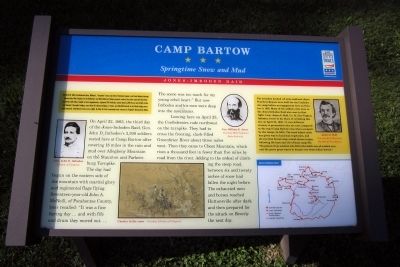
1. Camp Bartow CWT Marker
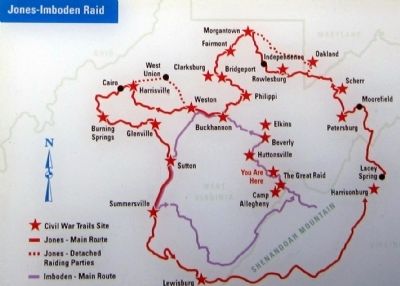
On April 20, 1863, Confederate Gens. William F. “Grumble” Jones and John D. Imboden began a raid from Virginia through present-day West Virginia on the Baltimore and Ohio Railroad. Taking separate routes, they later reported that they marched 1,100 miles , fought several engagements, captured 700 Federals, seized about 1,200 horses and 4,000 cattle, and burned 4 turnpike bridges, more than 20 railroad bridges, 2 trains, and 150,000 barrels of oil. Most bridges were soon repaired. Confederate losses were slight. By May 26, both commands had returned to Virginia’s Shenandoah Valley.
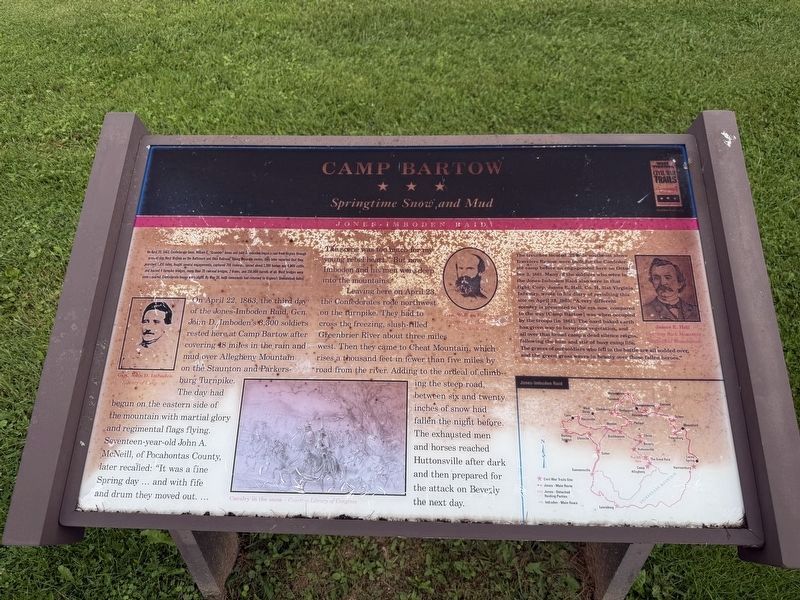
On April 22, 1863, the third day of the Jones-Imboden Raid, Gen. John D. Imboden’s 3,300 soldiers rested here at Camp Bartow after covering 18 miles in the rain and mud over Allegheny Mountain on the Staunton and Parkersburg Turnpike. The day had begun on the eastern side of the mountain with martial glory and regimental flags flying. Seventeen-year-old John A. McNeill, of Pocahontas County, later recalled: “It was a fine Spring day … and with fife and drum they moved out. … The scene was too much for my young rebel heart.” But now Imboden
this page online
Leaving here on April 23, the Confederates rode northwest on the turnpike. They had to cross the freezing, slush-filled Greenbrier River about three miles west. Then they came to Cheat Mountain, which rises a thousand feet in fewer than five miles by road from the river. Adding to the ordeal of climbing the steep road, between six and twenty inches of snow had fallen the night before. The exhausted men and horses reached Huttonsville after dark and then prepared for the attack on Beverly the next day.
[Sidebar:]
The trenches located .25 mile southeast above Travelers Repose were built for the Confederate camp before an engagement here on October 3, 1861. Many of the soldiers who were in the Jones-Imboden Raid also were in that fight. Corp. James E. Hall, Co. H, 31st Virginia Infantry, wrote in his diary of revisiting this site on April 22, 1863: “A very different scenery is presented to the eye now, compared to the way [Camp Bartow] was when occupied by the troops [in 1861]. The hard baked earth has given way to luxurious vegetation, and all over that broad camp a dead silence reigns following the hum and stir of busy camp life. The graves of our soldiers who fell in the battle are all sodded over, and the green grass waves in beauty over those fallen heroes.”
(captions)
Gen. John D. Imboden Courtesy Library of Congress
Cavalry in the snow - Courtesy Library of Congress
Gen. William E. Jones Courtesy West Virginia State Archives
James E. Hall Courtesy Rich Mountain Battlefield Foundation
Erected by West
Photographed by Devry Becker Jones (CC0), August 8, 2026
2. Camp Bartow Marker
Unfortunately the marker has weathered significantly.
Topics and series. This historical marker is listed in this topic list: War, US Civil. In addition, it is included in the West Virginia Civil War Trails series list. A significant historical date for this entry is April 22, 1863.
Location. 38° 32.452′ N, 79° 46.674′ W. Marker is in Bartow, West Virginia, in Pocahontas County. It is on U.S. 250 0.3 miles west of West Virginia Route 28, on the right when traveling west. Located in the parking lot of the US Forest Service Ranger Station. Touch for map. Marker is in this post office area: Bartow WV 24920, United States of America. Touch for directions.

Regionally, this marker is in West Virginia’s Potomac Highlands. It is also in the American South, specifically in the Upper South, in Appalachia, and specifically in Southern Appalachia. Globally, it is in North America, the Western Hemisphere, the Western World, and the Anglosphere. Historically, it finds itself in what was once the territory of the Mississippian Culture.
Other nearby markers. At least 8 other markers are within walking distance of this marker: Greenbrier Ranger District Centennial 1922-2022
Photographed by Bernard Fisher, August 8, 2012
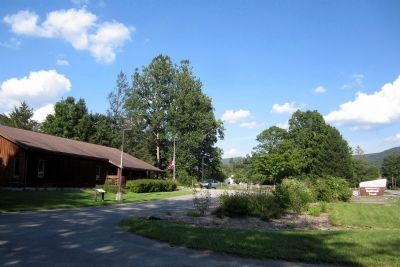
3. US Forest Service Ranger Station
Also see . . .
1. Camp Bartow. West Virginia Land Trust (Submitted on November 14, 2021.)
2. Camp Bartow Historic District. Wikipedia (Submitted on November 14, 2021.)
3. Camp Bartow Historic District (pdf file, redacted). National Register of Historic Places (Submitted on November 14, 2021.)
August 8, 2012
4. Jones-Imboden Raid Map
Credits. This page was last revised on August 9, 2026. It was originally submitted on August 9, 2012, by Bernard Fisher of Richmond, Virginia. This page has been viewed 1,314 times since then and 47 times this year. Photos: 1. submitted on August 9, 2012, by Bernard Fisher of Richmond, Virginia. 2. submitted on August 9, 2026, by Devry Becker Jones of Washington, District of Columbia. 3, 4. submitted on August 9, 2012, by Bernard Fisher of Richmond, Virginia.
