Bamberg, Bavaria, Germany — Central Europe
The Old Main Watch
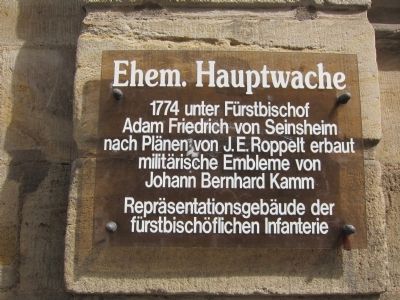
Ehem. Hauptwache
Photographed by Andrew Ruppenstein, July 13, 2012
1. The Old Main Watch Marker

Adam Friedrich von Seinsheim
nach Plänen von J.E. Roppelt erbaut
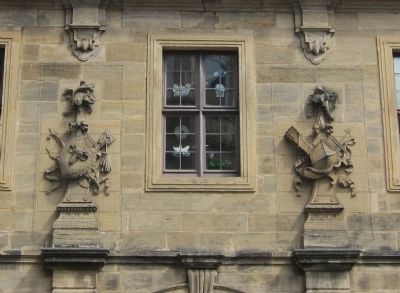
militärische Embleme von
Johann Bernhard Kamm
Repräsentationsgebäude der fürstbischöfliche Infantrie
Topics. This historical marker is listed in these topic lists: Government & Politics • Religion & Religious Structures. A significant historical year for this entry is 1774.
Location. 49° 53.709′ N, 10° 53.448′ E. Marker is in Bamberg, Bayern (Bavaria). It is at the intersection of Hauptwachstrasse and Promenadenstrasse, on the right when traveling north on Hauptwachstrasse. Touch for map. Marker is at or near this postal address: Hauptwachstrasse 16, Bamberg BY 96047, Germany. Touch for directions.

Regionally, it is in Europe, the European Union, Atlantic Europe, Central Europe, the Schengen Area, Western Europe, and
this page online
Other nearby markers. At least 8 other markers are within walking distance of this marker: Maximiliansplatz / Maximilian Square (about 90 meters away, measured in a direct line); St. Martinskirche / St. Martin Church (about 90 meters away); Friedrich von Brenner (about 90 meters away); Catharinakapelle / Catherina Chapel (about 150 meters away); Carl Friedrich Kunz (about 150 meters away); Heinrich Gerber (about 210 meters away); Ehem. Kaufhaus H. & C. Tietz / Former department store H. & C. Tietz (about 210 meters away); Christoph Clavius (approx. 0.3 kilometers away). Touch for a list and map of all markers in Bamberg.
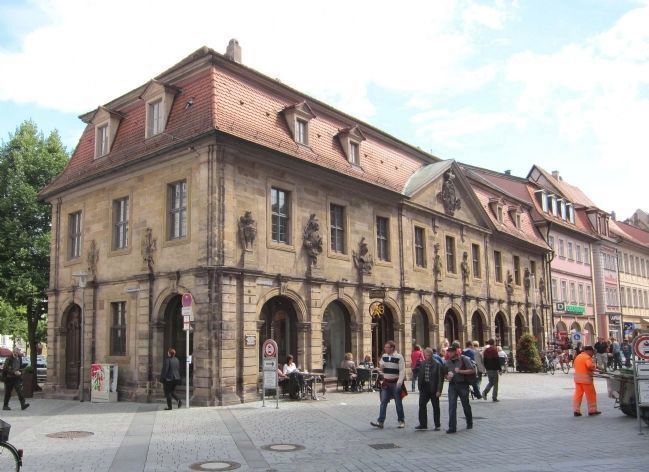
Also see . . . Hauptwache (Bamberg). Wikipedia (German language) entry for the Hauptwache, translated to Engish: The former Main Watch, located on Hauptwachstrasse 16, in Bamberg, is a two-story building constructed out of sandstone, with a Baroque-style mansard roof. The building was constructed from 1772-1774 for the military, under contract with Prince Bishop Adam Friedrich von Seinsheim. Construction was carried out by Johann Joseph Vogel according to the plans of architect Johann Georg von Roppelt. The military trophies and reliefs were executed by the sculptor Johann Bernhard Kamm (1736-1816).
Photographed by Andrew Ruppenstein, July 13, 2012
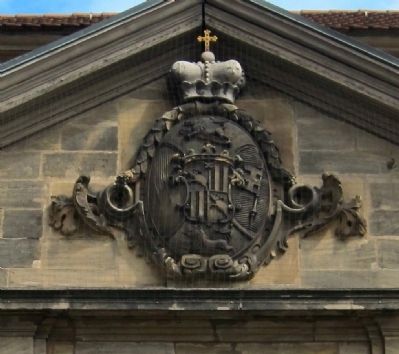
2. Coat of Arms of Prince Bishop Adam Friedrich von Seinsheim - Above main entrance
Photographed by Andrew Ruppenstein, July 13, 2012
3. Examples of military emblems by Johann Bernhard Kamm
Photographed by Andrew Ruppenstein, July 13, 2012
4. The Old Main Watch / Die ehemalige Hauptwache
Credits. This page was last revised on April 25, 2024. It was originally submitted on August 27, 2012, by Andrew Ruppenstein of Lamorinda, California. This page has been viewed 661 times since then and 14 times this year. Photos: 1, 2, 3, 4. submitted on August 27, 2012, by Andrew Ruppenstein of Lamorinda, California. • Bill Pfingsten was the editor who published this page.
