
Lookout Mountain in Hamilton County, Tennessee — The American South (East South Central)
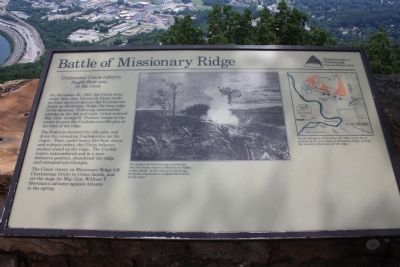
Battle of Missionary Ridge
Photographed by Dale K. Benington, July 18, 2012
1. Battle of Missionary Ridge Marker
fought their way
to the crest
On November 25, 1863, the Union army under Maj. Gen. Ulysses S. Grant made its final moves to destroy the Confederate forces on Missionary Ridge, the long ridge in the distance. Following unsuccessful attacks on the left and right, Grant ordered Maj. Gen. George H. Thomas' troops in the center to seize the Confederate rifle-pits at the base of the ridge.
The Federals stormed the rifle-pits, and drove the retreating Confederates up the slopes. Then, under heavy fire from above, and without orders, the Union infantry pushed up the ridge. The Confederates, outnumbered and in a poor defensive position, abandoned the ridge and retreated into Georgia.
The Union victory on Missionary Ridge left Chattanooga firmly in Union hands, and set the stage for Maj. Gen. William T. Sherman's advance against Atlanta in the spring.
[Text of the picture's caption]:
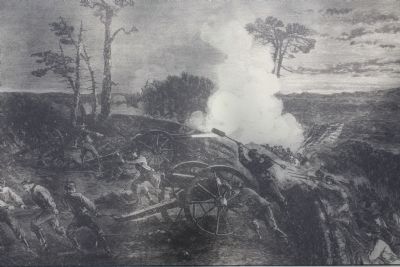
The battles for Chattanooga culminated with the Union victory at Missionary Ridge, visible ahead. In this historic engraving, Federals overwhelm a Confederate battery on the crest.
[Text of the map's caption]:
On
this page online
Erected by Chickamauga-Chattanooga National Military Park.
Topics. This historical marker is listed in this topic list: War, US Civil. A significant historical month for this entry is November 1989.
Location. 35° 0.753′ N, 85° 20.619′ W. Marker is in Lookout Mountain, Tennessee, in Hamilton County. It can be reached from Point Park Road north of East Brow Road. This historic marker is located in Point Park, atop Lookout Mountain, at the Ochs Museum, on the museum observation deck, at the point of Lookout Mountain. Touch for map. Marker is in this post office area: Lookout Mountain TN 37350, United States of America. Touch for directions.

Regionally, this marker is in the American South, specifically in the Upper South, in Appalachia, and specifically in Southern Appalachia. Globally, it is in North America, the Western Hemisphere, the Western World, and the Anglosphere. Historically, it finds itself in what was once the original Cherokee Nation, the territory of the Mississippian Culture,
Photographed by Dale K. Benington, July 18, 2012
2. Battle of Missionary Ridge Marker
Close-up view of the picture displayed on the marker showing the Union troops attacking a Confederate battery on the crest of the ridge.
Other nearby markers. At least 8 other markers are within walking distance of this marker: Chattanooga and Missionary Ridge (here, next to this marker); Battle Above the Clouds (a few steps from this marker); Tennessee River and Moccasin Bend (a few steps from this marker); Lookout Valley and Browns Ferry (a few steps from this marker); 29th Pennsylvania Infantry (a few steps from this marker); Cobham's Brigade (a few steps from this marker); Point Hotel (within shouting distance of this marker); Lookout Mountain Trails (within shouting distance of this marker). Touch for a list and map of all markers in Lookout Mountain.
Other markers no longer nearby. Campaign for Chattanooga (Continued) (was a few steps from this marker but has been confirmed missing); Campaign for Chattanooga (was a few steps from this marker but has been confirmed missing); Battle of Chattanooga, 3d Day, Nov. 25 (was a few steps from this marker but has been confirmed missing); Localities of the Campaign (was a few steps from this marker but has been confirmed missing); Battle of Chattanooga,
Photographed by Dale K. Benington, July 18, 2012
3. Battle of Missionary Ridge Marker
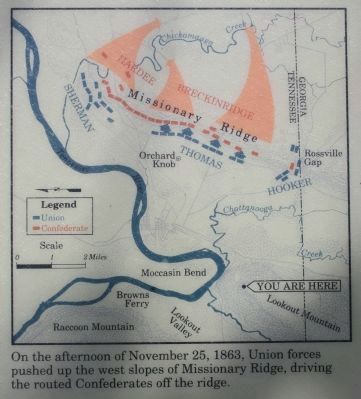
Close-up view of the battlefield map displayed on the marker.
Photographed by Dale K. Benington, July 18, 2012
4. Battle of Missionary Ridge Marker
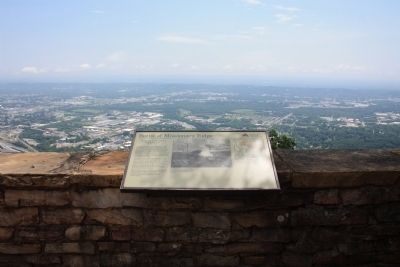
View of the historic marker affixed to the retaining wall surrounding the museum observation deck, with a very distant view of Missionary Ridge in the background.
Photographed by Dale K. Benington, July 18, 2012
5. Battle of Missionary Ridge Marker
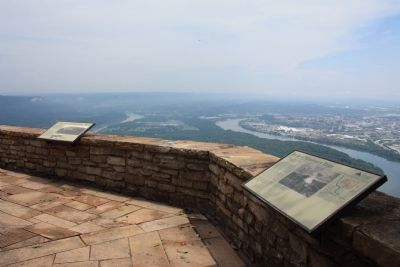
View, looking northwest, of the historic marker affixed to the retaining wall surrounding the museum observation deck, with a distant view of both the Tennessee River and downtown Chattanooga.
Photographed by Dale K. Benington, July 18, 2012
6. Battle of Missionary Ridge Marker
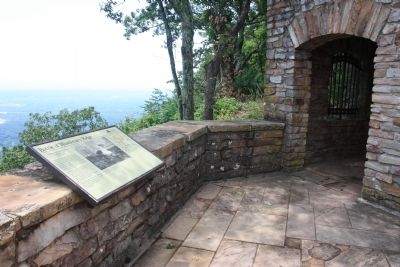
View, looking east, of the historic marker affixed to the retaining wall surrounding the museum observation deck, with a view of the eastern exit of the observation deck.
Credits. This page was last revised on June 16, 2016. It was originally submitted on August 31, 2012, by Dale K. Benington of Toledo, Ohio. This page has been viewed 1,178 times since then and 41 times this year. Photos: 1, 2, 3, 4, 5, 6. submitted on September 1, 2012, by Dale K. Benington of Toledo, Ohio.
