Santa Clara in Washington County, Utah — The American Mountains (Southwest)
Santa Clara Relief Society House
Photographed by Bill Kirchner, August 28, 2012
1. Santa Clara Relief Society House Marker
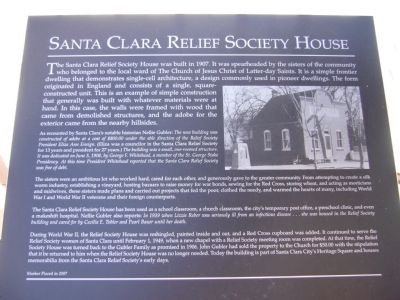
As recounted by Santa Clara's notable historian Nellie Gubler: The new building was constructed of adobe at a cost of $800.00 under the able direction of the Relief Society President Eliza Ann Ensign. (Eliza was a councilor in the Santa Clara Relief Society for 13 years and president for 27 years.) The building was a small, one-roomed structure. It was dedicated on June 5, 1908, by George F. Whitehead, a member of the St. George Stake Presidency. At this time President Whitehead reported that the Santa Clara Relief Society was free of debt.
this page online
The sisters were an ambitious lot who worked hard, cared for each other, and generously gave to the greater community. From attempting to create a silk worm industry, establishing a vineyard, hosting bazaars to raise money for war bonds, sewing for the Red Cross, storing wheat, and acting as morticians and midwives, these sisters made plans and carried out projects that fed the poor, clothed the needy, and warmed the hears of many, including World War I and World War II veterans and their foreign counterparts.
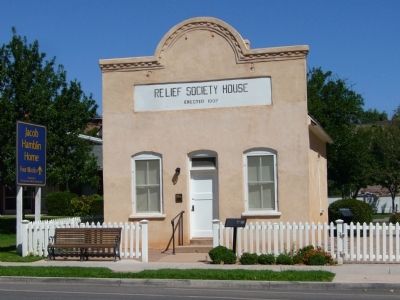
The Santa Clara Relief Society House has been used as a school classroom, a church classroom, the city's temporary post office, a preschool clinic, and even a makeshift hospital. Nellie Gubler also reports: In 1939 when Lizzie Rebar was seriously ill from an infectious disease…she was housed in the Relief Society building and cared for by Cecilia E Tobler and Pearl Bauer until her death.
During World War II, the Relief Society House was reshingled, painted inside and out, and a Red Cross cupboard was added. It continued to serve the Relief Society women of Santa Clara until February 1, 1949, when a new chapel with a
Photographed by Bill Kirchner, August 28, 2012
2. Santa Clara Relief Society House Marker
Erected 2007.
Topics. This historical marker is listed in these topic lists: Charity & Public Work • Religion & Religious Structures • Women. A significant historical date for this entry is February 1, 1949.
Location. 37° 7.983′ N, 113° 39.221′ W. Marker is in Santa Clara, Utah, in Washington County. It is on West Santa Clara Drive, on the right when traveling west. Touch for map. Marker is in this post office area: Santa Clara UT 84765, United States of America. Touch for directions.

Regionally, this marker is in Utah’s Color Country. It is also in the American Southwest, in the Mountain West, and on the Colorado Plateau. Globally, it is in North America, the Rocky Mountains, the Western
Photographed by Bill Kirchner, August 28, 2012
3. Santa Clara Relief Society House Marker
Other nearby markers. At least 8 other markers are within walking distance of this marker: Hug-Gubler Home (a few steps from this marker); The Settling of Santa Clara / First Public Buildings / Missionaries and Settlers (a few steps from this marker); John George and Susette Bosshard Hafen Home (within shouting distance of this marker); Swiss Colony (within shouting distance of this marker); Preston and Vella Ruth Hafen Home (within shouting distance of this marker); Frederick and Anna Reber Home (within shouting distance of this marker); Santa Clara Merc (about 600 feet away, measured in a direct line); Santa Clara Tithing Granary (about 600 feet away). Touch for a list and map of all markers in Santa Clara.
Credits. This page was last revised on April 18, 2018. It was originally submitted on September 3, 2012, by Bill Kirchner of Tucson, Arizona. This page has been viewed 965 times since then and 49 times this year. Photos: 1, 2, 3. submitted on September 3, 2012, by Bill Kirchner of Tucson, Arizona. • Syd Whittle was the editor who published this page.
