Union in Monroe County, West Virginia — The American South (Appalachia)
Crook's Occupation of Union
Confederate Union under Federal Control

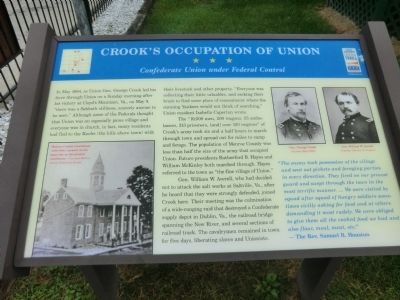
In May 1864, as Union Gen. George Crook led his force through Union on a Sunday morning after his victory at Cloyd’s Mountain, VA., on May 9, “there was a Sabbath stillness, scarcely anyone to be seen.” Although some of the Federals thought that Union was especially pious village and everyone was in church, in fact, many residents had fled to the Knobs (the hills above the town) with their livestock and other property. “Everyone was collecting their little valuables, and racking their brain to find some place of concealment where the cunning Yankees would not think of searching,” Union resident Isabella Caperton wrote.
The “10,000 men, 200 wagons, 35 ambulances, 213 prisoners, {and} over 100 negroes” of Crook’s army took six and a half hours to march through town and spread out for miles to camp and forage. The population of Monroe County was less than half the size of the army that occupied Union. Future presidents Rutherford B. Hayes and William McKinley both marched through. Hayes referred to the town as “the fine village of Union.”
Gen. William W. Averell, who had decided not to attack the salt works at Saltville,
this page online
"The enemy took possession of the village and sent out pickets and foraging parties in every direction. They fired on our provost guard and swept through the town in the most terrific manner. … We were visited by squad after squad of hungry soldier sometimes asking for food and at others demanding it most rudely. We were obliged to give them all the cooked food we had and also flour, meal, meat, etc."
— The Rev. Samuel R. Houston
Erected by West Virginia Civil War Trails.
Topics and series. This historical marker is listed in this topic list: War, US Civil. In addition, it is included in the Former U.S. Presidents: #25 William McKinley, and the West Virginia Civil War Trails series lists. A significant historical month for this entry is May 1864.
Location. 37° 35.466′ N, 80° 32.592′ W.
Photographed by Don Morfe, August 6, 2012
2. Crook's Occupation of Union Marker

Regionally, this marker is in the Southern Coalfields. It is also in the American South, specifically in the Upper South, in Appalachia, and specifically in Southern Appalachia. Globally, it is in North America, the Western Hemisphere, the Western World, and the Anglosphere. Historically, it finds itself in what was once the territory of the Mississippian Culture.
Other nearby markers. At least 8 other markers are within walking distance of this marker: William Porcher Miles (a few steps from this marker); Monroe Garden Club (a few steps from this marker); General John Echols (within shouting distance of this marker); Vietnam Memorial (within shouting distance of this marker); Veterans Memorial (within shouting distance of this marker); Union (within shouting distance of this marker); Bishop Matthew W. Clair, Sr. (within shouting distance

Another marker is no longer nearby. Bishop Matthew W. Clair, Sr. (was about 300 feet away, measured in a direct line but has been replaced with another marker now near it).
Credits. This page was last revised on April 28, 2026. It was originally submitted on September 7, 2012, by Don Morfe of Baltimore, Maryland. This page has been viewed 1,028 times since then and 47 times this year. Photos: 1. submitted on April 28, 2026, by Devry Becker Jones of Washington, District of Columbia. 2. submitted on September 7, 2012, by Don Morfe of Baltimore, Maryland. 3. submitted on April 28, 2026, by Devry Becker Jones of Washington, District of Columbia. • Craig Swain was the editor who published this page.
