Near Locust Grove in Orange County, Virginia — The American South (Mid-Atlantic)
The Wilderness
⎯⎯⎯
The Battlefield Becomes a Park
Photographed by Paul Crumlish, September 14, 2012
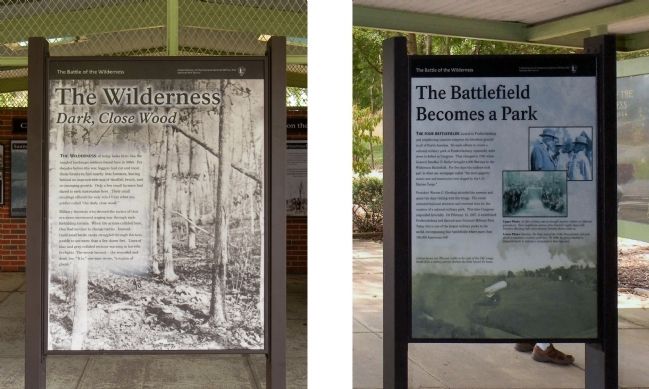
1. The Wilderness / The Battlefield becomes a Park Marker
The Wilderness
Dark, Close Wood
The Wilderness of today looks little like the tangled landscape soldiers found here in 1864. For decades before the war, loggers had cut and recut these forests to fuel nearby iron furnaces, leaving behind an impenetrable mix of dead fall, brush and re-emerging growth. Only a few small farmers had dared to seek sustenance here. Their small clearings offered only relief from what one soldier called “the dark, close wood.”
Military theorists who devised tactics of that era never envisioned waging war through such forbidding terrain. When the armies collided here, they had no time to change tactics. Instead, traditional battle ranks struggled through thickets, unable to see more than a few dozen feet. Lines of blue and gray collided without warning in horrific firefights. The woods burned – the wounded and dead, too. “It is,” one man wrote, “a region of gloom.”
The Battlefield Becomes a Park
The four battlefields located in Fredericksburg and neighboring counties comprise the bloodiest ground in all of North America. Yet early efforts to create a national military park at Fredericksburg
this page online
President Warren G. Harding attended the exercise and spent two days visiting with the troops. The event attracted national attention and renewed cries for the creation of a national military park. This time Congress responded favorably. On February 13, 1927, it established Fredericksburg and Spotsylvania National Military Park. Today this is one of the largest military parks in the world, encompassing four battlefields where more than 100,000 Americans fell.
Erected by National Park Service, U.S. Department of the Interior.
Topics and series. This historical marker is listed in this topic list: War, US Civil. In addition, it is included in the Former U.S. Presidents: #29 Warren G. Harding series list. A significant historical month for this entry is February 1851.
Location. 38° 19.051′ N, 77° 45.386′ W. Marker is near Locust Grove, Virginia, in Orange County.
Photographed by Paul Crumlish, October 6, 2012
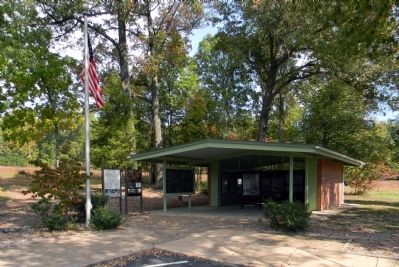
2. Wide view of the The Wilderness Marker

Regionally, this marker is in Northern Virginia and in the Piedmont. It is also in the American South and specifically in the Upper South. Globally, it is in North America, the Western Hemisphere, the Western World, and the Anglosphere. Historically, it finds itself in what was once the territory of the Mississippian Culture, one of the original Thirteen Colonies, one of the Confederate States of America, and the Antebellum South.
Other nearby markers. At least 8 other markers are within walking distance of this marker: Collision of Giants (a few steps from this marker); The Fighting Ends in Stalemate (a few steps from this marker); Clash on the Orange Turnpike (a few steps from this marker); Battle of the Wilderness (a few steps from this marker); Struggle on the Orange Plank Road (a few steps from this marker); a different
Photographed by Paul Crumlish, October 6, 2012
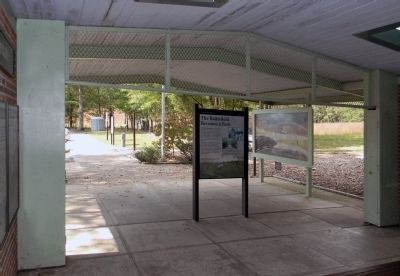
3. Wide view of The Battlefield becomes a Park Marker
Credits. This page was last revised on June 18, 2025. It was originally submitted on September 15, 2012, by PaulwC3 of Northern, Virginia. This page has been viewed 833 times since then and 41 times this year. Photos: 1. submitted on September 15, 2012, by PaulwC3 of Northern, Virginia. 2, 3. submitted on October 6, 2012, by PaulwC3 of Northern, Virginia. • Craig Swain was the editor who published this page.
