Appomattox in Appomattox County, Virginia — The American South (Mid-Atlantic)
Wartime Landscape
Appomattox Court House National Historical Park
| — | National Park Service | — |
Photographed by Bill Coughlin, April 26, 2007
1. Wartime Landscape Marker
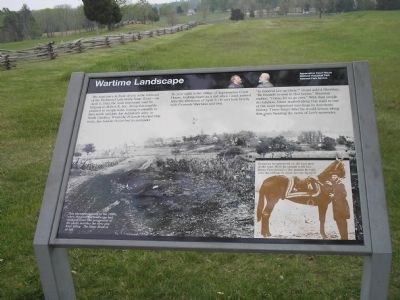
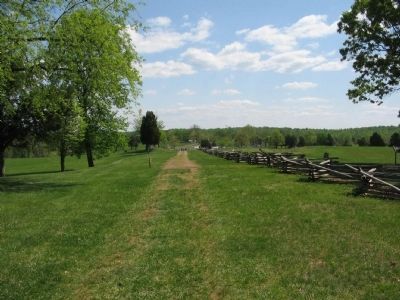
The road trace in front of you is the remnant of the Richmond-Lynchburg Stage Road – on April 9, 1865, the most important road in Virginia to Robert E. Lee. Along this road he planned to escape west, hoping eventually to turn south and join Joe Johnston’s army in North Carolina. When the Federals blocked this route, Lee had no choice but to surrender.
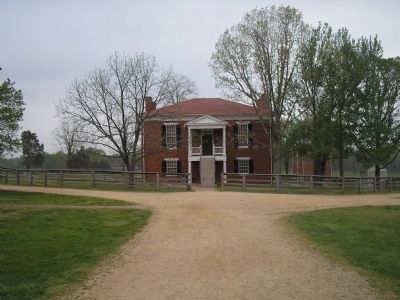
To your right is the village of Appomattox Court House, looking much as it did when Grant arrived here the afternoon of April 9. He met her briefly with Generals Sheridan and Ord.
“Is General Lee up there?” Grant asked Sheridan. “He himself is over in that house,” Sheridan replied. “Come, let us go over.” With that simple declaration, Grant started along this road to one of the most important meetings in American history. Three hours later he would return along this route bearing news of Lee’s surrender.
Erected by National Park Service, U.S. Department of the Interior.
Topics and series. This historical marker is listed in this topic list: War, US Civil. In addition, it is included in the Former U.S. Presidents: #18 Ulysses S. Grant series list. A significant historical month for this entry is April 1735.
Location. 37° 22.583′ N,
this page online

Regionally, this marker is in the Piedmont and in Central Virginia. It is also in the American South and specifically in the Upper South. Globally, it is in North America, the Western Hemisphere, the Western World, and the Anglosphere. Historically, it finds itself in what was once the territory of the Mississippian Culture, one of the original Thirteen Colonies, one of the Confederate States of America, and the Antebellum South.
Other nearby markers. At least 8 other markers are within walking distance of this marker: The First African American School in Appomattox (here, next to this marker); Appomattox Confederate Cemetery Memorial (within shouting distance of this marker); Confederate Cemetery (within shouting distance
Photographed by Bill Coughlin, April 26, 2007
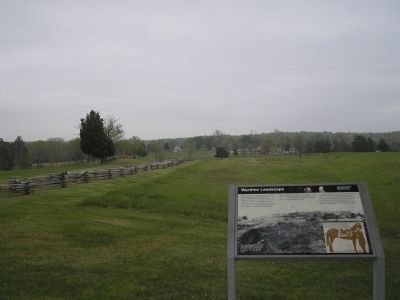
2. Marker with the village of Appomattox Court House in background
Another marker is no longer nearby. Sears Lane (was about 400 feet away but has been permanently removed).
More about this marker. The background of the marker is a photograph of the area with the caption This photograph dates to the 1890s, when the wartime landscape had changed little. The perspective of the photo matches the view you have today. The Stage Road is at left.
The bottom right of the marker features a photo of Gen. Grant and his mount, with the caption Grant as he appeared in the last year of the war. Here he stands with his horse Cincinnati – the mount he rode into the village to meet Lee on April 9.
Also see . . . Appomattox Court House National Historical Park. (Submitted on March 5, 2008, by Bill Coughlin of Woodland Park, New Jersey.)
Photographed by Bill Coughlin, April 26, 2007
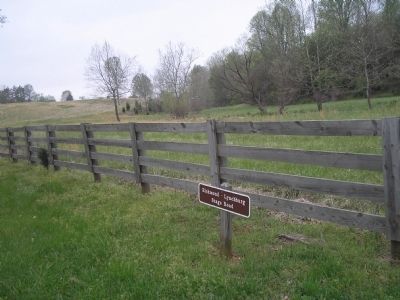
4. Richmond-Lynchburg Stage Road
This is the road that Gen. Lee had hoped to use as an escape route, and the one that Grant used to reach the surrender ceremony.
Photographed by Bill Coughlin, April 26, 2007
5. Village of Appomattox Court House
The court house is located in the center of the village. It now serves as the Visitors Center of Appomattox Court House National Historical Park.
Photographed by Craig Swain, April 18, 2010
6. Stage Road and Appomattox Village
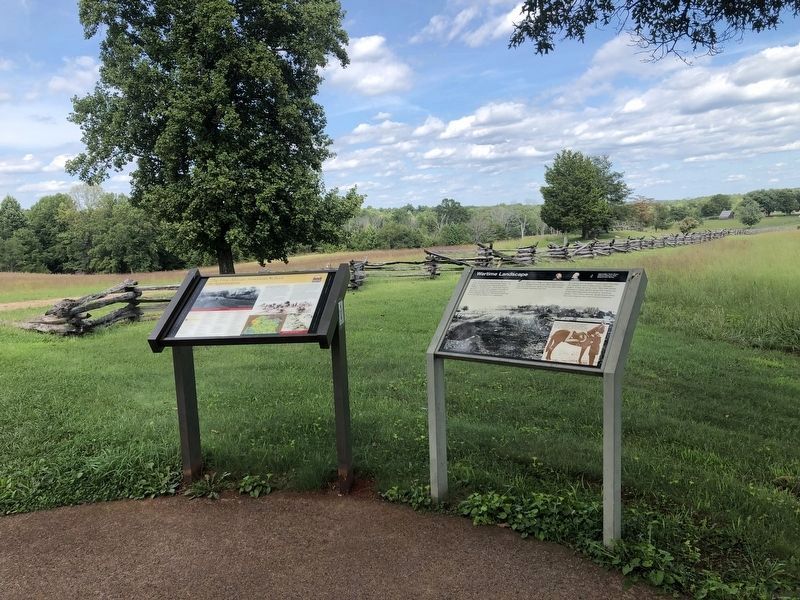
Looking past the marker location along the trace of the Richmond-Lynchburg Stage Road toward the historic village of Appomattox.
Credits. This page was last revised on September 6, 2021. It was originally submitted on March 5, 2008, by Bill Coughlin of Woodland Park, New Jersey. This page has been viewed 1,698 times since then and 48 times this year. Photos: 1, 2. submitted on March 5, 2008, by Bill Coughlin of Woodland Park, New Jersey. 3. submitted on September 6, 2021, by Devry Becker Jones of Washington, District of Columbia. 4, 5. submitted on March 5, 2008, by Bill Coughlin of Woodland Park, New Jersey. 6. submitted on April 25, 2010, by Craig Swain of Leesburg, Virginia. • Craig Swain was the editor who published this page.
