Tyler in Smith County, Texas — The American South (West South Central)
Camp Ford Confederate Guards
Photographed by Mike Stroud, September 17, 2012
1. Camp Ford Confederate Guards Marker
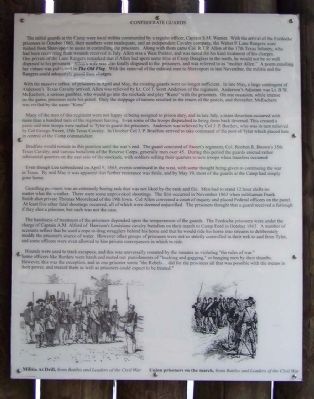
With the massive influx of prisoners in April and May, the existing guards were no longer sufficient. In late May, a large
this page online
Many of the men of this regiment were not happy at being assigned to prison duty, and in late July, a mass desertion occurred with more than a hundred men of the regiment leaving. Even some of the troops dispatched to bring them back deserted. This created a panic and new troops were rushed to Tyler to guard the prisoners. Anderson was relieved by Col. J.P. Borders, who was in turn relieved by Col. George Sweet, 15th Texas Cavalry. In October Col. J.P. Bradfute arrived to take command of the post of Tyler which placed him in control of the Camp commandant.
Bradfute would remain in this position until war's end. The guard consisted of Sweet's regiment, Col.
Photographed by Camp Ford Confederate Guards Marker, September 17, 2012
2. Camp Ford Confederate Guards Marker
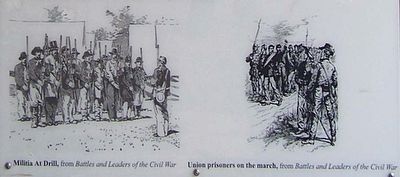
Militia at drill (l) and Union prisoners on the march (r)
Even though Lee surrendered on April 9, 1865, events continued in the west, with some thought being given to continuing the war in Texas. By mid May it was apparent that further resistance was futile and by May 19, most of the guards at the Camp had simply gone home.
Guarding prisoners was an extremely boring task that was not liked by the rank and file. Men had to stand 12 hour shifts no matter what the weather. There were some unprovoked shootings. The first occur in November 1863 when militiaman Frank Smith shot private Thomas Moorehead of the 19th Iowa. Col. Allen convened a court of inquiry and placed Federal officers on the panel.
At least five other fatal shootings occurred, all of which were deemed unjustified. The prisoners thought that a guard recieved furlough if they shot a prisoner, but such was not
Photographed by Mike Stroud, September 17, 2012
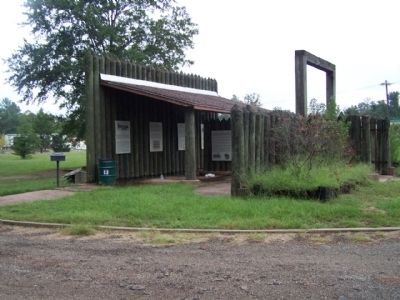
3. Camp Ford Confederate Guards Marker, center
Hounds were used to track escapees, and this was universally resented by the inmates as violating "the rules of war." Some officers like Borders were harsh and meted out punishments of "bucking and gagging, " or hanging men by their thumbs. However, this was the exception, and as one prisoner wrote "the Rebels... did for the prisoners all that was possible with the means in their power, and treated them as well as prisoners could expect to be treated."
Erected by Smith County Historical
Photographed by Mike Stroud, September 17, 2012
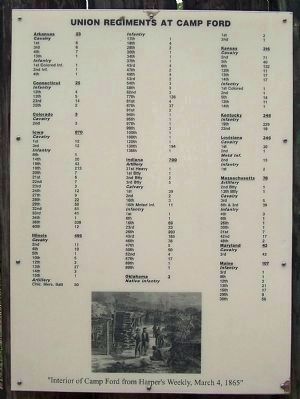
4. Camp Ford Confederate Guards Marker, List of Union Regiments at Camp Ford
Topics. This historical marker is listed in this topic list: War, US Civil. A significant historical month for this entry is October 1863.
Location. 32° 23.78′ N, 95° 16.102′ W. Marker is in Tyler, Texas, in Smith County. It is on U.S. 271 near Loop State Highway 323, on the right when traveling north. Touch for map. Marker is in this post office area: Tyler TX 75702, United States of America. Touch for directions.

Regionally, this marker is in the American South, specifically in the Deep South, and in the Piney Woods. Globally, it is in North America, a Gulf of Mexico state, the Western Hemisphere, the Western World, and the Anglosphere. Historically, it finds itself in what was once New Spain, the Republic of Texas, one of the Confederate States of America, and the Antebellum South.
Other nearby markers. At least 8 other markers are within walking distance of this marker: Camp Ford - Establishment of the Camp (here, next to this marker); Camp Ford - Early Days as a Prison Camp (here, next to this marker); African Americans at Camp Ford (here, next to this marker); Camp Ford - Prisoners from Louisiana (here, next to this
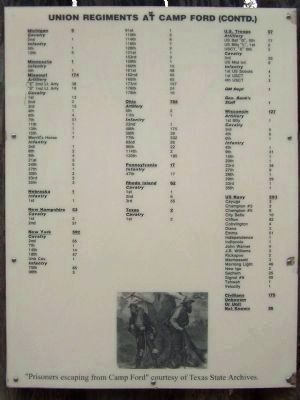
Photographed by Mike Stroud, September 17, 2012
5. Camp Ford Confederate Guards Marker, List of Union Regiments at Camp Ford - Contd.-
Regarding Camp Ford Confederate Guards. Camp Ford was the largest Confederate Prisoner of War Camp west of the Mississippi River during the American Civil War. Established in August of 1863, the camp was not closed until May 19, 1865. At its peak in July 1864, over 5,300 prisoners were detained there. (Smith County Historical Society)
Additional commentary.
1. Fordoche
At least two American Civil War battles were fought in and around Fordoche, in Louisiana . The Battle of Fordoche Bridge was fought in September 1863. Union troops were sent to prevent the Confederacy from operating in the upper Atchafalaya but the Confederates were successful in driving back the Union forces.
In May 1864, the Confederates were again victorious over the Union troops at the "Skirmish on Bayou Fordoche Road".
— Submitted October 10, 2012, by Mike Stroud of Bluffton, South Carolina.
Credits. This page was last revised on June 21, 2016. It was originally submitted on October 9, 2012, by Mike Stroud of Bluffton, South Carolina. This page has been viewed 961 times since then and 29 times this year. Photos: 1, 2, 3. submitted on October 9, 2012, by Mike Stroud of Bluffton, South Carolina. 4, 5. submitted on November 5, 2012, by Mike Stroud of Bluffton, South Carolina.
