Locust Point Industrial Area in Baltimore, Maryland — The American Northeast (Mid-Atlantic)
A Pivotal Battle
Star-Spangled Banner National Historic Trail
| — | National Park Service, U.S. Department of the Interior | — |
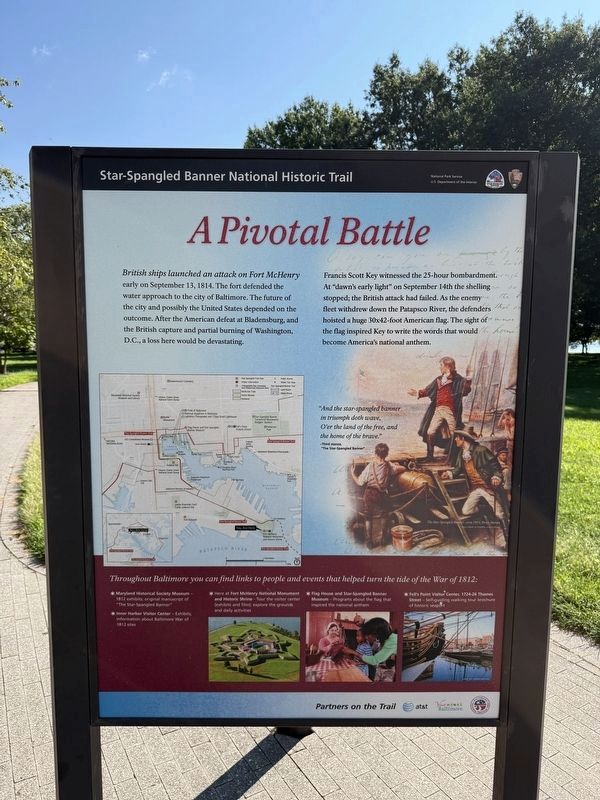
British ships launched an attack on Fort McHenry early on September 13, 1814. The fort defended the water approach to the city of Baltimore. The future of the city and possibly the United States depended on the outcome. After the American defeat at Bladensburg, and the British capture and partial burning of Washington, D.C. a loss here would be devastating.
Francis Scott Key witnessed the 25-hour bombardment. At "dawn's early light" on September 14th, the shelling stopped; the British attack had failed. As the enemy fleet withdrew down the Patapsco River, the defenders hoisted a huge 30x42-foot American flag. The sight of the flag inspired Key to write the words that would become America's national anthem.
"And the star-spangled banner in triumph shall wave, O'er the land of the free, and the home of the brave." Third stanza "The Star Spangled Banner"
Erected by National Park Service, U.S. Department of the Interior.
Topics and series. This historical marker is listed in these topic lists: Forts and Castles • War of 1812 • Waterways & Vessels. In addition, it is included in the Star-Spangled Banner National Historic Trail
this page online
Location. 39° 15.925′ N, 76° 34.757′ W. Marker is in Baltimore, Maryland. It is in the Locust Point Industrial Area. It can be reached from East Fort Avenue. At the visitors center, Fort McHenry. Touch for map. Marker is at or near this postal address: 2400 E Fort Ave, Baltimore MD 21230, United States of America. Touch for directions.

Regionally, this marker is in Central Maryland. It is also in the American Mid-Atlantic, in the Chesapeake Bay Region, and on the Eastern Seaboard. Globally, it is in the North Atlantic Region, North America, the Western Hemisphere, the Western World, and the Anglosphere. Historically, it finds itself in what was once one of the original Thirteen Colonies and also the Antebellum South.
Other nearby markers. At least 8 other markers are within walking distance of this marker: "O! say can you see..." (here, next to this marker); War in the Chesapeake (here, next to this marker); Fort McHenry National Monument & Historic Shrine (within shouting distance of this marker); Welcome! You Are Now "On Post" (about 300 feet away, measured in
Photographed by Allen C. Browne, October 13, 2012
2. A Pivotal Battle Marker
Photographed by Bill Coughlin, April 22, 2023
3. A Pivotal Battle Marker
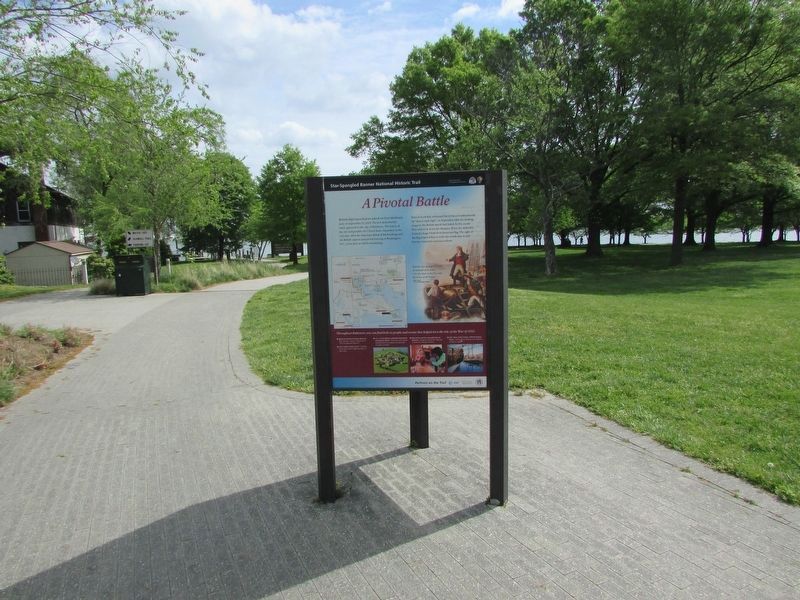
This view of the three-paneled kiosk shows the A Pivotal Battle Marker.
Credits. This page was last revised on August 23, 2026. It was originally submitted on December 2, 2012, by Allen C. Browne of Silver Spring, Maryland. This page has been viewed 1,117 times since then and 34 times this year. Photos: 1. submitted on August 23, 2026, by Devry Becker Jones of Washington, District of Columbia. 2. submitted on December 2, 2012, by Allen C. Browne of Silver Spring, Maryland. 3. submitted on May 2, 2023, by Bill Coughlin of Woodland Park, New Jersey. • Bill Pfingsten was the editor who published this page.
