Augusta in Richmond County, Georgia — The American South (South Atlantic)
Gen. Montgomery C. Meigs, U.S.A.
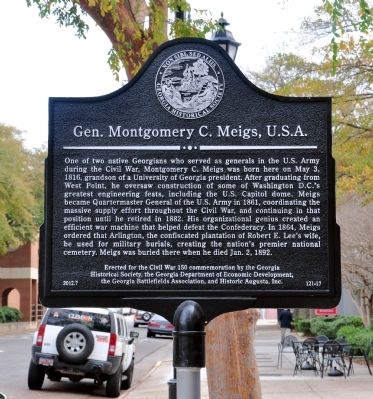
Photographed by David Seibert, December 7, 2012
1. Gen. Montgomery C. Meigs, U.S.A. Marker
Erected 2012 by Georgia Historical Society, the Georgia Department of Economic Development, the Georgia Battlefields Association, and Historic Augusta, Inc. for the Civil War 150 Commemoration. (Marker Number 121-17.)
Topics and series. This historical marker is listed in this topic list: War, US Civil.
this page online
Location. 33° 28.45′ N, 81° 57.783′ W. Marker is in Augusta, Georgia, in Richmond County. It is at the intersection of Broad Street (U.S. 1) and Seventh Street, on the right when traveling east on Broad Street. Touch for map. Marker is at or near this postal address: 662 Broad Street, Augusta GA 30901, United States of America. Touch for directions.

Regionally, this marker is in the American South and specifically in the Deep South. Globally, it is in North America, the Western Hemisphere, the Western World, and the Anglosphere. Historically, it finds itself in what was once the territory of the Mississippian Culture, one of the original Thirteen Colonies, one of the Confederate States of America, and the Antebellum South.
Other nearby markers. At least 8 other markers are within walking distance of this marker: Georgia Railroad and Banking Company (within shouting distance of this marker); Emily Harvie Thomas Tubman (about 400 feet away, measured in a direct line); Historic Site in Journalism (about
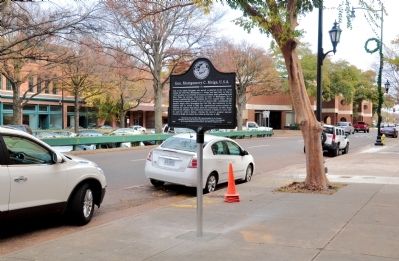
Photographed by David Seibert, December 7, 2012
2. Gen. Montgomery C. Meigs, U.S.A. Marker
Also see . . . Montgomery C. Meigs. Excerpt:
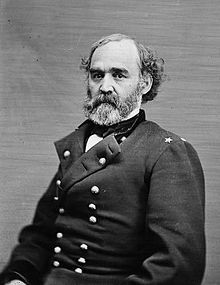
Montgomery Cunningham Meigs (/ˈmɛɡz/; May 3, 1816 – January 2, 1892) was a career United States Army officer and military and civil engineer, who served as Quartermaster General of the U.S. Army during and after the American Civil War. Although a Southerner from Georgia, Meigs strongly opposed secession and supported the Union. His record as Quartermaster General was regarded as outstanding, both in effectiveness and in ethical probity, and Secretary of State William H. Seward viewed Meigs' leadership and contributions as key factors in the Union victory in the war.(Submitted on May 25, 2025, by J.T. Lambrou of New Boston, Michigan.)
Meigs was one of the principal architects of Arlington National Cemetery. Meigs's decision to locate the cemetery on Robert E. Lee's family estate, Arlington House, was partly a gesture to humiliateLee for siding with the Confederacy.Photographed by Wikipedia3. Major-General Montgomery C. Meigs

Photographed by David Seibert, December 7, 2012
4. Gen. Montgomery C. Meigs, U.S.A. Marker Dedication
Augusta (Georgia) street scene: waiting for the dedication ceremony to begin. The (covered) marker is at the far left.

Photographed by David Seibert, December 7, 2012
5. Gen. Montgomery C. Meigs, U.S.A. Marker Dedication
Dr. W. Todd Groce, President and CEO, Georgia Historical Society, welcomed attendees and introduced guests.
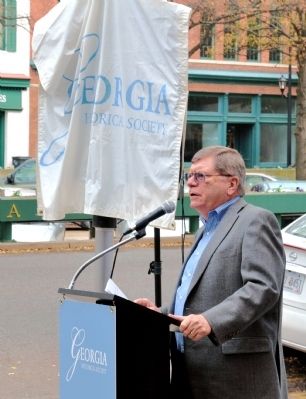
Photographed by David Seibert, December 7, 2012
6. Gen. Montgomery C. Meigs, U.S.A. Marker Dedication
Mr. Fred Russell, City Administrator for Augusta-Richmond County, welcomed attendees to Augusta.
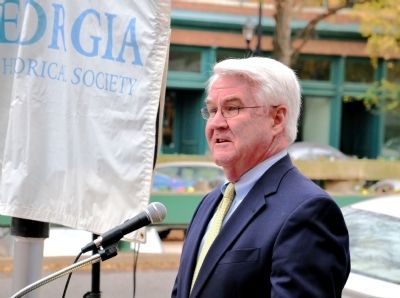
Photographed by David Seibert, December 7, 2012
7. Gen. Montgomery C. Meigs, U.S.A. Marker Dedication
Mr. Wyck Knox, Jr., a member of the Board of Curators of the Georgia Historical Society, introducte the Keynote Speaker.

Photographed by David Seibert, December 7, 2012
8. Gen. Montgomery C. Meigs, U.S.A. Marker Dedication
General Montgomery C. Meigs, USA (Ret.), President and CEO, Business Executives for National Security, gave the Keynote Address. General Meigs is the great-great-great-grandnephew of General Meigs, the subject of the marker. General Meigs is a West Point graduate who received a PhD from the University of Wisconsin. The rank of General (or four-star general or full general) is the highest rank normally achievable in the U.S. Army. There have been only 220 four-star generals in the history of the U.S. Army.
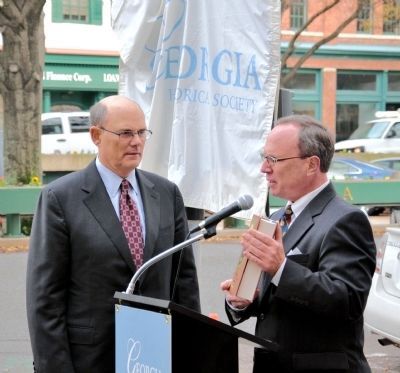
Photographed by David Seibert, December 7, 2012
9. Gen. Montgomery C. Meigs, U.S.A. Marker Dedication
Dr. Groce presented Gen. Meigs with a copy of Elizabeth Brown Prior's book, Reading the Man: A Portrait of Robert E. Lee Through His Private Letters.

Photographed by David Seibert, December 7, 2012
10. Gen. Montgomery C. Meigs, U.S.A. Marker Dedication
Mr. Charles Crawford, President of the Georgia Battlefields Association (at right), spoke for the unveiling of the marker.
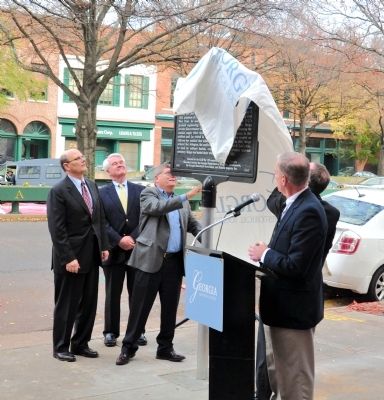
Photographed by David Seibert, December 7, 2012
11. Gen. Montgomery C. Meigs, U.S.A. Marker Dedication
The marker was unveiled by Gen. Meigs, Mr. Knox, Mr. Russell, and Dr. Groce as Mr. Crawford looked on.
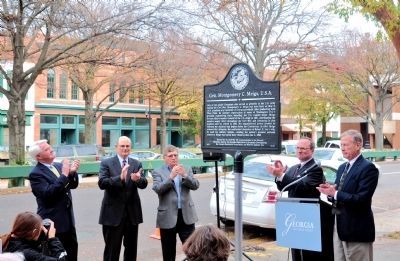
Photographed by David Seibert, December 7, 2012
12. Gen. Montgomery C. Meigs, U.S.A. Marker Dedication
The marker dedicated and unveiled.
Photographed by David Seibert, December 7, 2012
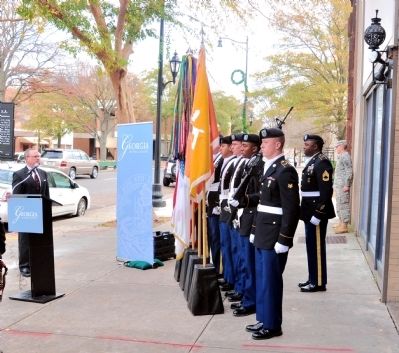
13. Gen. Montgomery C. Meigs, U.S.A. Marker Dedication
The Fort Gordon Color Guard prepares to retire the colors at the conclusion of the dedication.
Photographed by Mike Stroud, July 16, 2011
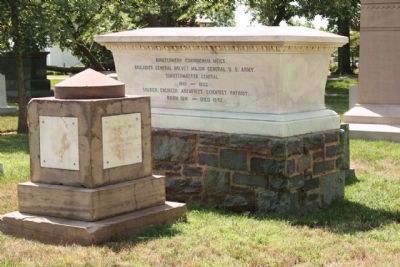
14. Gen. Montgomery C. Meigs, U.S.A. at Arlington National Cemetery, as mentioned.
Meigs died in 1892, and was buried in Section One of Arlington Cemetery, less than one hundred feet from Mrs. Lee's rose garden.
Plot: Section 1, Lot 1, Grid N-32.5
Credits. This page was last revised on May 27, 2025. It was originally submitted on December 7, 2012, by David Seibert of Sandy Springs, Georgia. This page has been viewed 1,347 times since then and 36 times this year. Photos: 1, 2. submitted on December 7, 2012, by David Seibert of Sandy Springs, Georgia. 3, 4, 5, 6, 7, 8, 9, 10, 11, 12, 13. submitted on December 16, 2012, by David Seibert of Sandy Springs, Georgia. 14. submitted on December 16, 2012, by Mike Stroud of Bluffton, South Carolina. • Bill Pfingsten was the editor who published this page.
