Little Italy in Chicago in Cook County, Illinois — The American Midwest (Great Lakes)
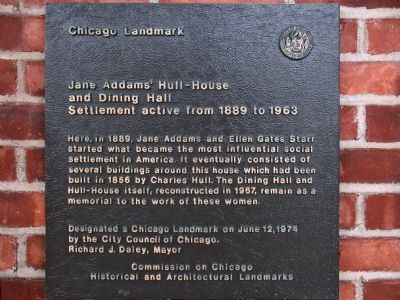
Jane Addams' Hull-House and Dining Hall
Settlement active from 1889 to 1963
Photographed by Allen C. Browne, November 10, 2007
1. Jane Addam's Hull-House and Dining Hall Marker
Here, in 1899, Jane Addams and Ellen Gates Starr started what became the most influential social settlement in America. It eventually consisted of several buildings around this house which had been built in 1856 by Charles Hull. The Dining Hall and Hull-House itself, reconstructed in 1967, remain as a memorial to the work of these women.
Designated a Chicago Landmark on June 12, 1974 by the City Council of Chicago. Richard J. Daley, Mayor
Commission on Chicago Historical and Architectural Landmarks
Erected 1974 by Commission on Chicago Historical and Architectural Landmarks.
Topics and series. This historical marker is listed in these topic lists: Charity & Public Work • Women. In addition, it is included in the Chicago's Surviving Pre-Fire Structures, and the Illinois, Chicago Landmarks Commission series lists. A significant historical date for this entry is June 12, 1974.
Location. 41° 52.296′ N, 87° 38.844′ W. Marker is in Chicago, Illinois, in Cook County. It is in Little Italy. It is at the intersection of South Halsted Street and West Polk Street, on the right when traveling south on South Halsted Street.
this page online

Regionally, this marker is on Chicago’s West Side. It is also in the American Midwest. Globally, it is in North America, on the Great Lakes, in the Western Hemisphere, in the Western World, and in the Anglosphere. Historically, it finds itself in what was once the Viceroyalty of New France, the territory of the Mississippian Culture, and the Northwest Territory.
Other nearby markers. At least 8 other markers are within walking distance of this marker: Jane Addams' Hull House (here, next to this marker); Juvenile Court of Cook County Building (a few steps from this marker); Land Acknowledgement (approx. ¼ mile away); Takeaway (approx. 0.3 miles away); Paul Muni (approx. 0.3 miles away); Site of the Origin of the Chicago Fire of 1871 (approx. 0.3 miles away); Former Site of the Armed Forces Examining and Entrance Station (approx. 0.4 miles away); James "Jimmy" Stefanovic (approx. 0.4 miles away). Touch for a list and map of all markers in Chicago.
Also see . . .
1. Hull House Museum.
Photographed by Allen C. Browne, November 10, 2007
2. Jane Addam's Hull-House and Dining Hall Marker
2. Hull House. Wikipedia entry (Submitted on December 14, 2012, by Allen C. Browne of Silver Spring, Maryland.)
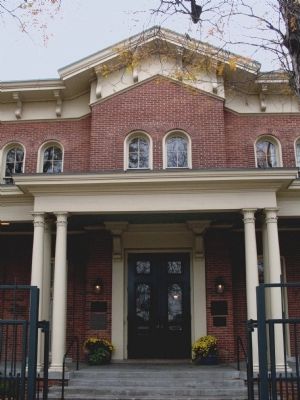
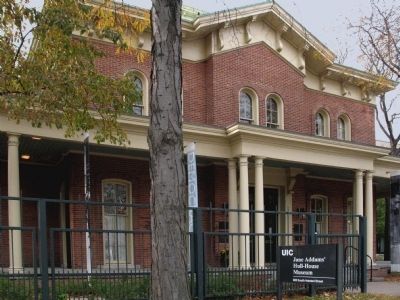
3. Charles J. Hull House, 800 South Halsted Street, Chicago, Cook County, IL. The Historic American Buildings Survey record for the Hull House. According to the statement of significance: The Charles J. Hull mansion, an architecturally interesting example of Italianate Victorian architecture constructed in 1856, did not actually take on significance until 1889, when Jane Addams and Ellen Gates Starr began using it as a settlement house. Here they established one of the earliest and certainly the best known of all social settlements. The house is a National Historic Landmark. (Submitted on December 15, 2012.)
Photographed by Allen C. Browne, November 10, 2007
3. Jane Addam's Hull-House and Dining Hall
Photographed by Allen C. Browne, November 2, 2011
4. Jane Addams
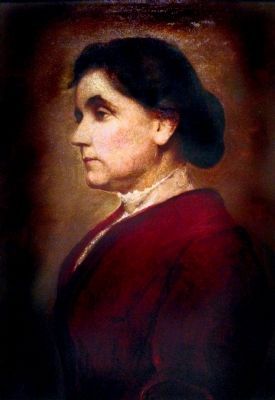
This 1906 portrait of Jane Addams by George de Forest Brush hangs in the National Portrait Gallery in Washington, D.C.
“Jane Addams was among the first of the college educated women of the late nineteenth century to escape the social and cultural constraints limiting professional women to teaching and missionary work. As low wages, long hours, and wretched living conditions became the norm for America's urban industrial workers, many, including Addams, were disturbed by the specter of a permanently oppressed lower class ruled by a privileged elite. Having admired settlement houses (neighborhood social welfare centers) in London, Addams in 1889 established Hull-House in a Chicago slum, the second settlement house in the United States. Within a decade, it offered practical education and a myriad of opportunities to the poor. With the sponsorship of Chicago's wealthy women, Hull-House became the most influential and innovative of the 400 settlement houses in the United States before World War I.” — National Portrait Gallery
“Jane Addams was among the first of the college educated women of the late nineteenth century to escape the social and cultural constraints limiting professional women to teaching and missionary work. As low wages, long hours, and wretched living conditions became the norm for America's urban industrial workers, many, including Addams, were disturbed by the specter of a permanently oppressed lower class ruled by a privileged elite. Having admired settlement houses (neighborhood social welfare centers) in London, Addams in 1889 established Hull-House in a Chicago slum, the second settlement house in the United States. Within a decade, it offered practical education and a myriad of opportunities to the poor. With the sponsorship of Chicago's wealthy women, Hull-House became the most influential and innovative of the 400 settlement houses in the United States before World War I.” — National Portrait Gallery
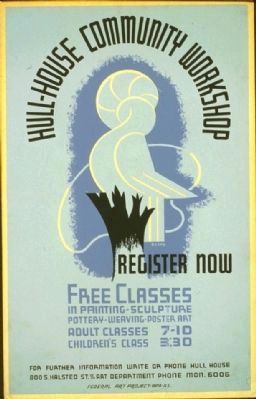
Photographed by Federal Arts Project, WPA Illinois, 1938
5. Hull House Art Classes WPA poster (1938)
From the Works Project Administration Poster Collection of the Library of Congress, this silkscreened poster for art classes at the Hull House depicts a budding plant, an artist's palette, and a bird.
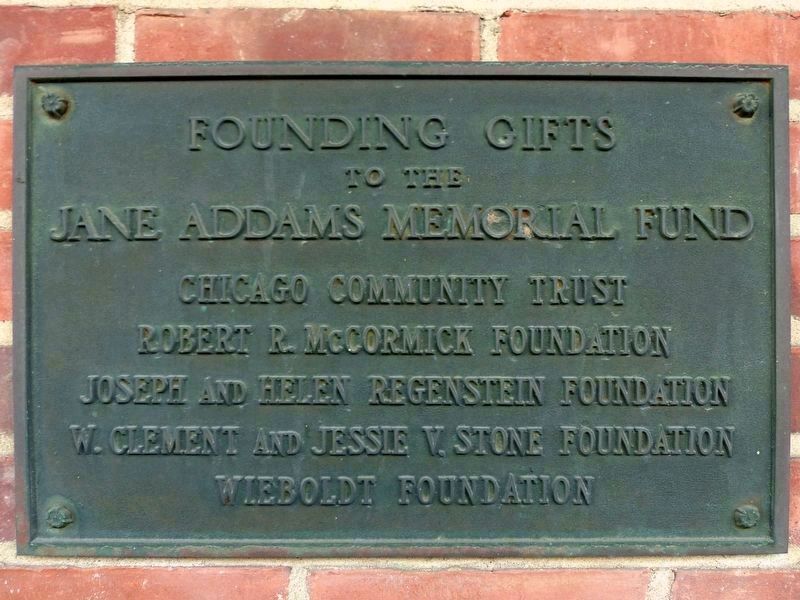
Photographed by Allen C. Browne, November 16, 2016
6. Founding Gifts
Jame Addams Memorial Fund
Chicago Community Trust
Robert McCormick Foundation
Joseph and Helen Regenstein Foundation
W. Clement and Jessie V. Stone Foundation
Wieboldt Foundation
Credits. This page was last revised on May 31, 2024. It was originally submitted on December 14, 2012, by Allen C. Browne of Silver Spring, Maryland. This page has been viewed 1,385 times since then and 57 times this year. Photos: 1, 2, 3. submitted on December 14, 2012, by Allen C. Browne of Silver Spring, Maryland. 4. submitted on June 12, 2015, by Allen C. Browne of Silver Spring, Maryland. 5. submitted on December 15, 2012. 6. submitted on November 18, 2016, by Allen C. Browne of Silver Spring, Maryland. • Bernard Fisher was the editor who published this page.
