Near Charles City in Charles City County, Virginia — The American South (Mid-Atlantic)
Stuart's Ride
Coffee at Rowland’s
| — | 1862 Peninsula Campaign | — |
Photographed by Bernard Fisher, December 15, 2012
1. Stuart's Ride CWT Marker
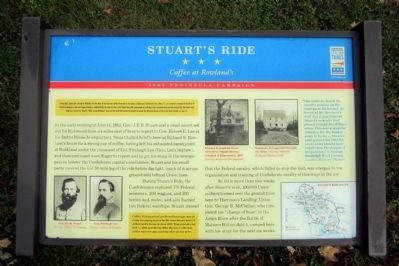
In the early evening of June 14, 1862, Gen. J.E.B. Stuart and a small escort set out for Richmond from six miles east of here to report to Gen. Robert E. Lee at his Dabbs House headquarters. Stuart halted briefly here at Richard S. Rowland’s house for a strong cup of coffee, having left his exhausted cavalrymen at Buckland under the command of Col. Fitzhugh Lee (Gen. Lee’s nephew), and then continued west. Eager to report and to get his story in the newspapers to bolster the Confederate capital’s confidence, Stuart and his small party covered the last 30-mile leg of the ride before daylight, much
this page online
During Stuart’s Ride, the Confederates captured 170 Federal prisoners, 200 wagons, and 300 horses and mules, and also burned two Federal warships. Stuart showed that the Federal cavalry, which failed to stop the raid, was unequal to the organization and training of Confederate cavalry at this stage in the war.
In little more than two weeks after Stuart’s visit, 100,000 Union soldiers teemed over the ground from here to Harrison’s Landing. Union Gen. George B. McClellan, who completed his “change of base” to the James River after the Battle of Malvern Hill on July 1, camped here with his army for the next six weeks.
“One night we heard the cavalry passing on the road up to Richmond. We heard at Mr. Rowland’s next day it was General Stuart’s men who had passed around McClellan’s army. This was a singular situation for the Yankee army to be in. …Stuart’s raid around his [McClellan’s] army should have taught him the danger of his position.” - George Randolph Wood journal Courtesy Mariners’ Museum
(sidebar)
Coffee, Richmonders’ preferred beverage, was already
Photographed by Bernard Fisher, December 15, 2012
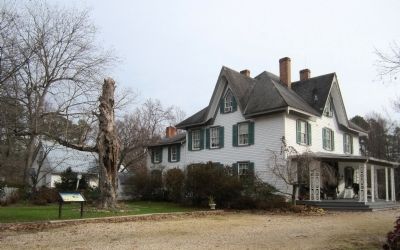
2. Edgewood Plantation (Rowland's)
Erected 2012 by Virginia Civil War Trails.
Topics and series. This historical marker is listed in this topic list: War, US Civil. In addition, it is included in the Virginia Civil War Trails series list. A significant historical month for this entry is May 1862.
Location. 37° 19.839′ N, 77° 11.205′ W. Marker is near Charles City, Virginia, in Charles City County. It can be reached from John Tyler Memorial Highway (Virginia Route 5) 0.2 miles east of Herring Creek Road ( Route 640), on the right when traveling east. Located in the parking lot of Edgewood Plantation. Touch for map. Marker is at or near this postal address: 4800 John Tyler Memorial Hwy, Charles City VA 23030, United States of America. Touch for directions.

Regionally, this marker is in Coastal Virginia. It is also in the American South, specifically in the Upper South, in the Tidewater, and on the Eastern Seaboard. Globally, it is in the North Atlantic Region, North America, the Western Hemisphere, the Western World, and the Anglosphere. Historically, it finds itself in what was once the territory of the Mississippian Culture, one of the original Thirteen Colonies, one of the Confederate States of America, and the Antebellum South.
Other nearby markers. At least 8 other markers are within walking distance of this marker: Emanuel Quivers (approx. 0.2 miles away); First English Thanksgiving in Virginia (approx. 0.2 miles away); a different marker also named Berkeley Plantation or Harrison's Landing (approx. ¼ mile away); Westover (approx. ¼ mile away); Herring Creek & Kimages (approx. ¼ mile away); Herring Creek (approx. ¼ mile away); Berkeley and Harrison's Landing (approx. 0.9 miles away); Colonial Kitchen (approx. one mile away). Touch for a list and map of all markers in Charles City.
Another marker is no longer nearby. Berkeley Plantation or Harrison's Landing (was approx. ¼ mile away but has been replaced with another marker now near it).
More about this marker. (captions)
Gen. J.E.B. Stuart Courtesy Library of Congress
Gen. Fitzhugh Lee Courtesy Library of Congress
Richard S. Rowland House (new owner Mamie Drewry renamed it Edgewood in 1899) Courtesy Julian and Dot Boulware
Rowland’s Mill operated through the 1930s - Courtesy Valentine Richmond History Center
Also see . . .
1. Richmond Discoveries - Stuart's Ride. Information and map of the Stuart's Ride Civil War Trail (pdf file). (Submitted on December 16, 2012.)
2. Edgewood. (Submitted on December 16, 2012.)
Credits. This page was last revised on November 19, 2016. It was originally submitted on December 16, 2012, by Bernard Fisher of Richmond, Virginia. This page has been viewed 1,772 times since then and 116 times this year. Photos: 1, 2. submitted on December 16, 2012, by Bernard Fisher of Richmond, Virginia.
