
Old City in Philadelphia in Philadelphia County, Pennsylvania — The American Northeast (Mid-Atlantic)
Tamanend
Photographed by J. J. Prats, May 14, 2010
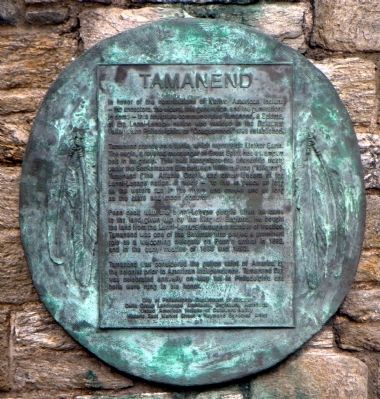
1. Tamanend Marker
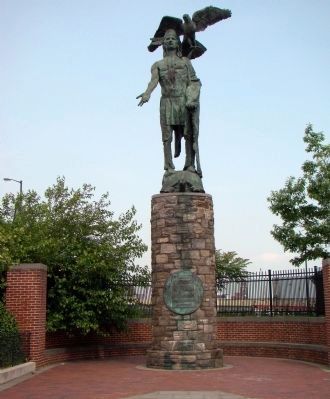
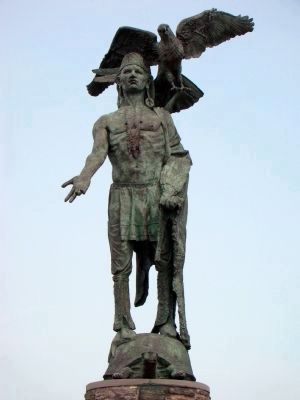
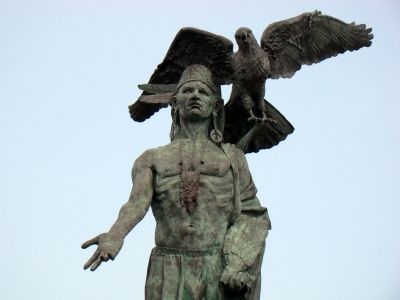
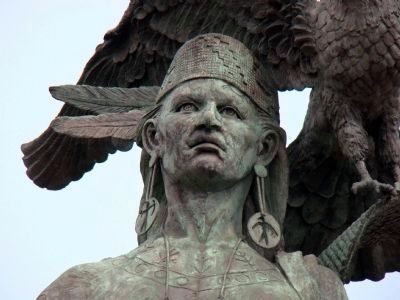
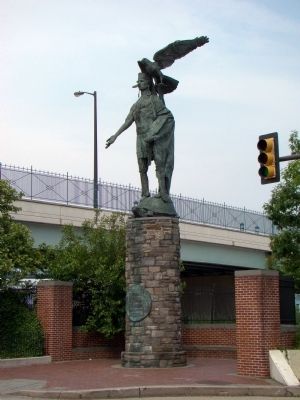
Tamanend stands on a turtle, which represents Mother Earth. The eagle, a revered messenger of the Great Spirit has a wampum belt in its grasp. This belt recognizes the friendship treaty under the Shackamaxon Elm between William Penn (“Mikwon”), Tamanend (“the Affable One”) and other leaders of the Lenni-Lenape nation. It reads—“to live in peace as long as the waters run in the rivers and creeks and as long as the stars and moon endure.”
Penn dealt with the Lenni-Lenape people when he came to the land given him by the King of England. He bought the land from the Lenni-Lenape through a number of treaties. Tamanend was one of the Sakimas who played a prominent role as a welcoming delegate on Penn’s arrival in 1682, and in the early treaties of 1683 and 1692.
Tamanend
this page online
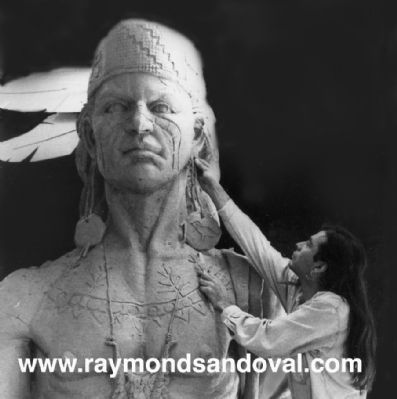
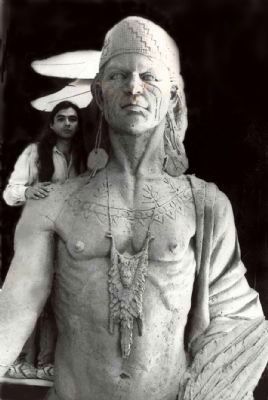
Erected 1996 by City of Philadelphia Department of Streets, Delta Group Landscape Architects, Enginners, Architects, United American Indians of Delaware Valley, Historic East Market Street. • Raymond Sandoval, Artist.
Topics. This historical marker is listed in this topic list: Indigenous Peoples and Communities. A significant historical month for this entry is May 1978.
Location. 39° 56.982′ N, 75° 8.52′ W. Marker is in Philadelphia, Pennsylvania, in Philadelphia County. It is in Old City. It is at the intersection of North Front Street and Market Street, on the right when traveling north on North Front Street. Touch for map. Marker is at or near this postal address: 2 N Front St, Philadelphia PA 19106, United States of America. Touch for directions.

Regionally, this marker is in Southeast Pennsylvania. It is also in the American Northeast and in the Mid-Atlantic. Globally, it is in North America, the Western Hemisphere, the Western World,
Photographed by J. J. Prats, May 14, 2010
2. Tamanend Monument
Other nearby markers. At least 8 other markers are within walking distance of this marker: London Coffee House (within shouting distance of this marker); Philip Syng, Jr. (within shouting distance of this marker); Robert Aitken (1734-1802) (within shouting distance of this marker); Penn's View Hotel (within shouting distance of this marker); A National Historic Site in Journalism (about 400 feet away, measured in a direct line); Benjamin Franklin (about 400 feet away); The Tun (about 500 feet away); Christ Church (about 600 feet away). Touch for a list and map of all markers in Philadelphia.
More about this marker. The Tamanend Statue was one of the first sculptures of a Native American in the United States. There is talk of moving it to Philadelphia's Penn Treaty Park.
Also see . . . Wikipedia Entry for Tamanend. “It is believed that Tamanend died in 1698. Over the next century, many folk legends surrounded Tamanend and his fame assumed
Photographed by J. J. Prats, May 14, 2010
3. Tamanend Sculpture
1996 bronze by Raymond Sandoval
Additional keywords. Tammany, Tammamend
Photographed by J. J. Prats, May 14, 2010
4. Tamanend
Photographed by J. J. Prats, May 14, 2010
5. Tamanend
Photographed by J. J. Prats, May 14, 2010
6. Tamanend Monument
Photographed by Raymond Sandoval, circa April 95
7. Tamanend
Photographed by Raymond Sandoval, April 95
8. Tamanend
Credits. This page was last revised on February 2, 2023. It was originally submitted on May 15, 2010, by J. J. Prats of Powell, Ohio. This page has been viewed 4,717 times since then and 109 times this year. Last updated on December 20, 2012, by Keith S Smith of West Chester, Pennsylvania. Photos: 1, 2, 3, 4, 5, 6. submitted on May 15, 2010, by J. J. Prats of Powell, Ohio. 7, 8. submitted on March 15, 2011, by Raymond Sandoval of Jemez Springs, New Mexico. • Kevin W. was the editor who published this page.
