
Downtown Silver Spring in Montgomery County, Maryland — The American Northeast (Mid-Atlantic)
A Community Grows
Wayne Avenue Landmarks
| — | Silver Heritage Georgia Avenue | — |
Jerry McCoy, Silver Spring Historical Society
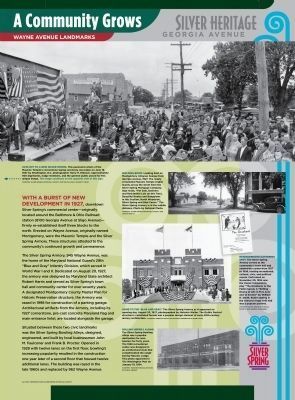
1. A Community Grows Marker
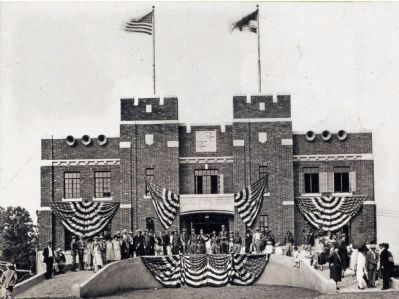
The Silver Spring Armory, 924 Wayne Avenue, was the home of Maryland National Guard's 29th "Blue and Gray" Infantry Division, which served in World War I and II. Dedicated on August 20, 1927, the armory was designed by Maryland State architect Robert Harris and served as Silver Spring's town hall and community center for seventy years. A designated Montgomery County Master Plan for Historic Preservation structure, the Armory was razed in 1998 for construction of a parking garage. Architectural artifacts from the Armory, including its 1927 cornerstone, pre-cast concrete Maryland flag and main level lintel, are located alongside the garage.
Situated between these two civic landmarks was the Silver
this page online
Topics and series. This historical marker is listed in these topic lists: Entertainment • Fraternal or Sororal Organizations • Industry & Commerce • Settlements & Settlers • War, US Civil • War, World I • War, World II. In addition, it is included in the Baltimore and Ohio Railroad (B&O) series list. A significant historical year for this entry is 1927.
Location. 38° 59.649′ N, 77° 1.594′ W. Marker is in Silver Spring, Maryland, in Montgomery County. It is in Downtown Silver Spring. It is at the intersection of Georgia Avenue (Maryland Route 97) and Wayne Avenue, on the right when traveling north on Georgia Avenue. On the corner of Georgia and Wayne Avenue in a small park in front of the Masonic Temple. Touch for map. Marker is at or near this
Photographed by Allen C. Browne, December 22, 2012
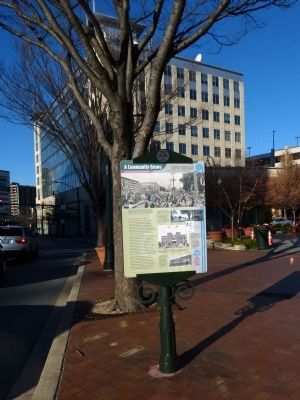
2. A Community Grows Marker

Regionally, this marker is in the Washington Metropolitan Area. It is also in the American Mid-Atlantic. Globally, it is in North America, the Western Hemisphere, the Western World, and the Anglosphere. Historically, it finds itself in what was once one of the original Thirteen Colonies and also the Antebellum South.
Other nearby markers. At least 8 other markers are within walking distance of this marker: Springing Up (here, next to this marker); A New Deal in Town (within shouting distance of this marker); You Are Here - 1931 (within shouting distance of this marker); The Global Refugee Mural (within shouting distance of this marker); Silver Spring Armory (about 300 feet away, measured in a direct line); First Bank, First Heist (about 300 feet away); Spirited Entertainment (about 300 feet away); Silver Spring Shopping Center (about 600 feet away). Touch for a list and map of all markers in Silver Spring.
Related markers. Click here for a list of markers that are related to this marker. These two markers are back
Photographed by Allen C. Browne, December 22, 2012
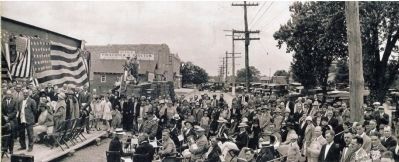
3. Hats off to a new Silver Spring.
This panoramic photo of the Masonic Temple's cornerstone-laying ceremony was taken on June 18, 1927 by Washington D.C. photographer Harry H. Rideout. Approximately 300 dignitaries, lodge members, and the general public posed for this unique image. The image continues on the opposite side of this sign. Courtesy Silver Spring Historical Society and William H. Packett family
Photographed by Allen C. Browne, December 22, 2012
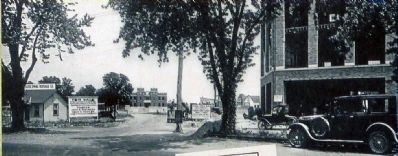
4. Building Boom.
Looking East on Montgomery (Wayne) Avenue from Georgia Avenue, 1927. The nearly completed Masonic Temple (right) stands across the street from the Silver Spring Mortgage company. Sign reads "For Sale, Business and Residential Lots on this Tract, Beautiful Homes and Bungalows in this Section, North Woodside, Silver Spring and Blair Farms." Silver Spring Armory is in the middle distance. Photo by National Photo. Courtesy of Silver Spring Historical Society and John P. Hewitt
Photographed by Allen C. Browne, December 22, 2012
5. Home to the "Blue and Gray."
The Silver Spring Armory as it appeared on opening day, August 20, 1927, photographed by Malcolm Walter. The Gothic Revival structure's castellated facade was a popular design element in the early-20th-century armory architecture. Courtesy Peerless Rockville Historic Preservation (Maryland)
Photographed by Allen C. Browne, December 22, 2012
6. Neighborhood Gathering Spot.
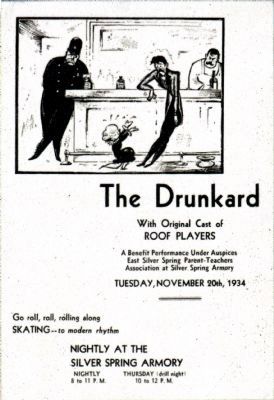
The Silver Spring Armory served as the community's town hall and community center from 1927 to 1998, hosting recreational, cultural, civic and political events. Performed on November 20, 1934 was the classic temperance play "The Drunkard, or the Fallen Saved, A Thrilling Drama of Life in Five Acts and 12 Scenes" by William H. Smith. Roller skating in the Armory's huge Drill Hall was a popular pastime. Courtesy Silver Spring Historical Society and Gordon Townsend
Photographed by Allen C. Browne, December 23, 2012
7. Rolling Merrily Along.
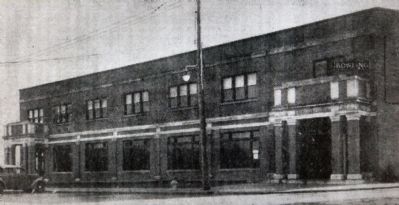
The Silver Spring Bowling Alleys was a popular destination for forty years. The 1928 recreational center was designed in an architectural style that complimented the neighboring Masonic Lodge. This photo appeared in the Washington Post on January 19, 1934. Courtesy Washingtoniana Division DC Public Library
Credits. This page was last revised on February 20, 2023. It was originally submitted on December 26, 2012, by Allen C. Browne of Silver Spring, Maryland. This page has been viewed 1,977 times since then and 73 times this year. Photos: 1. submitted on February 8, 2013. 2, 3, 4, 5, 6, 7. submitted on December 26, 2012, by Allen C. Browne of Silver Spring, Maryland. • Bill Pfingsten was the editor who published this page.
