Scotland in St. Mary's County, Maryland — The American Northeast (Mid-Atlantic)
A Crucial Point
Star-Spangled Banner National Historic Trail
| — | National Park Service, U.S. Department of the Interior | — |
Photographed by Allen C. Browne, January 7, 2013
1. A Crucial Point Marker
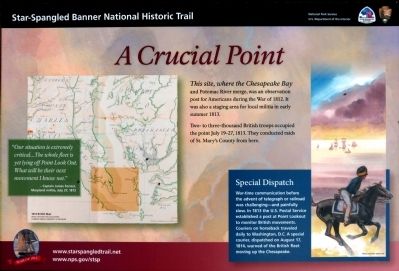
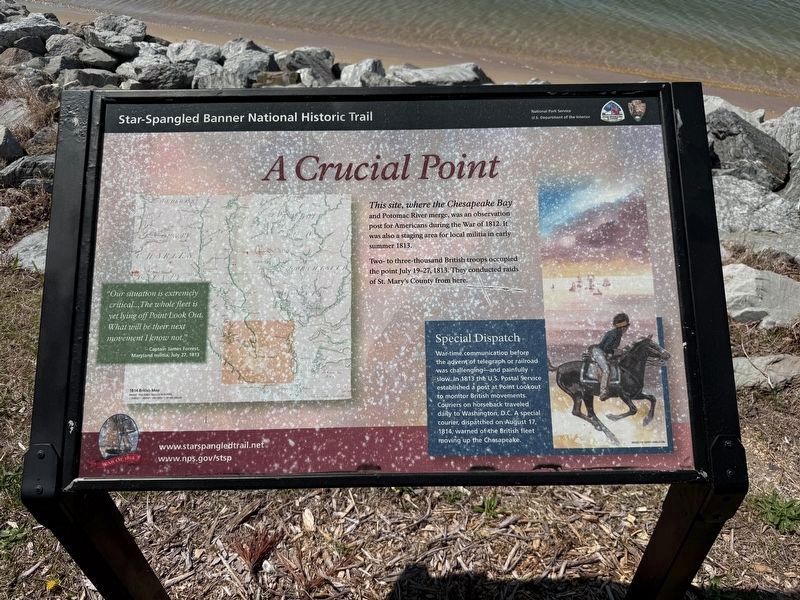
This site, where the Chesapeake Bay and Potomac River merge, was an observation post for Americans during the War of 1812. It was also staging area for local militia in early summer of 1813.
Two- to Three-thousand British troops occupied the point July 19-27, 1813. They conducted raids into St. Mary's County from here.
"Our situation is extremely critical…The whole fleet is yet lying off Point Look Out. What will be their movement I know not."
— Captain James Forrest, Maryland militia, July 27, 1813
[Sidebar:]
Special Dispatch
War-time communication before the advent of telegraph or railroad was challenging—and painfully slow. In 1813 the U.S. Postal Service established a post at Point Lookout to monitor British movements. Couriers on horseback traveled daily to Washington, D.C. A special courier, dispatched on August 17, 1814, warned of the British fleet moving up the Chesapeake.
Erected 2012 by National Park Service, U.S. Department of the Interior.
Topics and series. This historical marker is listed in these topic lists: Communications • War of 1812 • Waterways & Vessels. In addition,
this page online
Location. 38° 2.881′ N, 76° 19.554′ W. Marker is in Scotland, Maryland, in St. Mary's County. It can be reached from Point Lookout Trail west of Point Lookout Road (Maryland Route 5), on the right when traveling south. Touch for map. Marker is in this post office area: Scotland MD 20687, United States of America. Touch for directions.

Regionally, this marker is in Southern Maryland. It is also in the American South, specifically in the Upper South, in the Mid-Atlantic, in the Tidewater, in the Chesapeake Bay Region, and on the Eastern Seaboard. Globally, it is in the North Atlantic Region, North America, the Western Hemisphere, the Western World, and the Anglosphere. Historically, it finds itself in what was once one of the original Thirteen Colonies and also the Antebellum South.
Other nearby markers. At least 8 other markers are within walking distance of this marker: Storm Blocks the Road to Freedom (here, next to this marker); Defense Strategies (a few steps from this marker); Civil War Fort #3
Photographed by Devry Becker Jones (CC0), April 11, 2026
2. A Crucial Point Marker
The marker has weathered but remains legible.
Other markers no longer nearby. Fort Lincoln (was a few steps from this marker but has been replaced with another marker now near it); Shipwreck! (was within shouting distance of this marker but has been permanently removed).
Photographed by Allen C. Browne, January 7, 2013
4. A Crucial Point Marker
This is a photo of the marker in its prior context.
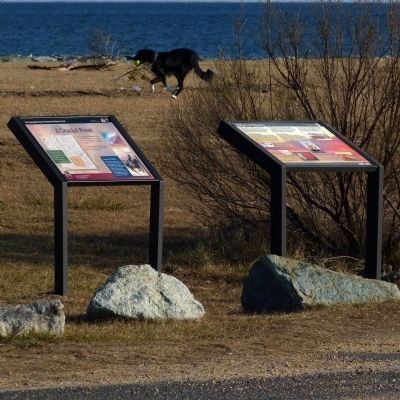
Photographed by Allen C. Browne, January 7, 2013
5. A Crucial Point Marker & A Place of History Marker
This is a photo of the marker in its prior context.
Credits. This page was last revised on April 12, 2026. It was originally submitted on January 7, 2013, by Allen C. Browne of Silver Spring, Maryland. This page has been viewed 801 times since then and 32 times this year. Photos: 1. submitted on January 7, 2013, by Allen C. Browne of Silver Spring, Maryland. 2, 3. submitted on April 12, 2026, by Devry Becker Jones of Washington, District of Columbia. 4, 5. submitted on January 7, 2013, by Allen C. Browne of Silver Spring, Maryland. • Bill Pfingsten was the editor who published this page.
