South of Broad in Charleston in Charleston County, South Carolina — The American South (South Atlantic)
The Walled City of Charles Town
Photographed by Mike Stroud, December 22, 2012
1. The Walled City of Charles Town Marker
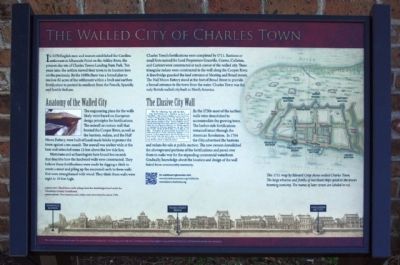
In 1670 English men and women established the Carolina settlement at Albemarle Point on the Ashley River, the present-day site of Charles Towne Landing State Park. Ten years later, the settlers moved their town to its location here on the peninsula. By the 1690s there was a formal plan to enclose 62 acres of the settlement within a brick and earthen fortification to protect its residence from French, Spanish, and hostile Indians.
Charles Town's fortifications were completed by 1711. Bastions or small forts were named for Lord Proprietors Granville, Craven Colleton, and Carteret were constructed at each corner of the walled city. Three triangular redans were constructed in the wall along the Cooper River. A drawbridge guarded the land entrance at Meeting and Broad streets. The Half Moon Battery stood at the foot of Broad Street to provide a formal entrance to the town from the water. Charles Town was the only British walled city built in North America.
Anatomy of the Walled City
The engineering plans for the walls likely were based on European design principals for the fortifications. The seawall or curtain wall
this page online
Historians and archaeologists have found a few records that describe how the landward walls were constructed. They believe these fortifications were made by digging a ditch to create a moat and piling up the excavated earth to form walls that were strengthened with wood. They think these walls were eight to 10 feet high.
The Elusive City Wall
By the 1730s most of the earthen walls were demolished to accommodate the growing town. The harbor-side fortifications remain intact through the American Revolution. In 1784 the City advertised the bastions and redans for sale at public auction. The new owners demolished the aboveground portions of the fortifications and paved over them to make way for the expanding commercial waterfront. Gradually, knowledge about the location and design of the wall faded from community memory.
[Captions:]
Above Left: Hand-hewed cedar pilings from the drawbridge found under the Charleston County Courthouse.
Above Right: Two bastions and a redan were advertised for sale in 1784.
This 1711 map by Edward Crisp shows walled Charles Town. The large wharves and flotilla of merchant ships speak to the town's booming economy. The names of later streets are labeled red.
Erected 2012
Photographed by Mike Stroud, December 22, 2012
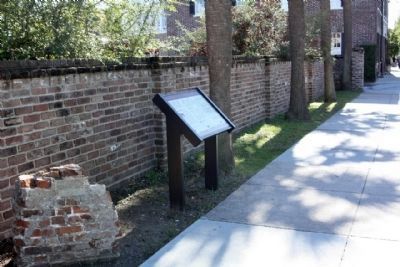
2. The Walled City of Charles Town Marker, present day wall example , seen here along East Bay Street
Topics. This historical marker is listed in these topic lists: Colonial Era • Settlements & Settlers. A significant historical year for this entry is 1670.
Location. 32° 46.5′ N, 79° 55.627′ W. Marker is in Charleston, South Carolina, in Charleston County. It is in South of Broad. It is on East Bay Street (U.S. 52) near South Adgers Wharf, on the right when traveling north. The marker stands beside the Historic Charleston Foundation. Touch for map. Marker is at or near this postal address: 84 E Bay St, Charleston SC 29401, United States of America. Touch for directions.

Regionally, this marker is in Historic Charleston and in the Lowcountry. It is also in the American South, specifically in the Deep South, and on the Eastern Seaboard. Globally, it is in the North Atlantic Region, North America, the Western Hemisphere, the Western World, and the Anglosphere. Historically, it finds itself in what was once the territory of the Mississippian Culture, one of the original Thirteen Colonies, one of the Confederate States of America,
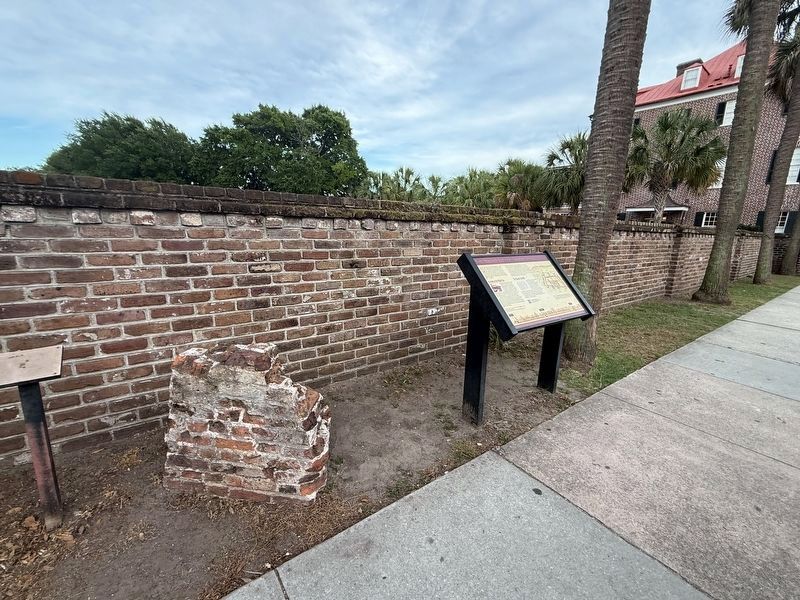
Other nearby markers. At least 8 other markers are within walking distance of this marker: In Search of the Walled City (a few steps from this marker); 90 East Bay Street Ancrum Wharf Building (within shouting distance of this marker); Thomas Smith (within shouting distance of this marker); The John Fabre Jr. House (within shouting distance of this marker); 8-10 Tradd Street (within shouting distance of this marker); Inglis Arch House (about 300 feet away, measured in a direct line); 99 - 101 East Bay (about 300 feet away); 83-107 East Bay Street Rainbow Row (about 300 feet away). Touch for a list and map of all markers in Charleston.
Related markers. Click here for a list of markers that are related to this marker. the relationship, markers for the bastions mentioned
Credits. This page was last revised on May 26, 2026. It was originally submitted on January 12, 2013, by Mike Stroud of Bluffton, South Carolina. This page has been viewed 7,821 times since then and 440 times this year. Photos: 1, 2. submitted on January 13, 2013, by Mike Stroud of Bluffton, South Carolina. 3. submitted on May 26, 2026, by Devry Becker Jones of Washington, District of Columbia.
