Newry in Oconee County, South Carolina — The American South (South Atlantic)
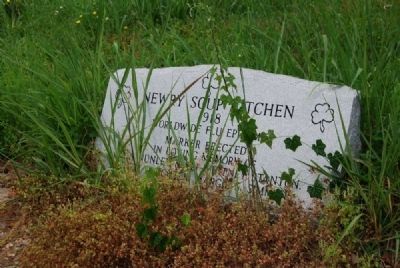
Newry Soup Kitchen
Photographed by Brian Scott, May 7, 2012
1. Newry Soup Kitchen Marker
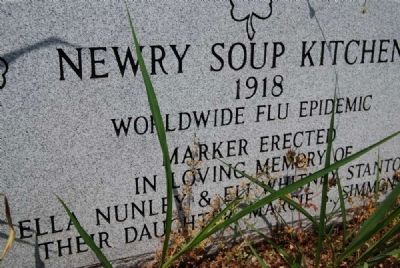
Worldwide Flu Epidemic
Marker Erected
in Loving Memory of
Ella Nunley & Eli Whitney Stanton by
Their Daughter Marcie S. Simmons
Topics. This historical marker is listed in this topic list: Science & Medicine. A significant historical year for this entry is 1918.
Location. 34° 43.533′ N, 82° 54.467′ W. Marker is in Newry, South Carolina, in Oconee County. It is at the intersection of Broadway Street (State Highway 37-203) and Palmetto Avenue, on the left when traveling west on Broadway Street. Touch for map. Marker is in this post office area: Newry SC 29665, United States of America. Touch for directions.

Regionally, this marker is in South Carolina’s and pstate, in the Foothills, in the Golden Corner. It is also in the American South, specifically in the Deep South, in Appalachia, and specifically in Southern Appalachia. Globally, it is in North America, the Western Hemisphere, the Western World, and the Anglosphere. Historically, it finds itself in what was once the original Cherokee Nation, the territory of the Mississippian Culture, one of the original Thirteen Colonies, one of the Confederate
this page online
Other nearby markers. At least 10 other markers are within 4 miles of this marker, measured as the crow flies: Newry World War II Memorial (within shouting distance of this marker); The Church Bell (within shouting distance of this marker); Oconee County World War Veterans (approx. 3.2 miles away); Cane Creek Town (approx. 3.4 miles away); Fairplay Community Veterans Memorial (approx. 3.6 miles away); Oconee County Training School (approx. 3.6 miles away); Memorial Gateway (approx. 3.7 miles away); Wall of Honor (approx. 3.8 miles away); Seneca Firsts (approx. 3.9 miles away); Seneca (approx. 3.9 miles away). Touch for a list and map of all markers in Newry.
Also see . . . 1918 flu pandemic. The 1918 flu pandemic (January 1918 – December 1920) was an unusually deadly influenza pandemic which infected 500 million people across the world, including remote Pacific islands and the Arctic, and killed 20 to 50 million of them—1 to 3 percent of the world's population at the time—making it one of the deadliest natural disasters in human (Submitted on February 15, 2013, by Brian Scott of Anderson, South Carolina.)
Photographed by Brian Scott, May 7, 2012
2. Newry Soup Kitchen Marker

Photographed by Brian Scott, May 7, 2012
3. Newry Soup Kitchen Marker
Credits. This page was last revised on June 16, 2016. It was originally submitted on February 15, 2013, by Brian Scott of Anderson, South Carolina. This page has been viewed 814 times since then and 24 times this year. Photos: 1, 2, 3. submitted on February 15, 2013, by Brian Scott of Anderson, South Carolina.
