St. Simons Island in Glynn County, Georgia — The American South (South Atlantic)
Battle of Bloody Marsh
Photographed by Mike Stroud, September 20, 2008
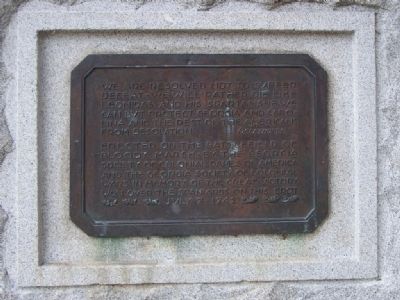
1. Battle of Bloody Marsh Marker
We are resolved not to suffer defeat - we will rather die like Leonidas and his Spartans - if we can but protect Georgia and Carolina and the rest of the Americans from desolation Oglethorpe
Erected on the battlefield of Bloody Marsh - by the Georgia Society of Colonial Dames of America and the Georgia Society of Colonial Wars in memory of the great victory won over the Spainiards on this spot July 7 - 1742
Tiffany & Co.
Erected by Society of Colonial Dames of America, Georgia Society of Colonial Wars.
Topics and series. This historical marker is listed in these topic lists: Colonial Era • Military. In addition, it is included in the The Colonial Dames of America, National Society of series list. A significant historical year for this entry is 1742.
Location. 31° 9.387′ N, 81° 22.78′ W. Marker is on St. Simons Island, Georgia, in Glynn County. It is on Demere Rd. This marker is located in the Blood Marsh Unit of the Fort Fredericka National Monument. The unit is located on Demere Rd., south of Stewart St. Touch for map. Marker is in this post office area: Saint Simons Island GA 31522,
this page online

Regionally, this marker is on the Coastal Plain, on the Georgia Coast and the Golden Isles, and on the Sea Islands. It is also in the American South, specifically in the Deep South, and on the Eastern Seaboard. Globally, it is in the North Atlantic Region, North America, the Western Hemisphere, the Western World, and the Anglosphere. Historically, it finds itself in what was once New Spain, the territory of the Mississippian Culture, one of the original Thirteen Colonies, one of the Confederate States of America, and the Antebellum South.
Other nearby markers. At least 8 other markers are within 2 miles of this marker, measured as the crow flies: A Clash Of Cultures (within shouting distance of this marker); Slave Cabin (approx. 0.6 miles away); Welcome (approx. 0.6 miles away); Demere Road (approx. 0.6 miles away); S.S. Oklahoma and Esso Baton Rouge (approx. 0.8 miles away); Retreat Plantation (approx. 1.4 miles away); St. Simons Park (approx. 1½ miles away); Fort Saint Simons (approx. 1½ miles away). Touch for a list and map of all markers in St. Simons Island.
Regarding Battle of Bloody Marsh. Occupying
Photographed by Mike Stroud, September 2008
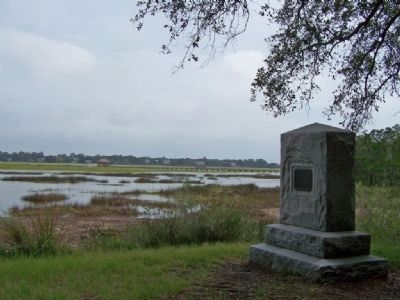
2. Battle of Bloody Marsh Marker
Granite monument on St. Simons Island commemorating the victory of James Oglethorpe's forces over a Spanish invasion force at the Battle of Bloody Marsh. The monument is on dry land at the edge of the marsh where the July 1742 battle was fought.
Related marker. Click here for another marker that is related to this marker. The Battle of Gully Hole Creek which occurred earlier in the same day.
Also see . . . Wikipedia entry ; War of Jenkins Ear. The battle took place during the War of Jenkins’ Ear, which comes from an incident involving a Spanish officer cutting off one of Robert Jenkins’ ears. (Submitted on October 24, 2008, by Mike Stroud of Bluffton, South Carolina.)
Photographed by Mike Stroud, September 2008
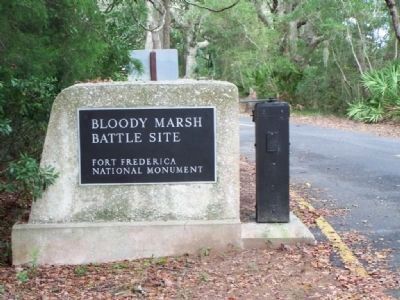
3. Bloody Marsh Battle Site
In the 1742 Battle of Bloody Marsh on St. Simons Island, General Oglethorpe's soldiers defeated Spanish forces in what was the only Spanish invasion of Georgia during the War of Jenkins' Ear. The battle earned its name from its location rather than from the number of casualties, which were minimal.
General Oglethorpe's English, Scottish Highlander, and Indian forces numbered around 650 men. Spanish Governor Montiano's invasion forces numbered 52 ships and over 2000 men.
Photographed by Byron Hooks, March 20, 2013
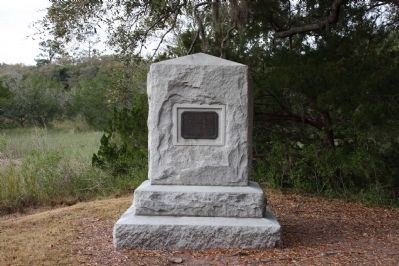
4. Battle of Bloody Marsh Marker
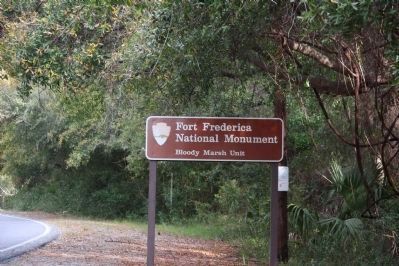
Photographed by Byron Hooks, March 20, 2013
5. NPS sign located on Demere Road, looking north
Credits. This page was last revised on January 25, 2021. It was originally submitted on October 24, 2008, by Mike Stroud of Bluffton, South Carolina. This page has been viewed 4,640 times since then and 142 times this year. Last updated on March 23, 2013, by Byron Hooks of Sandy Springs, Georgia. Photos: 1, 2, 3. submitted on October 24, 2008, by Mike Stroud of Bluffton, South Carolina. 4, 5. submitted on March 23, 2013, by Byron Hooks of Sandy Springs, Georgia.
